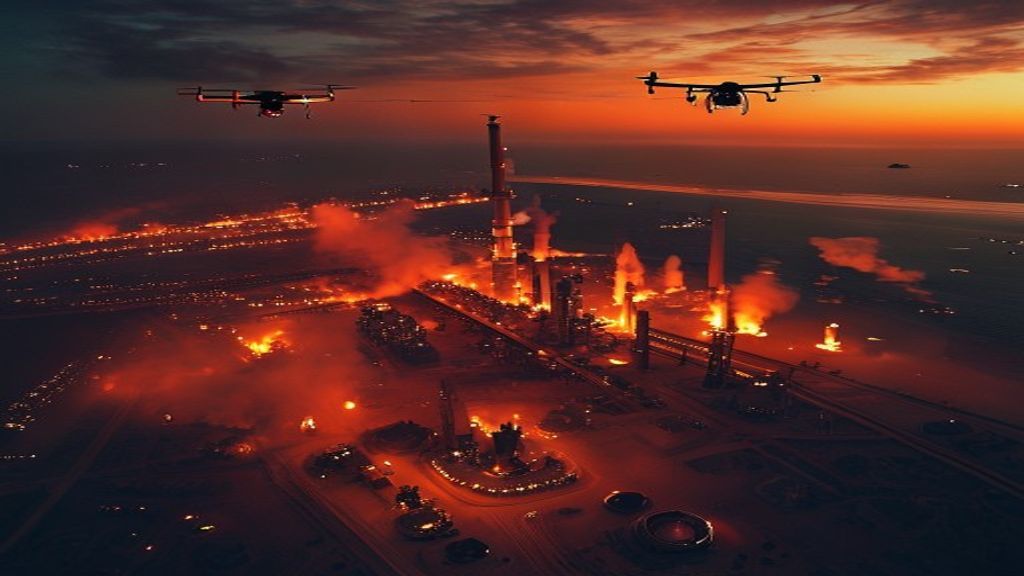
Missiles and Drones Target Aramco Sites
Yemen’s Iran-backed Houthi rebels launched coordinated missile and drone attacks against Saudi Arabia’s oil infrastructure on July 25, 2026, striking facilities operated by the state oil giant Aramco in the cities of Jizan and Yanbu. The assaults mark the emergence of a dangerous new front in the Middle East war, as the conflict that began with US-Israeli strikes on Iran in February spreads across the Arabian Peninsula. Houthi military spokesman Yahya Saree said in a video statement that the rebels targeted Aramco-operated sites and threatened to expand their response if Saudi Arabia continued its airstrikes on Yemeni territory.
Video footage verified by AFP showed dark clouds of smoke rising above an Aramco refinery in Jizan, confirming the strikes hit their intended targets. Saudi Arabia’s civil defence issued warnings for both Jizan, on the kingdom’s southwestern coast, and Yanbu to the north. A surface-to-air battery operated by Greek personnel in Saudi Arabia downed two ballistic missiles and a drone launched from Yemen targeting Yanbu, the Greek air force press office confirmed.
A New Front in a Regional War
The flare-up between the Houthis and Saudi Arabia represents the latest escalation in a conflict that has drawn in multiple regional actors since the joint US-Israeli bombing campaign against Iran at the end of February. The Houthis announced a maritime blockade of Saudi Arabia this week, hitting Saudi tankers in the Red Sea and threatening the Bab al-Mandab Strait, one of the world’s most critical shipping routes. This new Red Sea blockade compounds the parallel Iranian blockade of the Strait of Hormuz, Riyadh’s only other maritime route for oil exports.
Saudi Arabia had struck Houthi targets in Yemen on July 24, hitting a naval base in the port city of Hodeida and a military camp on Kamaran Island, according to a Yemeni security source who spoke to AFP. The Houthis accused the US-aligned kingdom of a “dangerous escalation.” Fighting in Yemen had been largely frozen since a UN-negotiated truce in 2022, but the broader regional war has now shattered that fragile calm. At least 4,329 people have been killed in Lebanon alone during this round of violence, while 37 Israeli soldiers and four Israeli civilians have died.
UN Warns of Wider Escalation
The United Nations on July 24 warned that the Houthi attacks risk drawing Yemen deeper into the regional conflict. UN Secretary-General Antonio Guterres said he was “deeply alarmed about the resumption of Houthi attacks on commercial vessels in the Red Sea this week and the renewed threats to maritime navigation,” according to a statement from his spokesperson. UN Spokesperson Stephane Dujarric said in a statement: “The attack on commercial vessels, claimed by the Houthis, risks further heightening regional tensions and widening the current cycle of escalation with the potential to draw Yemen deeper into regional conflict.”
The UN High Commissioner for Human Rights, Volker Turk, called for urgent action on behalf of thousands of seafarers stranded in the Strait of Hormuz. At least 6,000 crew members on some 400 vessels remain trapped there, having been unable to evacuate during a brief ceasefire that has since collapsed. “This number is not exhaustive as many others are unaccounted for, believed to be stuck in the Persian Gulf on a range of smaller vessels or have otherwise not been located,” said Shabia Mantoo, spokesperson for the High Commissioner.
Iran Links Peace to Lebanon Withdrawal
Iranian Supreme Leader Mojtaba Khamenei declared on July 26 that peace between Tehran and Washington is contingent on Israel stopping its attacks on Lebanon. In a post on X, Khamenei wrote that Iran “has designated the preservation of Lebanon’s territorial integrity, and the absolute, unconditional termination of the Zionist regime’s aggression as the primary condition for any agreement to ending the imposed war against the aggressive US.” His intervention comes amid reports of a halt to US-Iran attacks and renewed diplomacy between the two sides.
A US-Iran memorandum of understanding signed in June included the Lebanon condition in its first clause, but the agreement collapsed amid a dispute over the Strait of Hormuz. Iran’s Revolutionary Guards said their forces stopped four ships attempting to transit the strait on July 25. Iran’s Foreign Minister Abbas Araghchi insisted Tehran could not be blamed for the situation and offered to help start a dialogue between the Houthis and the Saudis, arguing that “there is no military solution to the issue.”
What Happens Next
The opening of a Red Sea front alongside the ongoing Strait of Hormuz blockade threatens to squeeze Saudi Arabia’s oil exports from both directions, with potentially severe consequences for global energy markets. Analysts warn that if the Houthis follow through on their threat to expand attacks, the conflict could draw in additional Gulf states and further destabilize maritime trade routes that carry roughly a quarter of global sea trade. The UN Special Envoy for Yemen, Hans Grundberg, has held extensive engagements with regional stakeholders in recent weeks, but diplomatic prospects remain dim as long as the broader US-Iran ceasefire remains fractured. The central question now is whether back-channel diplomacy can revive the collapsed memorandum before the fighting spirals into a full-scale regional war.