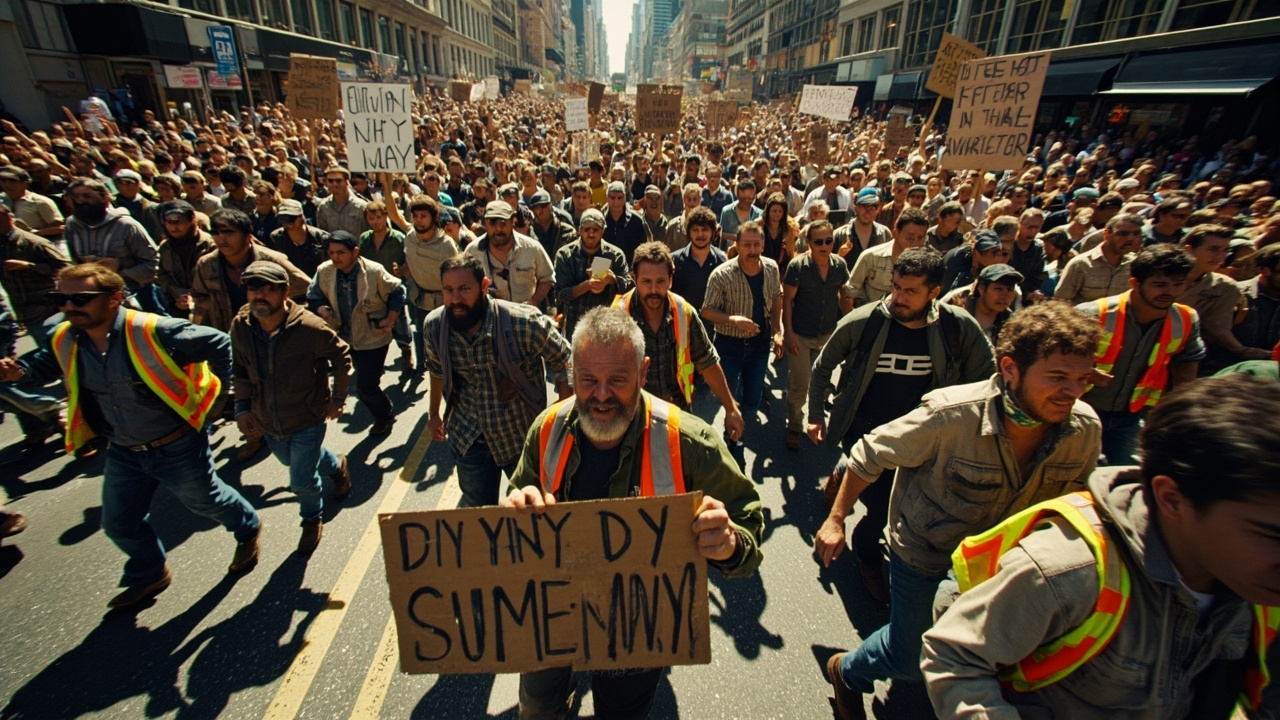
Millions of workers took to the streets across Asia, Europe, and the Americas on May Day 2026, merging traditional labour rights demands with fury over soaring energy costs triggered by the ongoing US-Iran war and its disruption of global oil markets.
A May Day Like No Other
International Workers Day 2026 unfolded against a backdrop of extraordinary global turbulence. Oil prices hovering near four-year highs, a stalled transatlantic trade war, and the longest US government shutdown in history provided fuel for protests that were as much about geopolitics as they were about wages and working conditions.
In Paris, an estimated 300,000 marchers filled the streets from Place de la Republique to Bastille, chanting slogans that linked labour rights to anti-war sentiment. CGT union leader Sophie Binet told crowds that “the same governments that bomb the Middle East are the ones cutting our pensions.”
Berlin saw its largest May Day turnout in over a decade, with organisers estimating 200,000 participants. The IG Metall union, representing Germany’s critical manufacturing sector, warned that the new 25 percent US tariff on European cars threatened up to 100,000 jobs. “This is not just a trade dispute,” said IG Metall chairman Christiane Benner. “This is an attack on the European social model.”
Energy Costs Drive Anger in Asia
In Jakarta, tens of thousands of workers from Indonesia’s KSPI labour federation marched to the presidential palace, demanding that President Prabowo Subianto intervene to cap fuel prices that have risen 40 percent since the Iran war began. The Strait of Hormuz blockade has disrupted tanker traffic across the region, sending diesel and petrol prices to record levels across Southeast Asia.
South Korean unions staged a massive rally in Seoul’s Gwanghwamun Square, combining traditional May Day demands with calls for a snap election following the Constitutional Court’s ruling on President Yoon Suk Yeol’s impeachment. The Korean Confederation of Trade Unions estimated turnout at 150,000, making it the largest May Day gathering in the country since 2019.
In Manila, Philippine labour groups marched under the banner “Workers Against War.” Federation of Free Workers president Sonny Matula said the energy crisis had pushed millions of Filipino families deeper into poverty, with electricity costs rising 30 percent in the first quarter of 2026.
Latin America: Anti-Imperialism Returns to the Streets
Mexico City hosted one of the day’s largest demonstrations, with an estimated 500,000 marchers proceeding from the Zocalo to the Angel of Independence. President Claudia Sheinbaum addressed the crowd, calling for an immediate end to the Iran war and the lifting of the Strait of Hormuz blockade. “Mexico stands with the workers of the world against imperial aggression,” she declared.
In Buenos Aires, Argentine unions used May Day to protest President Javier Milei’s austerity programme, which has slashed public sector wages and eliminated subsidies. The CGT labour federation reported that real wages have fallen 35 percent since Milei took office, compounding the pain of rising global energy costs.
Sao Paulo saw Brazil’s largest May Day march in years, with the CUT labour central estimating 400,000 participants. President Lula da Silva, addressing workers at a Ford factory, called for a global summit on energy security and warned that “the war in Iran is a war against the working class of every nation.”
Europe’s Anti-War Turn
What distinguished May Day 2026 from previous years was the explicit fusion of labour and anti-war sentiment. In London, the TUC organised a march that ended at Parliament Square with speeches condemning both the Iran war and the UK government’s decision to reject ICC arrest warrants against Israeli leaders.
Rome saw clashes between police and demonstrators near the Colosseum after Italian unions staged a general strike. The USB union called the strike to protest both energy costs and Prime Minister Giorgia Meloni’s support for the US-led coalition. Italian ports have been paralysed by dock workers refusing to handle military cargo.
In Athens, Greek unions marched to the US Embassy, demanding the closure of the Souda Bay naval base on Crete. Greece’s proximity to the Middle East conflict zone has made it a frontline state, and fuel costs have hit Greek island communities particularly hard.
The US: A Nation Divided
American May Day protests were smaller but deeply polarised. In New York, labour unions and anti-war groups marched from Times Square to the United Nations, demanding an end to the Iran war and the reopening of the Strait of Hormuz. The AFL-CIO issued a statement calling the energy crisis “an existential threat to American working families.”
In Washington, the 75-day DHS shutdown dominated the messaging. Federal workers, many of whom have gone unpaid since February, joined May Day rallies for the first time in living memory.
Counter-protests also emerged, with pro-Trump rallies in Dallas and Phoenix defending the president’s Iran policy and tariff strategy. The political fault lines running through May Day 2026 reflect a nation increasingly unable to agree on basic facts, let alone policy solutions.
What It Means
May Day 2026 is a warning shot. The convergence of labour unrest, anti-war sentiment, and economic pain has created a political cocktail that governments around the world are struggling to manage. When unions that have spent decades focused on wages and benefits start marching under anti-war banners, it signals a fundamental shift in the global political landscape.
The energy crisis shows no signs of abating. With the Strait of Hormuz blockade continuing and no breakthrough in US-Iran negotiations, the cost of fuel, food, and basic goods will keep rising. For the billions of workers who took to the streets on May 1, the question is whether their governments are listening. The answer, so far, is not encouraging.