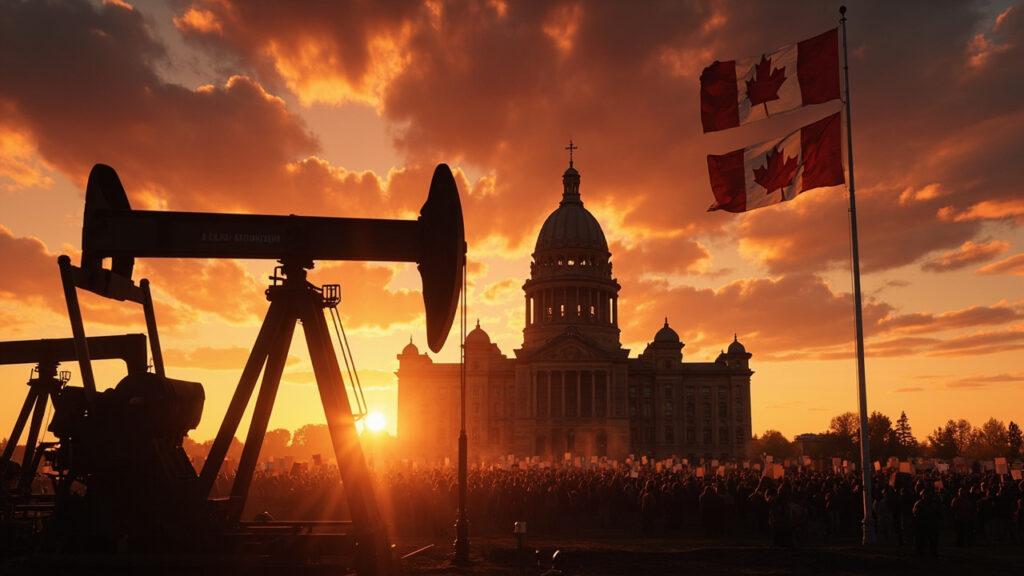
An Alberta separatist group announced Monday it has collected more than 300,000 signatures on a petition demanding a provincial referendum on whether the oil-rich province should leave Canada, potentially triggering a constitutional crisis with far-reaching implications for the country’s future.
The group, known as “Alberta First,” delivered the signatures to the provincial legislature in Edmonton, claiming the total exceeds the threshold required under Alberta law to force the government to hold a plebiscite on separation. If verified, the petition would mark the most serious challenge to Canadian unity since the Quebec sovereignty movement of the 1990s.
The Grievances Behind the Movement
Alberta First’s leaders say decades of federal energy and environmental policies have systematically disadvantaged Alberta’s oil and gas sector, costing the province billions in lost revenue and investment. They argue that Ottawa’s carbon pricing framework, pipeline restrictions, and environmental regulations amount to an economic war against Alberta’s primary industry.
“We’ve tried to work within Confederation for 120 years,” said Alberta First spokesperson Danielle Woodley at a press conference Monday. “Every time Alberta builds prosperity, Ottawa finds a way to take it away. Albertans are tired of being treated as a cash cow while our industries are suffocated by regulations designed in Toronto and Montreal.”
The Numbers Game
Under Alberta’s Referendum Act, a petition requires signatures from at least 10% of the province’s eligible voters to compel the government to hold a referendum. With Alberta’s electorate numbering roughly 2.8 million, the threshold sits at approximately 280,000 signatures. Alberta First claims to have surpassed that figure by a comfortable margin.
However, provincial officials have cautioned that the signatures must still be verified, a process that could take weeks or months. Elections Alberta, the independent agency responsible for overseeing referendums, will need to confirm that signatories are eligible voters and that there are no duplicates or fraudulent entries.
Federal Response: Alarm and Caution
In Ottawa, Prime Minister Mark Carney’s government struck a measured but firm tone. “Canada is stronger together,” Carney said in a statement. “We recognize Alberta’s frustrations, and we are committed to addressing them through dialogue and fair partnership — not through division.”
The federal government has signaled it may challenge any referendum attempt in court, arguing that unilateral provincial secession would violate the Constitution Act of 1982. Legal scholars note that the Supreme Court of Canada’s 1998 Reference Re Secession of Quebec ruling set a high bar for any province seeking to leave Confederation, requiring not just a clear majority vote but also negotiations with the federal government and other provinces.
Economic Implications
Financial markets reacted nervously to the news. The Canadian dollar dipped slightly against the U.S. dollar in Monday trading, while Alberta-based energy stocks saw volatile swings as investors weighed the uncertainty.
Economists warn that even the prospect of Alberta separation could chill investment in the province’s oil sands, which hold the third-largest proven oil reserves in the world. “No investor wants to put money into a jurisdiction whose constitutional status is in question,” said Dr. Robert Hines of the University of Calgary’s School of Public Policy.
What Comes Next
The coming weeks will determine whether Alberta First’s petition triggers a formal referendum process or gets bogged down in legal and bureaucratic challenges. Either way, the movement has already succeeded in forcing a national conversation about Alberta’s place within Canada — and the limits of federal power in a federation increasingly divided by region, industry, and ideology.
For now, Albertans and Canadians alike are watching closely as a province that has long seen itself as the engine of the national economy now contemplates whether that engine might be better off running alone.