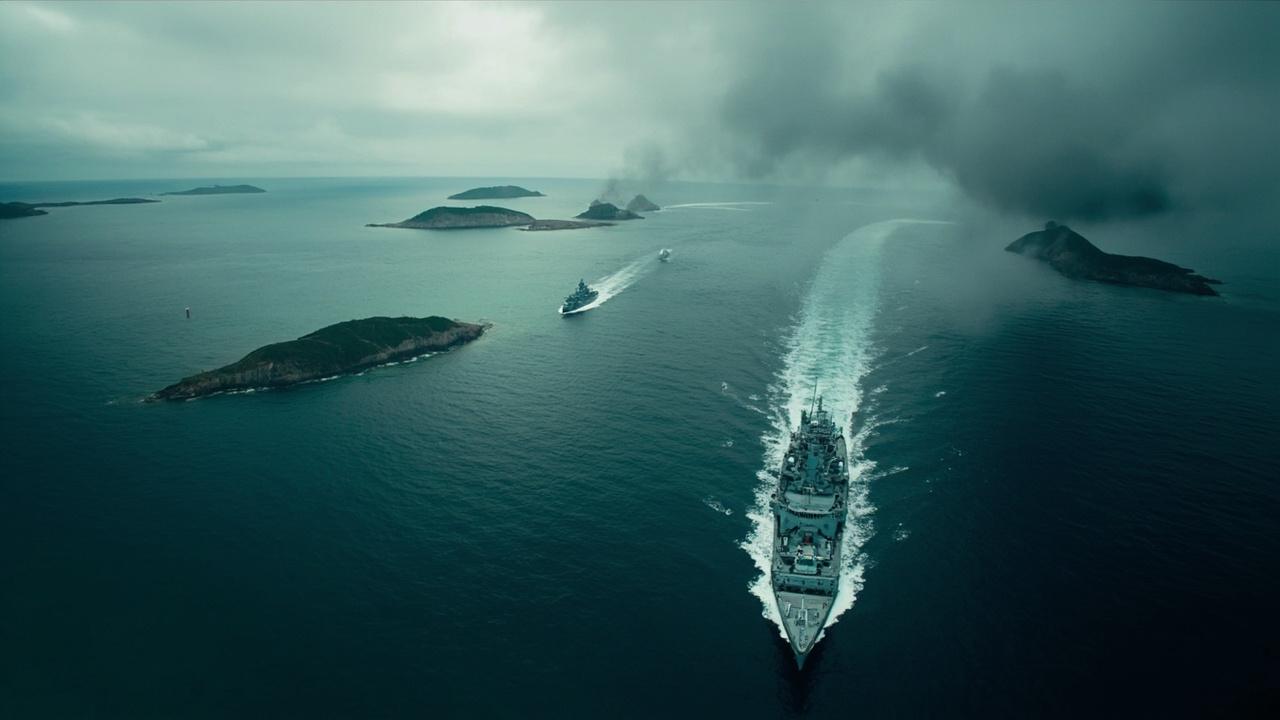
BEIJING/MANILA — China deployed its Liaoning aircraft carrier, three guided-missile destroyers and at least one diesel-electric submarine in a five-day live-fire exercise in the South China Sea beginning Monday, the largest naval drill conducted by Beijing in 18 months, according to Chinese state media and two regional defence officials briefed on the operation.
The exercise, announced by the People’s Liberation Army Navy without prior notice to neighbouring countries, centred on an area of the sea south of the Paracel Islands and east of Vietnam’s Exclusive Economic Zone — overlapping with claims by Vietnam, Malaysia and the Philippines. State broadcaster CCTV said the drills included anti-submarine warfare, carrier air operations and live-fire missile exercises, and would continue through Friday.
Vietnam’s foreign ministry summoned China’s ambassador in Hanoi and formally protested what it called “a serious violation of Vietnamese sovereignty.” Malaysia’s maritime enforcement agency said it had scrambled patrol vessels to monitor the exercise but would not enter the drill zone. The Philippines filed a diplomatic note with Beijing through back-channel intermediaries, demanding the exercise area be disclosed and civilian shipping lanes kept clear.
The timing of the drills has drawn particular attention. They began the same day the Philippines coast guard cutter BRP Teresa Magbanua concluded its six-hour patrol near Scarborough Shoal, and three days after eight Indo-Pacific defence chiefs signed a joint maritime security communiqué in Singapore that explicitly referenced “grey-zone coercion” in the South China Sea. China was not invited to that summit.
“This is not coincidental — it is a direct signal to the countries that signed the Singapore communiqué,” said Dr Ren Yisheng, a maritime security analyst at the National University of Singapore. “Beijing is demonstrating it can shut down contested waters whenever it chooses, and that diplomatic agreements with its neighbours carry no deterrent weight.”
The US Seventh Fleet said it was tracking the exercise through routine reconnaissance flights and reiterated that freedom of navigation operations in the South China Sea would continue “regardless of Chinese military exercises.” A Pentagon spokesperson said the scale of the drill was “destabilising” and inconsistent with China’s stated commitment to regional stability.
China’s foreign ministry spokesperson, Mao Ning, defended the exercise as “routine and transparent” and said it was conducted in “Chinese territorial waters.” When pressed on whether Beijing had notified the UN or ASEAN, Mao said China was “not obligated to inform any external party of legitimate military activities in its own territory.”
Oil and gas prices in Asia ticked upward on Tuesday on concerns the exercise could disrupt tanker traffic through the busy sea lanes that carry roughly 30 percent of global commercial shipping. LNG carriers rerouting around the exercise zone faced delays of 24 to 36 hours, shipping analysts said.
The Liaoning, China’s first operational aircraft carrier, has conducted increasingly frequent drills in the South China Sea and Taiwan Strait over the past two years as Beijing has sought to normalise carrier operations near contested areas. Its sister ship, the Fujian, entered service last year and is expected to begin sea trials in the coming months.
Written by Kenji Tanaka, Asia Pacific Correspondent