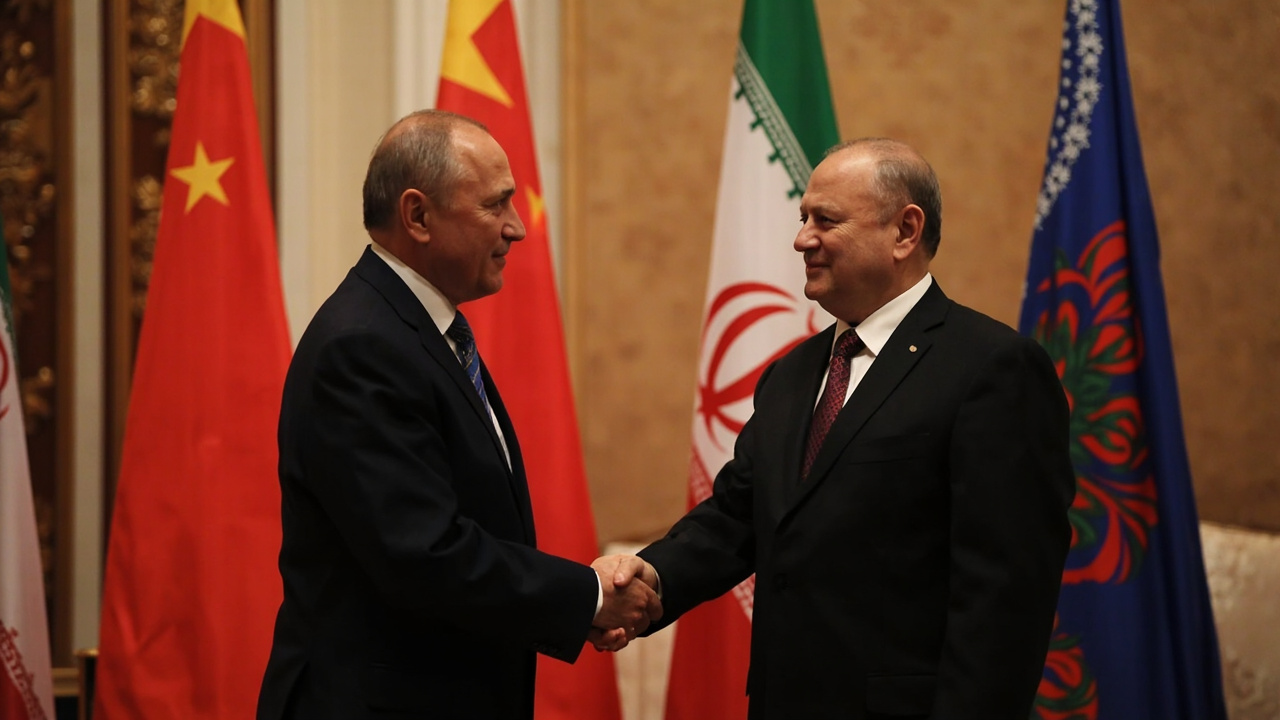

The New Axis: How the Russia-China-Iran Nexus Is Rewriting the Rules of Global Power
May 8, 2026 · Analysis · David Foster
For most of the post-Cold War era, the dominant framework for understanding global power was simple: Washington and its allies set the rules, and everyone else adapted to them. That framework is now obsolete. In its place, something considerably more complex and considerably more dangerous is taking shape. A trilateral nexus connecting Moscow, Beijing, and Tehran is becoming the defining geopolitical structure of the 2020s, reshaping everything from global energy markets to military doctrine to the architecture of international institutions.
This is not an alliance in the traditional sense. There is no Warsaw Pact equivalent, no formal treaty structure, no unified military command. What exists instead is something functionally more powerful: a deeply institutionalized pattern of strategic cooperation spanning trade, technology, military affairs, and diplomatic coordination that has proven surprisingly durable even under significant external pressure. The three nations have found, in each other, the partners they need to challenge American hegemony without having to confront it directly.
The Architecture of the Nexus
The Russia-China relationship has evolved furthest and fastest. Since the signing of the “no limits” partnership in February 2022, bilateral trade has more than doubled, reaching approximately $240 billion in 2025. China has become Russia’s largest economic lifeline, purchasing energy at volumes that have largely compensated for the loss of European markets, supplying electronics and components that fill the gaps left by the withdrawal of Western technology firms, and providing diplomatic cover that has made Russia’s international isolation far less total than Washington expected.
The Russia-Iran dimension operates on a different but equally consequential logic. Russia has become one of Iran’s most important military technology partners, providing advanced air defense systems, satellite imagery, and economic support that has helped Tehran weather sustained external pressure. In turn, Iran has provided Russia with drones, missiles, and regional diplomatic support. The two countries have coordinated closely on Syria, where both maintain a presence, and increasingly on matters related to the global energy trade.
“What we are witnessing is not a return to Cold War logic. The old logic was ideological. This is transactional, pragmatic, and deeply institutionalized. These three countries have found a common interest in restructuring the international order, and they are executing that project with considerable discipline.”
– Senior Fellow, Council on Foreign Relations
The China-Iran dimension has been the least noticed but is arguably the most strategically significant over the long term. Beijing and Tehran signed a 25-year strategic cooperation agreement in 2021, and its implementation has accelerated substantially since then. Chinese investment in Iranian energy infrastructure, port access, and technology partnerships is converting Iran from an isolated actor into an integrated node in China’s Belt and Road ecosystem. For China, Iran represents an alternative to Gulf oil, a counterweight to American naval presence in the Indian Ocean, and a partner that shares Beijing’s interest in building a multipolar world order.
Economic Warfare and the SWIFT Alternative
Perhaps the most consequential development in the Russia-China-Iran nexus is the systematic effort to build alternatives to the dollar-denominated global financial infrastructure. The Western response to the 2022 Russian invasion demonstrated to both adversaries and allies alike the extent to which American control over SWIFT gives Washington extraordinary coercive power. The response from the nexus has been comprehensive and strategically sophisticated.
Russia and China have dramatically expanded the use of the Chinese Cross-Border Interbank Payment System (CIPS) for bilateral trade settlement, increasingly conducting transactions in yuan and rubles rather than dollars. Trade between the two countries that is dollar-denominated has fallen from roughly 80 percent in 2021 to under 40 percent by early 2026. Iran, largely locked out of SWIFT by American restrictions, has been forced to develop its own workarounds and has become an active participant in alternative financial infrastructure discussions with both Moscow and Beijing.
“The dollar weapon has worked — once. But using it has fundamentally changed the calculus of every country that trades with any nation America might someday decide to restrict. The demand for alternatives is now a global phenomenon, and the Russia-China-Iran nexus is the primary supplier of those alternatives.”
– Professor, Peterson Institute for International Economics
A trilateral payment system connecting CIPS, Russia’s SPFS, and Iran’s local financial infrastructure is no longer a theoretical possibility — it is an operational reality for a growing share of the three countries’ mutual trade. Even American allies in the Gulf and Southeast Asia are hedging by negotiating currency swap agreements with Beijing. They do not want to abandon the dollar, but they no longer trust that the political will to maintain dollar access will always exist on the part of Washington.
The Military Dimension
The military cooperation within the nexus has deepened substantially and in ways that directly challenge American strategic assumptions. Russian military advisors are present in significant numbers in both Iran and China, participating in joint exercises and sharing operational intelligence. Chinese and Iranian naval forces have conducted their first-ever joint exercises in the Gulf of Oman — a region that American planners have long considered their strategic backyard. Russian weapons systems, including the S-400 air defense network, have been positioned in ways that complicate American military planning across multiple theaters.
What is perhaps most significant is the intelligence-sharing architecture that has emerged. The three countries have established dedicated channels for sharing intelligence on American military operations, satellite tracking data, and cyber threat information. American military movements in the Pacific, the Middle East, and Europe are being watched collectively by an intelligence network that is more coordinated and more persistent than anything that existed during the Cold War Soviet bloc.
“This is not an intelligence alliance in the classic sense. There is no joint intelligence directorate, no shared classification system, no combined operations center. What there is, is a pattern of targeted sharing: each country passes what the others need, when they need it, through channels that are increasingly hard to disrupt.”
– Former senior intelligence official, speaking on background
The Institutional Build-Out
Beyond trade and military cooperation, the nexus has invested heavily in parallel international institutions. The Shanghai Cooperation Organization (SCO), originally focused on Central Asian security, has evolved into a broad geopolitical vehicle that now includes Iran as a full member and provides a framework for regular Russia-China-Iran trilateral coordination. The BRICS grouping, expanded significantly under Chinese and Russian diplomatic pressure, has become a vehicle for promoting alternative financial infrastructure, including a proposed BRICS Clear
ing and Settlement System (BCSS), which would allow BRICS members to settle trade in local currencies without touching dollar-denominated systems. The New Development Bank, BRICS’ lending arm, has expanded its membership and its lending capacity, positioning itself as an alternative to the World Bank and IMF for countries that find themselves on the wrong side of Western sanctions.
The United Nations Security Council has become effectively paralyzed on matters related to the nexus. Russia uses its veto power routinely on issues concerning Ukraine, Syria, and Iran. China has joined Russia in blocking sanctions on multiple occasions, most notably regarding North Korea and Iran. The nexus has shown a consistent willingness to protect each other from international accountability, creating a de facto veto coalition that fundamentally limits the efficacy of the multilateral system that the United States built.
“What the nexus has built is not a counter-order — they have no coherent alternative vision for the international system. What they have built is a set of tools for preventing the existing order from being enforced against them. That is in some ways more dangerous than a full ideological alternative, because it is harder to argue against.”
– Professor, Harvard Kennedy School
The Path Forward
The nexus is not without its tensions. Russia and China are strategic partners, not allies, and their interests do not always align. China has been careful not to provide direct lethal military aid to Russia in Ukraine, maintaining a strategic ambiguity that protects its relationship with Europe. Iran and Russia share a common adversary in the United States, but compete for influence in Central Asia and the Caucasus. These tensions limit the depth of cooperation but have not prevented functional alignment on the issues that matter most to all three countries.
What the nexus demonstrates is that the unipolar moment, far from being a stable endpoint, was a transitional phase that is now giving way to something far more competitive and far less stable. The United States faces a structural challenge that cannot be resolved by better diplomacy or smarter sanctions alone. The challenge is institutional: the nexus has built functional alternatives to key elements of American-led order, and those alternatives are gaining users and legitimacy globally.
The strategic implications for American foreign policy are profound. The assumption that economic integration with China would produce political convergence has been definitively falsified. The assumption that Russia could be contained through economic isolation has proven wrong. The assumption that Iran would eventually capitulate to American maximum pressure has been discredited. What remains is a world in which American power remains necessary but insufficient — a world that requires a level of strategic sophistication and coalition management that the American foreign policy establishment has not yet fully developed.
The Russia-China-Iran nexus will not replace American hegemony. But it has already permanently altered the structure of the international system in ways that will define the next several decades. The question is no longer whether the unipolar moment is over. It is whether the rules-based order that America built can survive in a world where its enforcement capacity is permanently contested.
David Foster is a Senior Analyst for Media Hook, specializing in geopolitical analysis, economic trends, and the forces reshaping the global order.