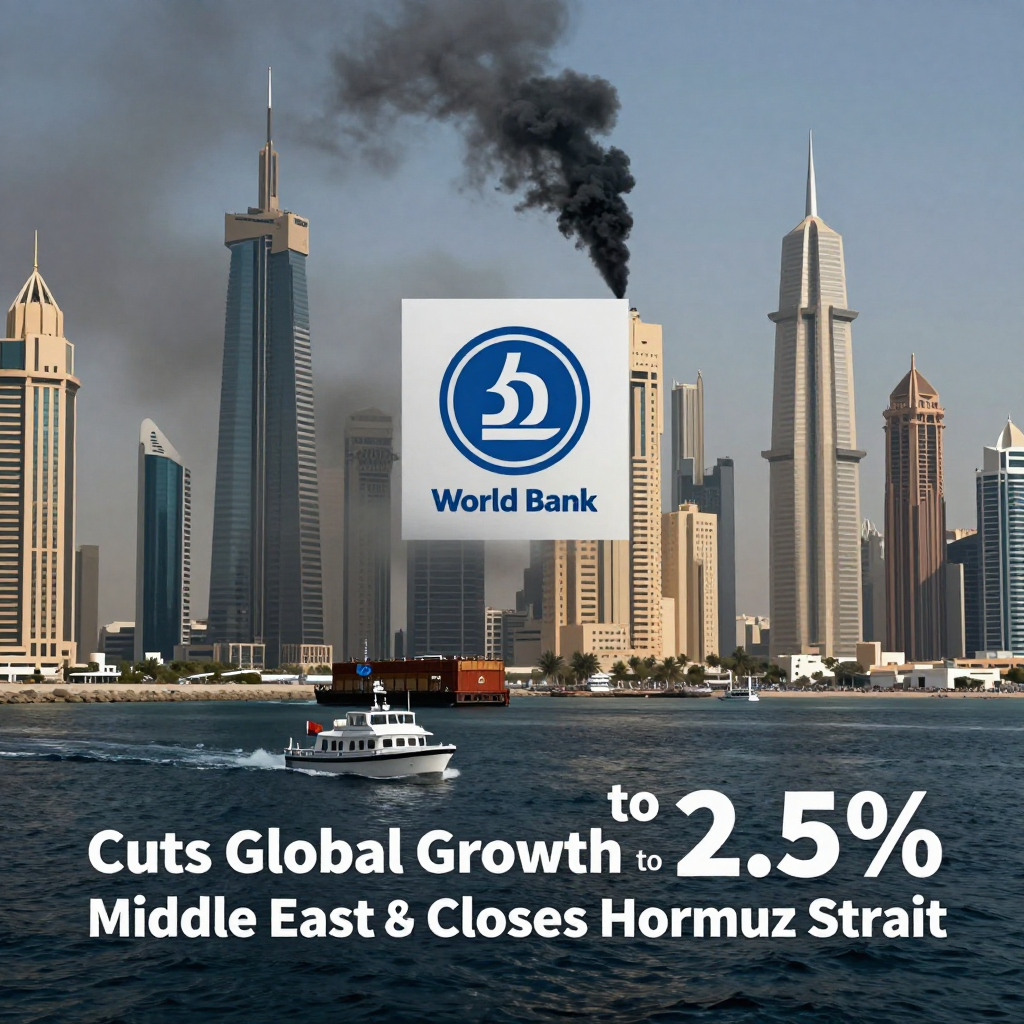

DUBAI — The World Bank has cut its 2026 global growth forecast to 2.5 percent, the lowest rate since the COVID–19 pandemic, as the conflict in the Middle East reverberates through energy markets, supply chains, and sovereign balance sheets from Washington to Riyadh.
The bank’s latest Global Economic Prospects report, released June 11, represents a sharp downgrade from the 2.9 percent growth recorded in 2025. Forecasts for nearly two–thirds of the world’s economies have been revised downward since January, with the most severe impacts concentrated in the Gulf, where growth is expected to approach near–zero this year before a modest recovery in 2027–28.
The Strait of Hormuz Squeeze
At the center of the downgrade is the closure of the Strait of Hormuz, the narrow shipping corridor through which roughly a fifth of the world’s oil passes. With tanker traffic disrupted, Brent crude is projected to average $94 a barrel across 2026 — 36 percent above 2025 levels — assuming the most severe disruptions ease by July. If they do not, the bank warns growth could fall to just 1.3 percent globally.
The impact differs by country, but the basic test is the same: protect people and preserve stability today, without giving up on growth and jobs tomorrow.
Fertilizer prices are also climbing sharply, with knock–on effects for food costs in import–dependent developing nations. The bank projects global inflation will rise to 4.0 percent this year, up from 3.3 percent in 2025 — a reversal of the disinflation trend that had allowed central banks to begin easing policy.
Gulf States Take the Hardest Hit
Economies in the Gulf Cooperation Council are expected to suffer the most immediate damage. The bank projects Gulf growth will tumble from 3.9 percent in 2025 to close to zero in 2026 — a collapse driven by oil revenue disruption, reduced transit fees, and the broader chilling of investment sentiment across the region.
Saudi Arabia, the UAE, Qatar, and Kuwait all face acute exposure given their reliance on hydrocarbon exports and their geographic proximity to the conflict zone. Sovereign wealth funds in the region have begun repositioning away from regional assets, with capital flows shifting toward safe–haven US and European instruments.
A rebound to approximately 5 percent is projected for 2027–28, contingent on a resolution of hostilities, the reopening of Hormuz, and the launch of reconstruction spending across the region. But the path back is uncertain: the bank cautions that political risks could keep investment subdued well beyond any ceasefire.
The Developing World Left Behind
Growth in developing economies — excluding China and India — is expected to drop to 3.6 percent in 2026, down from 4.4 percent in 2025. The bank warns that by 2028, these economies will have collectively experienced nearly a decade of stagnation in their per capita income gap with advanced economies.
Countries with high external financing needs, elevated public debt, or strong trade links to conflict zones face the steepest headwinds. Several nations in Sub–Saharan Africa and South Asia, already burdened by dollar–denominated debt servicing costs, could be pushed toward balance of payments difficulties if energy price pressures persist.
The bank has committed up to $50–60 billion in immediate financing through existing instruments, including $25 billion in pre–arranged support, to help affected countries maintain social safety nets and fiscal stability. If the conflict and its economic fallout persist, that figure can scale to $80–100 billion over 15 months.
Central Banks in a Bind
The World Bank’s projections create a difficult environment for monetary policymakers. The Federal Reserve, the European Central Bank, and the Bank of England had all begun signaling a new cycle of rate cuts, betting that inflation was on a durable downward path. The energy shock complicates that calculus significantly.
Analysts now expect the Fed to delay any reduction in its benchmark rate until late in the third quarter at the earliest. Core inflation in advanced economies has proven stickier than anticipated, and the energy–driven pickup in headline prices threatens to entrench inflation expectations at higher levels.
For emerging market central banks — many of which moved early to tighten policy during the 2022–23 inflation cycle — the dilemma is acute. Easing too quickly could reignite price pressures; holding rates too high risks deepening the growth slowdown in economies already facing external headwinds.
What Happens Next
The World Bank’s report amounts to a stark warning: the global economy entered 2026 having only partially recovered from the trade wars and pandemic disruptions of the previous five years. The Middle East conflict has added a new and severe shock on top of existing fragilities, and the world’s policymakers have limited tools — and limited time — to respond.
The bank has committed up to $50–60 billion in immediate financing through existing instruments, including $25 billion in pre–arranged support, to help affected countries maintain social safety nets and fiscal stability. If the conflict and its economic fallout persist, that figure can scale to $80–100 billion over 15 months. Whether that financing is sufficient will depend on how quickly the Hormuz situation resolves — and whether the world’s central banks can thread the needle between still–elevated inflation and a slowing global economy.