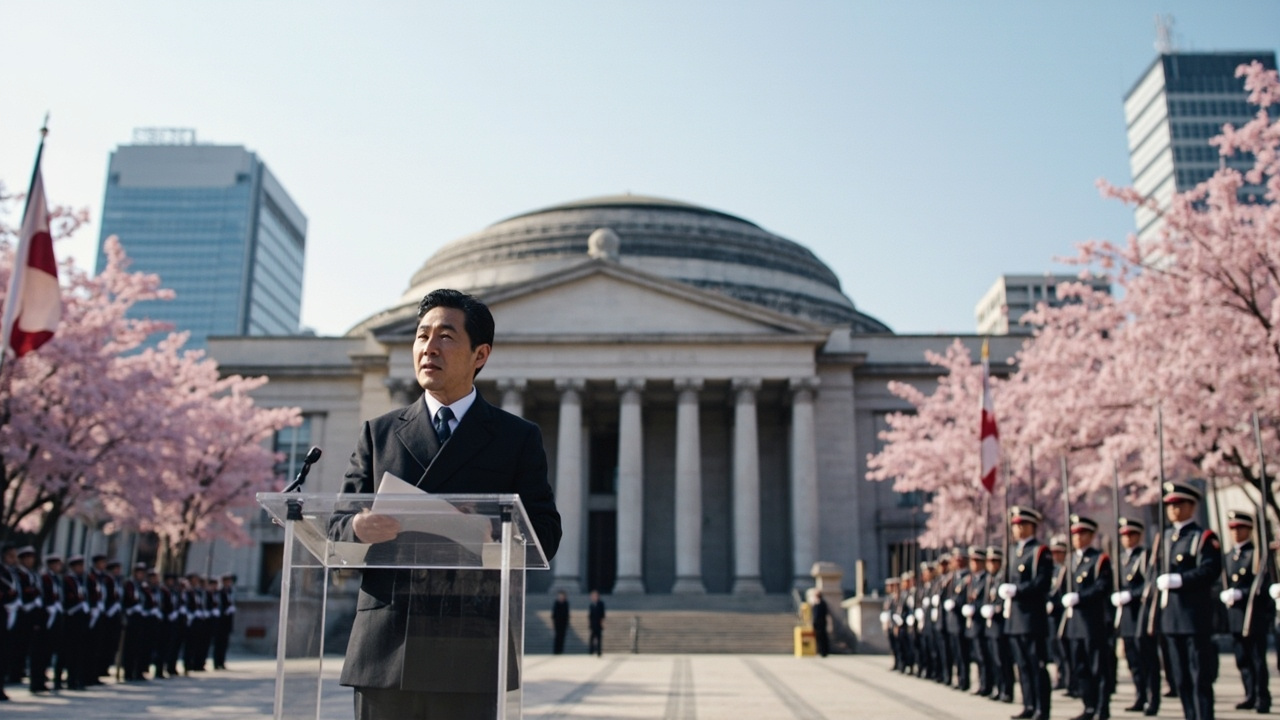
TOKYO — June 2026 marks a date that Japan has discussed, deferred, and reimagined for nearly eight decades: the constitutional revision of Article 9, the post-World War II pacifist clause that renounces war as a sovereign right and prohibits the maintenance of offensive military forces. Prime Minister Fumio Kishida’s governing coalition has secured the two-thirds parliamentary majority needed to trigger a referendum, and for the first time since the constitution’s 1947 promulgation, revision is not a question of if — but when, and at what cost to the regional order.
The political mechanics are formidable. Japan’s constitution can only be amended by a national referendum after a two-thirds supermajority in both chambers of the Diet — a threshold Kishida’s Liberal Democratic Party and its junior coalition partner Komeito reached following the October 2025 upper house elections. The referendum must be held within 60 days of parliamentary approval, placing the decisive vote somewhere between late autumn 2026 and early winter. The text on the table retains the war-renunciation clause but inserts a new paragraph explicitly recognizing Japan’s inherent right to self-defense “individually and collectively” — language designed to put Japan’s U.S.-aligned security posture on firmer constitutional ground.
The Security Calculus: Why Now
Japan’s hawks argue that the strategic environment has changed beyond recognition. China’s military modernization — now fielding the world’s largest navy by hull count and conducting regular carrier operations in the Philippine Sea — has rendered the Cold War-era threat assessments obsolete. North Korea’s accelerating missile program, including submarine-launched ballistic missile tests in 2025 that demonstrated reaching Tokyo, has added an unpredictable nuclear dimension. The August 2025 assassination of a Japanese diplomat in Pyongyang — still unsolved, widely attributed to the North Korean regime — hardened public opinion considerably.
“Article 9 was written for a defeated nation under occupation. Japan today is a sovereign democracy with $5 trillion in GDP and the world’s fourth-largest defense budget in nominal terms. The constitution should reflect who Japan is, not who Japan was in 1947.”
— Prime Minister Fumio Kishida, Diet address, January 2026
The numbers tell their own story. Japan’s defense spending has risen for eleven consecutive years. The 2026 budget allocates ¥8.9 trillion ($59 billion) to defense — a 14 percent increase over 2025 and the largest peace-time defense budget in Japan’s history. Tokyo has finalized the purchase of 200 Tomahawk cruise missiles from the United States, authorized the conversion of two Izumo-class destroyers to accommodate F-35B stealth fighters, and announced plans to establish a joint command structure for the Self-Defense Forces by 2028. These are not the expenditures of a nation planning to remain passive.
The Opposition: Constitutional Purists and Regional Anxiety
Japan’s constitutional review process has also mobilized the most sustained civic opposition in the country’s recent democratic history. The group Article 9 Japan — a coalition of legal scholars, Buddhist organizations, survivor organizations, and civil society groups — organized demonstrations in March and April 2026 that drew an estimated 180,000 protesters to the National Diet grounds in Tokyo, the largest constitutional protest since the 1960 Anpo demonstrations against the U.S.-Japan Security Treaty. Polling by NHK in April 2026 showed 51 percent of Japanese voters opposing revision, with support for the current constitution reaching its highest level since 2007.
The legal objections are substantive. Professor Midori Kawashima of Tokyo University argues that the self-defense paragraph as drafted — “Japan may maintain forces necessary for self-defense” — is sufficiently ambiguous to permit the eventual development of offensive strike capabilities. “The language says ‘necessary,’ and necessity is a political judgment, not a constitutional limit,” Kawashima told this correspondent. “We are being asked to trust that future governments will exercise the same restraint as the governments of the past 80 years. That is a significant ask.”
“The constitution is not merely a legal document. It is a moral commitment — to the Japanese people and to the world — that Japan will never again become a source of war. Amending Article 9 does not just change Japan’s military posture. It changes what Japan means.”
— Professor Midori Kawashima, University of Tokyo
The Regional Dimension: Beijing, Seoul, and the Ghosts of History
For Japan’s neighbors, the constitutional revision carries freight that domestic Japanese debate often understates. China’s Foreign Ministry issued a statement in February 2026 warning that any change to Article 9 “would constitute a serious provocation and a dangerous precedent for the region” — language that, while predictable in its formality, reflects genuine strategic concern in Beijing about the long-term trajectory of Japan’s military capacity. Chinese state media has run a sustained campaign featuring footage of Japan’s wartime campaigns across Asia, juxtaposed with images of current Japanese military modernization, intended for domestic and regional audiences.
South Korea occupies an awkward position. President Lee Jae-myung’s administration maintains the strongest U.S.-South Korea-Japan trilateral security cooperation in decades — a trajectory accelerated after the 2023 Camp David summit and sustained through shared concerns about North Korean missile capabilities. Seoul has publicly reframed its stance on Japanese rearmament from historical grievance to strategic acceptance. But behind closed doors, South Korean officials express reservations about an Japan that is less constitutionally constrained. “We can work with a Japan that is rearming within alliance structures. We are more uncertain about a Japan that rearms within a changed constitutional framework whose limits are untested,” a senior South Korean foreign ministry official told reporters in April, speaking on condition of anonymity.
The U.S. Role: Encouraging, but Carefully
Washington’s position has been supportive but calibrated. The Biden administration — in its final months — issued a carefully worded statement welcoming “Japan’s continued evolution as a capable security partner” while emphasizing the importance of “transparent democratic processes.” The Trump administration, returning to office in January 2027, has been more direct: multiple statements from senior officials have endorsed constitutional revision as consistent with America’s strategic interest in a Japan that can shoulder a greater share of regional security burdens.
U.S. Indo-Pacific Command has already begun contingency planning for an Japan with expanded strike capabilities — specifically, the ability to target North Korean missile launch sites pre-emptively in the event of an imminent nuclear weapons use scenario. These plans, first reported by The Washington Post in March 2026, have added a new and uncomfortable dimension to the domestic debate: that Japan’s rearmament is not purely defensive, and that U.S. strategic requirements are an important driver of the pace and scope of change.
The Stakes for the Regional Order
What is at stake extends well beyond Japan’s borders. The East Asian security architecture — built on the premise of a pacifist Japan anchored to the U.S. alliance, an economically integrated but strategically wary China, and a South Korea that has consolidated its democratic identity while maintaining robust deterrence — is entering a period of managed instability. A Japan that formally ends its war-renunciation commitment will accelerate a regional arms dynamics that China will respond to, that South Korea will feel compelled to match, and that the United States will seek to channel in its own strategic interest.
The referendum, when it comes, will be Japan’s most consequential act of democratic self-determination since the constitution’s original promulgation. That it is happening at all reflects a regional environment that has changed so fundamentally that even the most determinedly pacifist nation on earth must ask itself whether the architecture of its post-war settlement remains fit for purpose. The answer Japan gives will shape the Indo-Pacific for decades to come.
Elena Rodriguez is an International Affairs Correspondent for Media Hook, covering global diplomacy, conflict, and the emerging world order.
