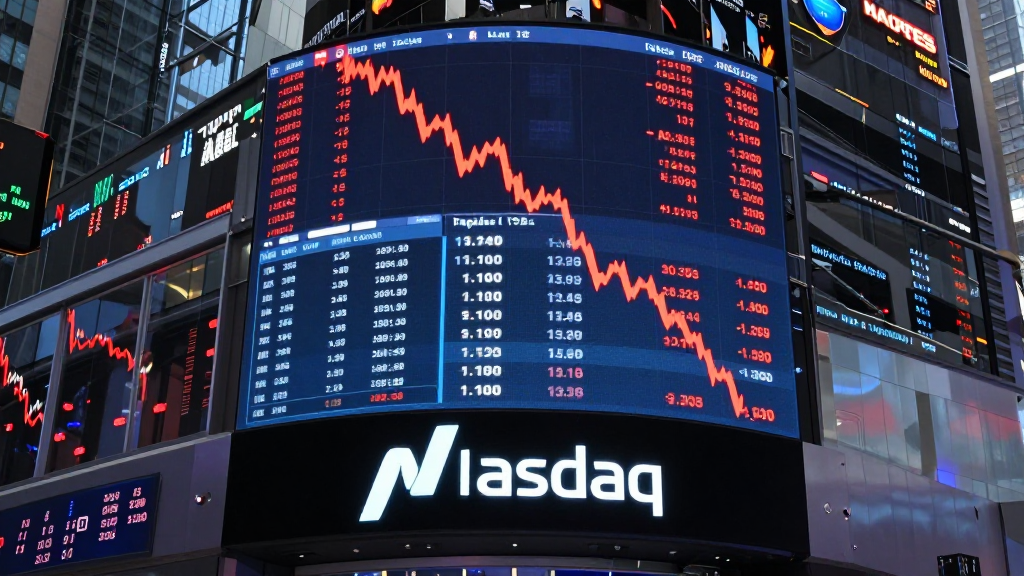
Global stock markets plunged in June 2026 as mounting fears of an artificial intelligence bubble triggered the most significant tech sell-off since the 2022 sector rotation. The Nasdaq Composite dropped 2.2 percent, South Korea’s Kospi index collapsed 10 percent — triggering a circuit breaker for the first time since March 2026 — and semiconductor stocks from Nvidia to Micron posted steep losses across every major exchange. The rout has exposed a growing fault line between AI investment hype and the earnings reality that capital expenditures continue to soar without producing proportionate returns. Federal Reserve rate hike expectations layered on top of the uncertainty, compressing valuations for high-growth tech precisely when investors were already reassessing risk exposure across the sector.
The Tech Wreck Spreads from Wall Street to Seoul
The sell-off was not contained to a single exchange or region. On Wall Street, the Nasdaq fell 2.2 percent on Tuesday following a 1.3 percent decline on Monday, while the S&P 500 dropped 1.4 percent and the Dow Jones Industrial Average slipped 0.7 percent. The carnage extended across semiconductor giants: Nvidia fell 4 percent, Advanced Micro Devices dropped 6.2 percent, Intel lost 7.6 percent, and Micron Technology sank 8.5 percent ahead of its quarterly earnings report. Oracle shed 5.5 percent, and Alphabet had its worst single-day performance in over a year after two prominent AI researchers departed the company. The Philadelphia Semiconductor Index had already tumbled over 10 percent in the preceding week following stronger-than-expected US jobs data that reinforced expectations for additional Fed rate increases.
Asia felt the pain even more acutely. South Korea’s Kospi index plunged 10 percent, triggering a 20-minute trading halt — the first circuit breaker activation since March 2026. Chip leaders SK Hynix and Samsung Electronics each lost over 12 percent. SK Hynix, which had recently overtaken Samsung as South Korea’s most valuable company, extended a steep selling streak that reflected the depth of investor concern about AI chip demand. Japan’s Nikkei 225 dropped 3.6 percent, and SoftBank — whose Vision Fund holds heavy AI-related exposure — sank 15 percent. European markets followed suit, with the Stoxx 600 Technology index down 3 percent on the session.
SpaceX and the $2 Trillion Valuation Question
Perhaps no single company illustrates the tension in AI-era valuations more than SpaceX. The aerospace company, which completed its public listing earlier in 2026, saw its stock fall for three consecutive sessions including a 16 percent drop on Monday before a partial intraday recovery. SpaceX’s first-quarter 2026 revenue grew 15.4 percent to $4.7 billion — solid by most measures — but the company posted a GAAP operating loss of $1.9 billion, deepening concerns about the gap between revenue growth and actual profitability. At a valuation near $2 trillion, SpaceX traded at over 100 times sales, a multiple that exceeds even the most aggressive comparables among pure-play software companies. The stock’s decline reflects broader market unease about debt-fueled capital expenditure programmes that assume AI infrastructure will eventually monetize at scale.
“The concentration of market gains in a handful of tech giants makes the broader market structurally vulnerable to a sector-specific correction,” said Tom Hulick, chief investment officer at Strategy Asset Managers. “We have not seen P/E ratios at these levels since the dot-com peak, and while the AI transformation is real, the question of which companies will actually capture lasting value remains unanswered.” His firm has not reduced its equity exposure but has shifted toward defensive positioning within the technology sector, favouring companies with demonstrated free cash flow over those dependent on continued capital raising.
The Fed’s Rate Dilemma and the Global Growth Slowdown
The market sell-off arrives against a backdrop of persistent inflationary pressure that complicates the Federal Reserve’s policy calculus. The central bank’s June 2026 Summary of Economic Projections showed PCE inflation at 3.6 percent — well above the 2 percent target — while the federal funds rate was projected at 3.8 percent for the year. Higher rates disproportionately hurt high-growth technology companies whose valuations depend on discounting future cash flows over long time horizons. The UN Department of Economic and Social Affairs independently revised its global GDP growth forecast down to 2.5 percent for 2026, representing a 0.2 percentage point downgrade from its January projection, citing Middle East disruptions to energy supply chains and the broader inflationary impact of ongoing geopolitical instability.
The sell-off has also accelerated foreign investor withdrawal from Asian markets. Overseas funds recorded net selling of 355 billion won — approximately $231 million — in South Korean equities, extending their selling streak to 21 consecutive sessions. That persistent outflow underscores how the combination of Fed rate expectations and domestic tech sector concerns is creating a simultaneous pullback across multiple investor bases. Central banks in developing economies face a particularly difficult balancing act: raising rates to defend currencies and contain imported inflation risks further weakening growth, while inaction risks allowing price pressures to become entrenched.
Despite the sharp losses, the long-term AI investment thesis retains significant institutional support. The Nasdaq remains up approximately 10 percent year-to-date, and several major investment banks have characterized the sell-off as a correction within a broader bull market rather than the beginning of a sustained downturn. Wedbush analyst Dan Ives described the episode as a “gut check moment” for investors who have overweighted AI exposure, while maintaining that the structural demand drivers for AI infrastructure — cloud migration, edge computing, defence applications — remain intact. The resolution of the current tension between valuation and earnings will likely determine whether the June 2026 sell-off becomes a footnote or a turning point in the AI investment cycle.