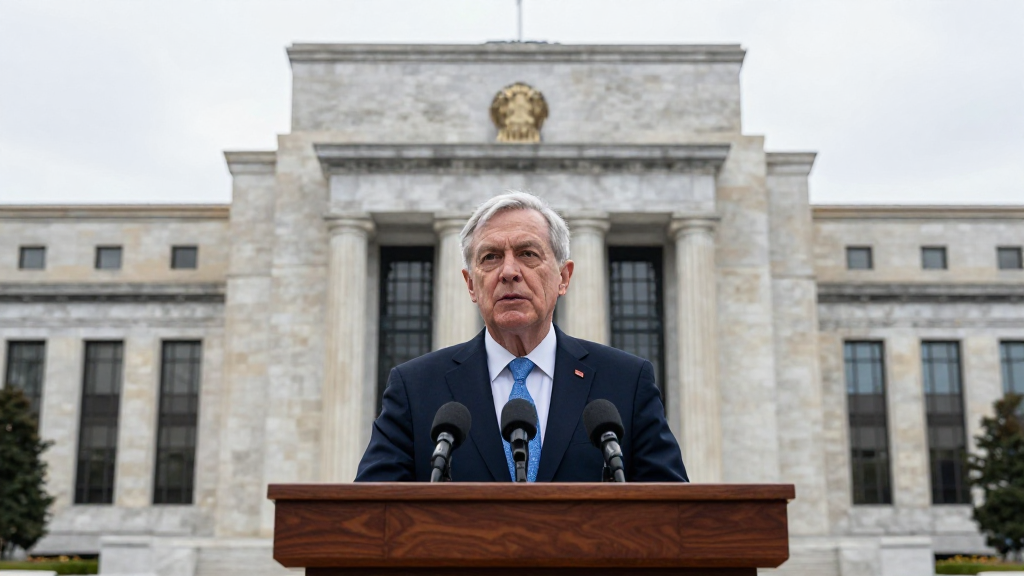
The Federal Reserve held interest rates steady at 4.25% to 4.5% for the fourth consecutive meeting in June 2025, a decision that landed amid the most intense political pressure the central bank has faced in decades. President Donald Trump publicly called for immediate rate cuts, describing the Fed’s stance as harmful to American families and business confidence. Fed Chair Jerome Powell rebuffed the calls with a blunt message: the central bank’s decisions are driven by data, not political deadlines. The standoff has placed the Fed’s hard-won independence in the spotlight and left markets navigating a landscape where the path of least resistance is suddenly far less clear.
The Fed Holds Its Ground as Inflation and Growth Diverge
The June 2025 FOMC decision reflected a central bank caught between competing pressures on opposite sides of its dual mandate. The updated Summary of Economic Projections showed officials raising their inflation forecast to 3.0% PCE by year-end, up from the 2.6% projected in March. Simultaneously, the GDP growth forecast was slashed to 1.4%, a sharp deterioration from the 2.1% the same projections showed just three months earlier. Unemployment is now expected to reach 4.5% by 2026, a meaningful climb from the current rate. The combination of slower growth and stickier inflation defines a stagflationary dynamic that complicates the Fed’s calculus and makes the next move harder to predict.
The Fed signaled two potential rate cuts totaling 50 basis points before year-end, a modest upgrade from the single cut penciled in during the March round of projections. Markets responded by pricing in a roughly 70% probability of a cut at the September meeting. Yet Powell was measured in his remarks, noting that confidence in the inflation trajectory had not yet been achieved. “We just don’t have that greater confidence yet,” he told reporters during the post-meeting press conference. That guarded language reflects a central bank that has been burned before by premature easing and is unwilling to telegraph a firm timeline when the data picture remains this murky.
Trump’s Pressure Campaign and the Independence Question
The political dimension of this meeting was impossible to ignore. Trump had made no secret of his desire for lower rates, framing high borrowing costs as a drag on the economy and an obstacle to the growth agenda tied to his administration’s tax and trade policies. His public criticism of Powell, including remarks suggesting the chair was “stupid” for not cutting faster, represented an unusual breach of the norms that have historically insulated the Fed from direct presidential interference. The remarks drew sharp rebukes from current and former central bankers who warned that undermining confidence in the Fed’s independence could erode the dollar’s global standing and push long-term interest rates higher rather than lower.
Powell’s response was unequivocal. “We are aware of political opinions, but our decisions are driven by data, not deadlines,” he said. The statement was widely interpreted within financial markets as a signal that the Fed would not capitulate to short-term political pressure even if economic conditions deteriorated further in the coming months. For investors and corporate planners who have relied on the Fed as a predictable anchor in an increasingly unpredictable global environment, that signal provided a measure of comfort even as the economic outlook darkened.
Global Divergence Deepens as World Adjusts to a Tighter Dollar
The Fed’s steadfast refusal to cut contrasts sharply with the actions of most other major central banks. The European Central Bank, the Bank of Canada, and the Bank of England have all moved to reduce rates in 2025, responding to the dampening effect of US tariffs on their export-driven economies. The Bank of Japan, alone among major central banks in its tightening cycle, held rates at 0.5%, a reflection of the unique inflation dynamics Japan has faced after decades of deflation. This creates a backdrop of significant monetary divergence: the United States is effectively the tightest major central bank in the world right now, a condition that has supported the dollar but created mounting stress for emerging market economies that have borrowed heavily in dollar-denominated debt.
The divergence also complicates the calculus for multinational corporations and sovereign debt managers who have structured their balance sheets around a era of near-zero interest rates. As the US rate environment remains elevated while Europe and Canada ease, capital flows are gravitating toward dollar-denominated assets with renewed vigor. That dynamic has contributed to dollar strength that, while beneficial for US import purchasing power, has added a layer of financial stress for developing economies facing both higher US rates and slower global trade growth.
The geopolitical context adds further uncertainty. Ongoing tensions in the Middle East and the broader trajectory of Trump’s tariff agenda are being factored into FOMC deliberations in ways that go beyond the traditional economic models. The Fed’s June statement acknowledged that the uncertainty surrounding the global trade environment makes the inflation outlook especially difficult to read, a admission that suggests policymakers themselves are operating with less confidence than usual in their analytical frameworks.