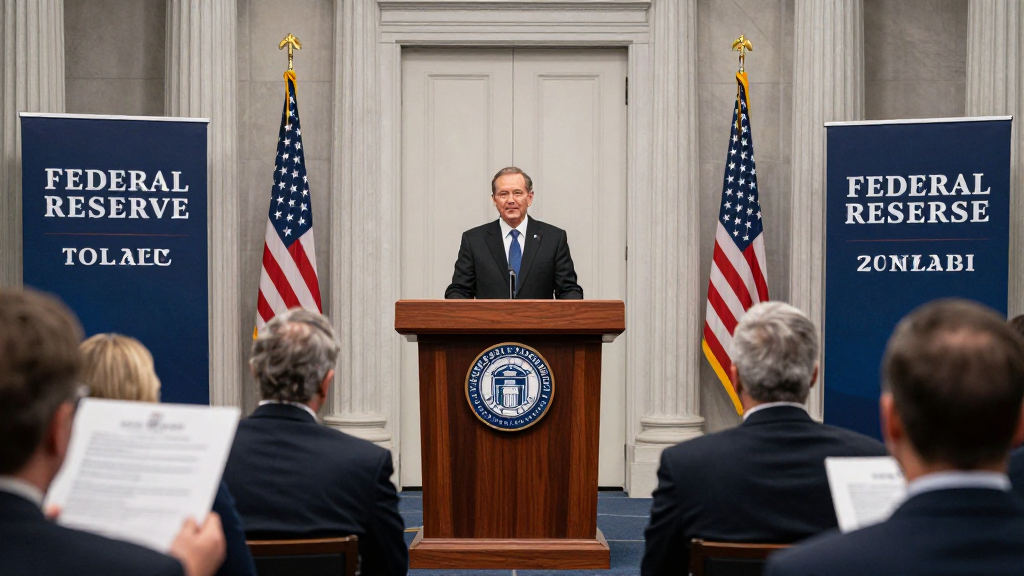
The Federal Reserve held its benchmark interest rate steady at 3.5% to 3.75% on June 17, 2026, but the underneath data told a sharply hawkish story that sent bond yields higher and equity markets into a brief spin. In Kevin Warsh’s first meeting as Federal Reserve chairman, the FOMC voted unanimously to pause, but the Summary of Economic Projections delivered a shock: the median official now expects rates to end 2026 higher than they are today, a dramatic reversal from March when the same committee projected a cut was on the table.
The median projection for the federal funds rate at the end of 2026 rose to 3.8% from 3.4% in March, moving from a level that implied an easing step to one above the current midpoint of 3.625%. That shift alone represents the clearest hawkish pivot in a single meeting in recent memory. Of the 18 officials who submitted projections, nine placed their dots above the current rate, signaling at least one rate hike this year, while just one official still foresaw a cut. The full range of projections stretched from 3.4% to 4.4%, with a central tendency of 3.6% to 4.1%.
The Statement Stripped of Its Easing Bias
The June statement was notably shorter than prior iterations and dropped all language that markets had previously read as an easing bias. Gone was the prior reference to possible additional adjustments, and gone too were the conditional formulations that had kept the door open for cuts. The committee described inflation as elevated relative to the 2% goal, tying part of the problem to supply shocks including energy prices, while noting that job gains have kept pace with the workforce and the unemployment rate has changed little. That is a committee singularly focused on price stability and unwilling to signal relief is coming soon.
Chair Warsh, in his debut press conference, was blunt about the shift. “That statement just gives you the facts, as best we can judge it,” he said, acknowledging the condensed format. On the contested dot plot, Warsh confirmed what many had suspected: he did not submit his own forecast. “I did not submit a dot for me,” he told reporters. “It’s not helpful in the conduct of policy.” Warsh added that he would form task forces to overhaul major Fed operations, including the communication framework, forward guidance, and possibly the dot plot itself, raising questions about the future of the committee’s most-watched forecasting tool.
Inflation Risks Tilted Sharply to the Upside
The most striking number in the June projections was not the median rate but the inflation risk assessment: 17 of 18 FOMC members judged the risks to inflation to be tilted to the upside. That near-unanimous recognition of upside price pressure is a direct reflection of persistent services inflation, a tight labor market, and the lingering effects of earlier tariff increases on imported goods. The committee’s own research divisions have been revising supply chain cost assumptions upward, and the energy sector remains volatile amid ongoing geopolitical disruption in key producing regions.
Financial markets initially sold off on the hawkish projections before partially recovering as traders absorbed the unanimous hold and Warsh’s assurances that the review of Fed operations would be thorough but methodical. The two-year Treasury yield, most sensitive to near-term rate expectations, jumped eight basis points to 4.31%, its highest level in three months. The dollar index rose 0.6%, pressuring emerging market currencies already struggling with capital outflows. Equity markets ended the day mixed, with rate-sensitive sectors like utilities and real estate taking the biggest hits.
Global Divergence Deepens the Pressure on Emerging Markets
The Fed’s hawkish pivot arrives as other major central banks are moving in opposite directions. The European Central Bank raised rates again in June, citing persistent core inflation that refuses to cool despite eleven consecutive hikes. The Bank of Japan continues its gradualist exit from ultra-loose policy, pushing the yen higher in a move that is reshaping carry trade dynamics globally. The result is a three-way divergence in monetary policy that economists say is creating the most complex global financial environment since the 2008 crisis.
For emerging market economies, the combination of a stronger dollar and higher U.S. rates is a double blow. Capital that flowed cheaply into developing economies during the era of near-zero U.S. rates is now reversing course, seeking higher returns in dollar-denominated assets. The Institute of International Finance reported outflows of $48 billion from emerging market equities and bonds in the two weeks following the Fed’s June decision, the largest such move since the COVID crash. Countries with high external debt burdens, currency mismatches, or reliance on commodity imports are feeling the stress most acutely, with several currencies hitting multi-year lows against the dollar.
IMF research published ahead of the G20 meetings this month estimates that a 100-basis-point rise in U.S. rates, combined with a 5% appreciation in the dollar, subtracts roughly 0.6 percentage points from emerging market growth over a two-year horizon. For heavily indebted frontier economies, that math can mean recession, debt distress, or both. The fund has urged the Fed to communicate its policy path as clearly as possible to reduce the volatility that abrupt shifts in expectations impose on the global financial system.
The tension in Fed communications goes beyond the domestic audience. Every hawkish signal from Washington tightens financial conditions abroad, and every emerging market devaluation feeds back into imported inflation for American consumers. Warsh’s promise to review the Fed’s communication tools is being watched closely in foreign ministries and central banks from Sao Paulo to Jakarta. The question now is whether the most powerful central bank in the world can recalibrate its message without triggering the very instability it is trying to contain.