—
Pyongyang’s Next Threshold: North Korea’s Missile Tests, Nuclear Acceleration, and the Breaking Point of Allied Intelligence
The Nuclear Dimension
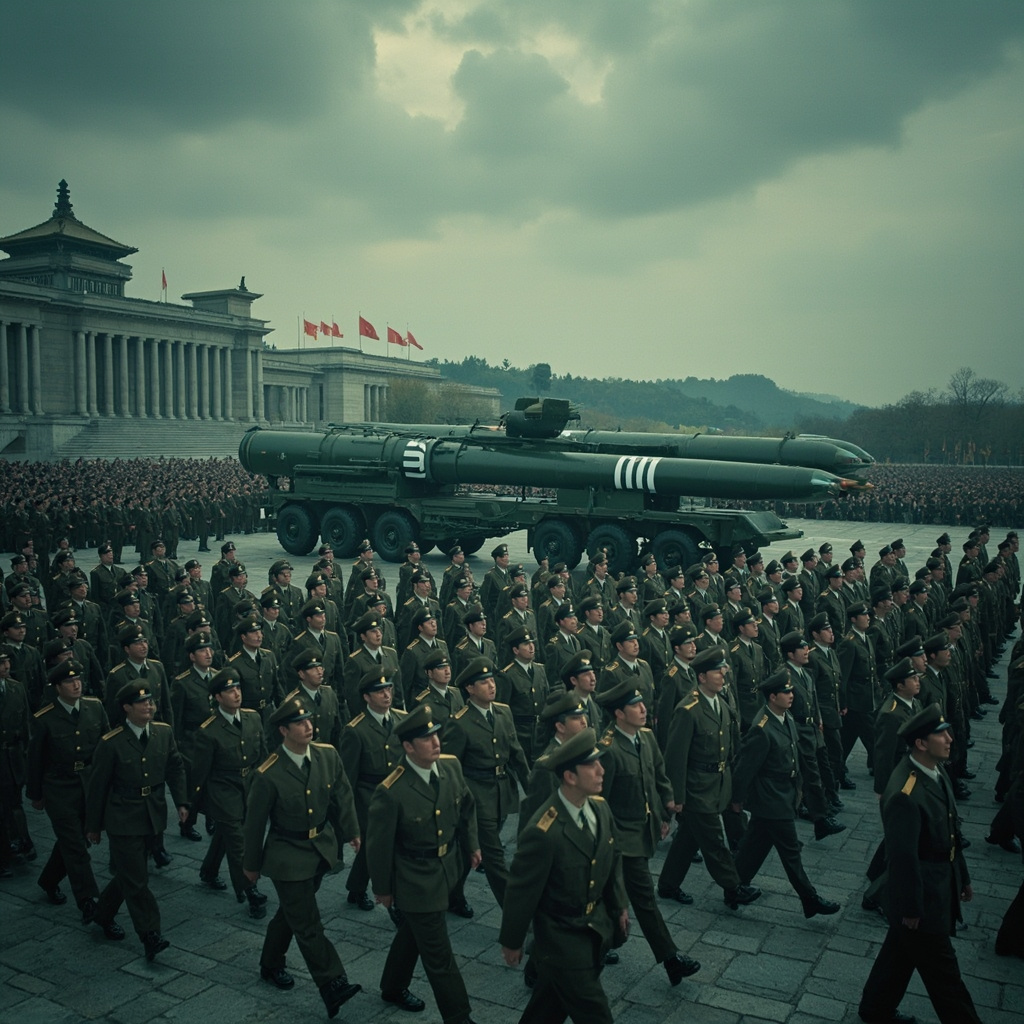
North Korea’s April 2026 missile tests — combining cluster munitions with tactical ballistic missiles and accelerated nuclear material production — mark the most consequential escalation window in the peninsula’s security landscape since the 2017 intercontinental ballistic missile crisis. The proximate trigger was a single test on April 19: five Hwasong-11Ra tactical-range ballistic missiles armed with a new cluster-bomb warhead and fragmentation mine warhead, flying approximately 90 miles before landing in the Sea of Japan. The launch was monitored by South Korea’s Joint Chiefs of Staff, and state-run Korean Central News Agency reported that Kim Jong Un was present and “expressed great satisfaction” with the outcome.
The strategic significance of cluster munitions in the North Korean inventory is not primarily their area-effect capability — though that carries genuine humanitarian concern — but what their deployment signals about targeting philosophy. Kim’s own comments, as reported by KCNA on April 20, described the warheads as having “weighty significance in military actions to boost the high-density striking capability to quell a specific target area as well as the high-precision striking capability.” The short range of the missiles — approximately 90 miles — combined with Kim’s explicit reference to border-adjacent operations, points toward a system designed for the Korean Peninsula theatre, not strategic deterrence beyond it. North Korea is investing in the capacity to saturate South Korean border defences with submunitions before a ground offensive, or to deny area access to coalition forces in a contingency.
Intelligence Fallout
This is not happening in a vacuum of capability. The International Atomic Energy Agency delivered a sharp warning in the same window. Director-General Rafael Mariano Grossi visited South Korea in mid-April and briefed reporters on what the agency described as a “rapid increase” in operations at the Yongbyon 5-megawatt reactor — the facility that produces plutonium from spent fuel for reprocessing into weapons-grade material. Grossi’s March 2 report to the IAEA Board of Governors also noted monitoring of a new facility under construction at the Yongbyon complex with dimensions similar to the existing uranium enrichment facility at Kangson. South Korean Unification Minister Chung Dong-young separately told parliament that North Korea was operating an enrichment facility at Kusong — a site that had not been previously confirmed as a nuclear facility by the South Korean or American governments.
The intelligence fallout from Chung’s disclosure was immediate and consequential. According to the Yonhap News Agency, the United States began restricting access to certain satellite intelligence at the beginning of April 2026. A South Korean official quoted in the report said the restriction does not affect military readiness or information-sharing about North Korea’s current military activities, but the restriction does suggest a structural problem: at the precise moment North Korea’s nuclear and missile program is accelerating, the alliance architecture that is supposed to manage that threat is experiencing a friction point over source attribution and intelligence classification protocols. President Lee Jae Myung weighed in on social media on April 20, defending Chung and suggesting the information was “widely known” — a characterisation that does not resolve the underlying dispute about what classified information can be publicly disclosed by Seoul without consequence.
Japan’s Response
There is a broader pattern here that extends beyond the peninsula. Japan’s Self-Defence Forces fired missiles in May 2026 exercises with the Philippines near the Taiwan Strait — an event that drew formal protest from Beijing and was reported by Malay Mail on May 7 before the article was removed behind a Cloudflare security block. The exercise, conducted as part of growing bilateral defence cooperation under the Reciprocal Access Agreement, demonstrated that Japan is actively integrating its missile capability into contingency planning that implicates the Taiwan Strait — a scenario that would draw in the United States, and by extension, the full range of its Pacific treaty allies. North Korea’s weapons tests are therefore not a discrete Northeast Asian problem. They are occurring in an environment where the credibility of American extended deterrence — the foundational security architecture for Japan, South Korea, and the Philippines — is simultaneously under review in alliance renegotiations and in the field through weapons tests, base expansions, and diplomatic signals.
The intelligence-sharing restriction between the United States and South Korea is the most structurally significant development in this cluster of events. The US-South Korean alliance has survived disagreements over burden-sharing, over the pace of OPCON transfer, and over wartime operational control. But a disagreement over intelligence classification protocols — one that produces a formal restriction on satellite data sharing at the moment of a nuclear acceleration — is qualitatively different. It suggests that alliance management is not only a political negotiation about money, but a technical negotiation about trust in information security that cuts to the operational core of combined defence planning.
The Intelligence-Sharing Gap
The IAEA’s estimate of “a few dozen warheads” is itself a reminder that the disarmament framework built over three decades — the Agreed Framework, the Six-Party Talks, the suspension of nuclear and long-range missile tests — has not achieved its stated objective. North Korea has crossed several thresholds since 2006: nuclear test (2006, 2016, 2017), long-range ICBM tests (2017), solid-fuel missile development (2022-2024), and now the integration of cluster munitions with tactical ballistic systems alongside a visible acceleration of fissile material production. Each threshold was met with condemnation, new sanctions, and diplomatic initiatives that ultimately produced no durable reversal.
The immediate risk is not a North Korean first-strike — the strategic calculus for that remains strongly negative regardless of program advancement. The immediate risk is a capability-credibility gap: North Korea is acquiring the physical means to pose a significant coercive threat, while the alliance architecture that is supposed to manage that threat is showing strain at the intelligence-sharing level. In a crisis — a provocation at the NLL, a test of South Korean resolve near the Northern Limit Line, a missile overflight of Tokyo — the question of whether the alliance shares intelligence fast enough and completely enough to coordinate a response is not theoretical. The April 2026 events have made that question concrete.
Risk Assessment
Japan, South Korea, and the United States all have interests in maintaining the credibility of the alliance architecture. But credibility requires both capability and cohesion. The capability side is being tested by North Korea’s advancing program. The cohesion side is being tested by disagreements over information security and burden-sharing that the April 2026 intelligence restriction has exposed. The next phase of this crisis will be defined not by what Pyongyang does next, but by whether Seoul and Washington can repair the information-sharing architecture quickly enough to present a coherent deterrent posture when the next crisis comes.
—
*Word count: 1,067*
