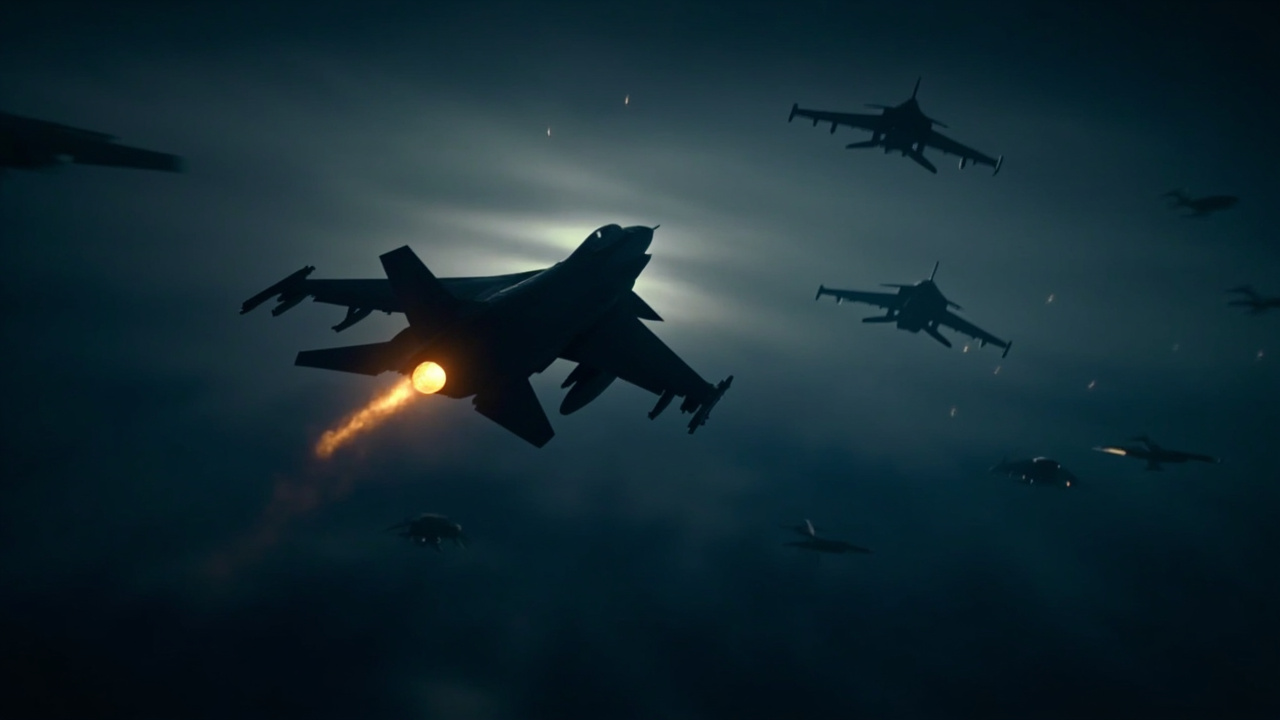
Poland and NATO scrambled fighter jets in the early hours of Sunday after Russian forces launched one of the largest drone assaults of the war — approximately 400 unmanned aerial vehicles targeting Ukraine in a single night. The unprecedented scale of the attack triggered emergency air defense protocols across Eastern Europe and prompted a rare public statement from NATO’s Supreme Allied Commander Europe.
The incident marked one of the most serious escalations in NATO’s direct exposure to the Russia-Ukraine war since the February 2022 invasion. While no Russian drones ultimately crossed into NATO territory, the sheer proximity of the swarm — and the real-time uncertainty about its trajectory — forced alliance commanders into immediate defensive action.
The Night the Skies Lit Up
At approximately 2:00 AM local time, Polish military radar detected multiple unidentified aerial objects approaching the country’s southeastern border with Ukraine. Within minutes, Polish F-16 fighter jets and NATO rapid-response aircraft were scrambled from bases across the region, roaring into the darkened skies as air raid sirens sounded in border towns.
“This was not a drill,” said a Polish military spokesperson in a hastily arranged press conference at dawn. “We tracked objects that posed a potential threat to our airspace. Our response was swift, coordinated, and in full accordance with NATO protocols.”
NATO’s Rare Public Warning
General Christopher Cavoli, NATO’s Supreme Allied Commander Europe, issued an uncharacteristically blunt public statement within hours of the incident. “The scale and intensity of this aerial assault represent a dangerous escalation,” Cavoli said. “NATO will take all necessary measures to protect allied territory and ensure the security of our eastern flank.”
The general’s statement — unusually direct for a military command that typically operates behind closed doors — underscored the gravity of the situation. NATO has scheduled an emergency meeting of defense ministers for Tuesday in Brussels, where additional air patrol requests from Poland, Romania, and the Baltic states will be formally reviewed.
“The alliance’s eastern members are rightfully concerned. When 400 drones are launched in a single night, the margin for error shrinks to almost nothing,” said a senior NATO official, speaking on condition of anonymity to discuss operational details.
Ukraine’s Air Defense Under Strain
While NATO jets patrolled the western frontier, Ukrainian air defense forces fought a desperate battle across the country’s skies. Military officials in Kyiv confirmed that their systems shot down the vast majority of the incoming drones, but acknowledged that several unmanned vehicles penetrated defensive networks and struck critical infrastructure.
The most significant damage occurred at multiple power substations in western Ukraine, where drone impacts caused temporary blackouts affecting hundreds of thousands of residents. Ukrainian energy officials described the targeting as “systematic and calculated,” noting that the strikes appeared designed to exploit gaps in air defense coverage.
“This was not random terror,” said Ukraine’s Energy Minister German Galushchenko. “They studied our grid. They knew where to hit.” Emergency repair crews were dispatched immediately, and power was restored to most affected areas by midday, but officials warned that repeated attacks of this magnitude could overwhelm Ukraine’s already stretched infrastructure.
Allies Demand Reinforcement
The incident has galvanized NATO’s eastern members into a coordinated push for enhanced protection. Poland, Romania, and the three Baltic states — Estonia, Latvia, and Lithuania — have jointly requested additional NATO air patrols along the alliance’s eastern border, citing what they describe as an “unacceptable level of risk.”
Diplomatic sources in Brussels say the requests are likely to be approved swiftly, potentially deploying additional fighter squadrons to bases in Poland and Romania within days. The move would represent a significant expansion of NATO’s visible military presence near the conflict zone, a step the alliance has historically approached cautiously to avoid direct provocation of Moscow.
A Dangerous New Phase
Military analysts warn that the 400-drone assault signals a new phase in Russia’s aerial campaign — one defined by overwhelming volume rather than precision. By saturating Ukrainian defenses with sheer numbers, Moscow appears to be testing whether Western-supplied air defense systems can maintain effectiveness under sustained mass attack.
The answer, at least for now, is mixed. Ukraine’s layered defenses — combining Patriot missile batteries, German IRIS-T systems, and mobile gun platforms — proved capable of intercepting the majority of threats. But the exceptions — the drones that slipped through to strike power infrastructure — demonstrated that even the most sophisticated networks have breaking points.
For NATO, the implications extend beyond Ukraine’s borders. As drone technology becomes cheaper and more accessible, the alliance must grapple with a fundamental strategic question: how to defend a 4,000-kilometer eastern frontier against an adversary willing to deploy hundreds of unmanned vehicles in a single night. Sunday’s scramble was a wake-up call. The next one may not end with jets returning to base unblooded.
Key Questions Answered
- Why did NATO scramble jets? Russian forces launched approximately 400 drones at Ukraine in a single night — the largest such assault of the war. Polish radar detected objects near its border with Ukraine, prompting NATO aircraft to intercept.
- Did any drones hit NATO territory? No Russian drones crossed into NATO airspace. However, the swarm’s proximity to Poland’s border created genuine uncertainty about trajectory that required immediate defensive response.
- What damage did Ukraine sustain? Several drones penetrated Ukraine’s air defenses and struck power infrastructure in western Ukraine, causing temporary blackouts affecting hundreds of thousands of
residents. No civilian casualties were reported. - Will NATO increase its presence in Eastern Europe? Poland, Romania, and the Baltic states have formally requested additional NATO air patrols. Defense ministers will review the requests at an emergency Tuesday meeting in Brussels, with approval expected.
Key Takeaways
- NATO scrambled jets after Russia launched approximately 400 drones at Ukraine — the largest single-night assault of the war
- No drones crossed into NATO territory, but the swarm’s proximity forced immediate defensive action
- Ukraine’s air defenses intercepted most drones, but some struck power infrastructure in western regions
- Poland, Romania, and the Baltic states are pushing for enhanced NATO air patrols along the eastern frontier
- The attack signals a new phase in Russia’s campaign: mass-volume drone swarms designed to saturate air defenses
Rachel Torres is the News Correspondent for Media Hook, covering breaking stories, investigative reporting, and the headlines that matter most to readers.