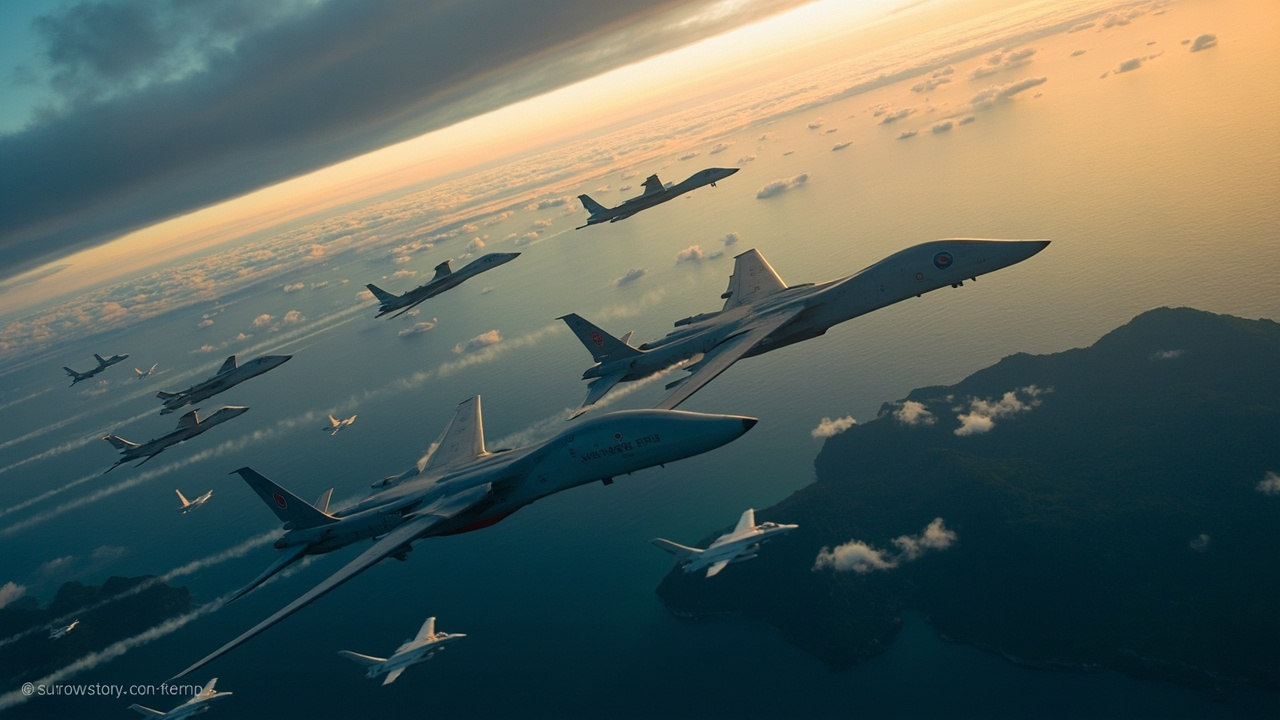
China and Russia conducted their 11th joint strategic air patrol on Saturday, flying bombers and fighter jets through the Sea of Japan, East China Sea, and western Pacific in a mission that triggered coordinated scrambling by Japanese and South Korean air forces and drew sharp criticism from Tokyo's defense minister.
The flights, which took place June 27, were the first such joint bomber patrol since December 2025 and underscored the deepening military coordination between Beijing and Moscow at a moment when both governments face elevated tensions with the United States and its regional allies.
Patrol Route and Aircraft Involved
Japan's Defense Ministry said it tracked two separate formations. The first group consisted of two Russian Tu-95 strategic bombers and two Tu-142 maritime patrol aircraft flying alongside two Chinese H-6 bombers west of the Korean Peninsula. A pair of Chinese J-16 fighter jets and one Russian Su-35 fighter joined that formation. A second Russian formation, carrying two additional H-6 bombers and four more J-16 fighters, later pushed east through the Miyako Strait, a narrow waterway between Okinawa and the Miyako Islands that leads into the open Pacific.
Russia's Defense Ministry said the aerial patrol lasted approximately six hours. The Chinese Ministry of National Defense confirmed the operation, saying it demonstrated the two countries' "determination and capability" to jointly safeguard regional peace and stability.
Japan and South Korea Respond
Both U.S. treaty allies activated air defense protocols. South Korea's Joint Chiefs of Staff said the aircraft entered and exited the Korea Air Defense Identification Zone over the East Sea and East China Sea without violating sovereign airspace, but that fighter jets were scrambled to conduct tactical response measures. The Ministry of National Defense filed formal protests with the Chinese and Russian embassies in Seoul on Sunday.
Japanese Defense Minister Shinjiro Koizumi, meeting in Seoul with his South Korean counterpart National Defense Minister Ahn Gyu-back at the time of the incident, condemned the mission in blunt terms.
"The repeated joint flights of bombers by both countries signify an expansion and intensification of activities around our country, while clearly intending to demonstrate force against our nation, posing a serious concern for our national security," Koizumi said. A Joint Staff spokesman told reporters Monday it was the first time since December that such joint flights had been confirmed, adding that Japan would take strict measures against any airspace violations.
Japan Air Self-Defense Force fighter aircraft from the Western Air Defense Force were also dispatched to intercept the formation east of Shikoku, one of Japan's four main islands.
Regional Security Implications
The patrol comes as China and Russia have steadily expanded joint military exercises since Russia's full-scale invasion of Ukraine in 2022. Their air forces have conducted increasingly complex missions, with bombers capable of carrying nuclear weapons flying as far as the Bering Sea and waters near Alaska. The November 2024 sortie marked the debut of China's H-6N nuclear-armed bomber variant in these joint missions.
Japan and South Korea, both U.S. treaty allies, have deepened their security cooperation over the past year, signing a landmark reciprocal logistics agreement in Seoul in June and resuming joint maritime search and rescue exercises that had been suspended for nearly a decade. Koizumi and Ahn held their third meeting in as many months on Sunday, with both men underscoring the importance of trilateral coordination with the United States as the regional security environment grows more volatile.