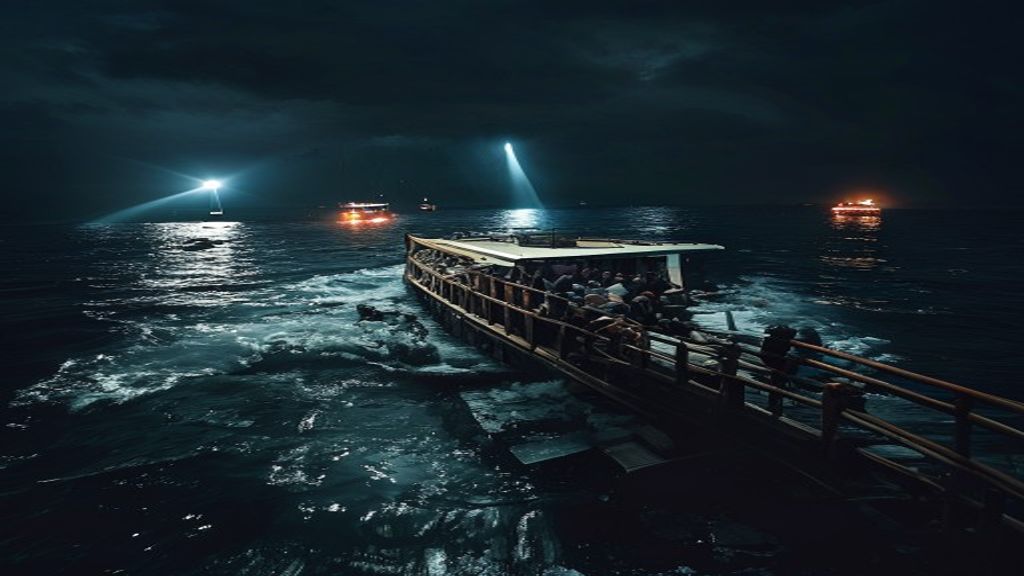
A passenger ferry carrying far more people than its manifest recorded capsized off the coast of Guyana late on Saturday, killing at least 53 and leaving dozens more missing in what is shaping up to be one of the deadliest maritime disasters in the Caribbean nation’s modern history. The MV Barima, an 87-year-old wooden vessel built in 1939, was en route from the capital Georgetown to Port Kaituma in the country’s northwest when it began taking on water shortly before midnight. Survivors described a chaotic scene in which the ferry tilted sharply after being struck by a large wave, sending passengers tumbling into the dark waters of the Essequibo region.
Prime Minister Mark Phillips confirmed that 76 people had been rescued alive as of Tuesday night, but authorities now believe as many as 179 people were aboard the vessel, far exceeding the 116 passengers and 17 crew listed on the official manifest. That discrepancy has triggered a criminal investigation and raised urgent questions about longstanding practices at Guyana’s state-run ferry terminals, where passengers have complained for years that ticket clerks sell seats to friends and associates for cash without recording their names.
Survivors Describe a Nightmare at Sea
Among the harrowing accounts to emerge from the disaster, a grandmother named Helena Moonsammy told local media she lost four of her grandchildren in the sinking. “I was fighting for my life. The boat sunk in minutes, seconds,” she recalled, describing how boxes fell on her as she tried to save the children. “I told my grandbabies to cling on to anything as I hollered for them. I prayed all night and was in the water for nine hours.”
Another survivor, 18-year-old Alicia Atkinson, said her three-year-old daughter was swept from her grasp as the vessel went down. Atkinson managed to save her 10-month-old son, floating with him in the ocean while clinging to debris for roughly eight hours. “I ended up in the water and was hustling to come up for air, but my daughter just rushed out of my hand and disappeared,” she said. “I miss my daughter.”
At least 15 children were among those rescued. Small private boats from nearby coastal communities played a crucial role in the initial rescue, pulling at least 17 survivors from the sea before government search teams arrived. The French army dispatched 12 divers, two doctors, and a mechanic from neighboring French Guiana to assist in the operation.
Captain and Crew Member Test Positive for Cannabis
Authorities have detained the ferry’s captain and at least one other crew member after both tested positive for cannabis use. Public Works Minister Juan Edghill expressed fury at a news conference on Sunday, revealing the drug test results and announcing that all staff associated with the management and loading of the MV Barima had been suspended pending the investigation.
“We have zero tolerance for members of the crew drinking or smoking while at work. And for us to have positive tests from the captain… this is serious,” Edghill said. Prime Minister Phillips reinforced the message, insisting that “where negligence, misconduct or criminal wrongdoing is established, those responsible will face the full force of the law.”
The MV Barima had been dry docked and overhauled in 2024 and was scheduled for major repairs in October, according to vessel tracking records. The 40-meter vessel was one of the oldest ferries still in regular service along Guyana’s remote inland waterways, a critical lifeline for communities in the country’s sparsely populated northwest that have few alternative transport links.
A Nation in Mourning Demands Answers
President Irfaan Ali addressed the nation in a somber broadcast, warning that the days ahead would be agonizing for the small Caribbean country. “Brace yourself for the coming days,” Ali said. “It is going to be a difficult period for us as a people and as a country. May God watch over Guyana and bring us through this horrible experience.”
Dozens of families have gathered at a hospital in the coastal town of Charity, waiting to identify the bodies of loved ones pulled from the water. Many wore face masks, a reflection of both grief and the practical reality of identifying decomposing remains after days in tropical waters. Moonsammy, still searching for her grandchildren, captured the raw despair of those waiting: “I have to see the bodies before I go home.”
As the search operation transitions from rescue to recovery, officials are bracing for the death toll to climb significantly. Neighboring countries have sent boats, spotter planes, and rescue personnel to assist, but hopes of finding more survivors in the open water have all but faded. The disaster has also renewed scrutiny of Guyana’s maritime safety oversight, particularly the chronic overcrowding and manifest irregularities that have plagued the state ferry system for decades without meaningful reform.