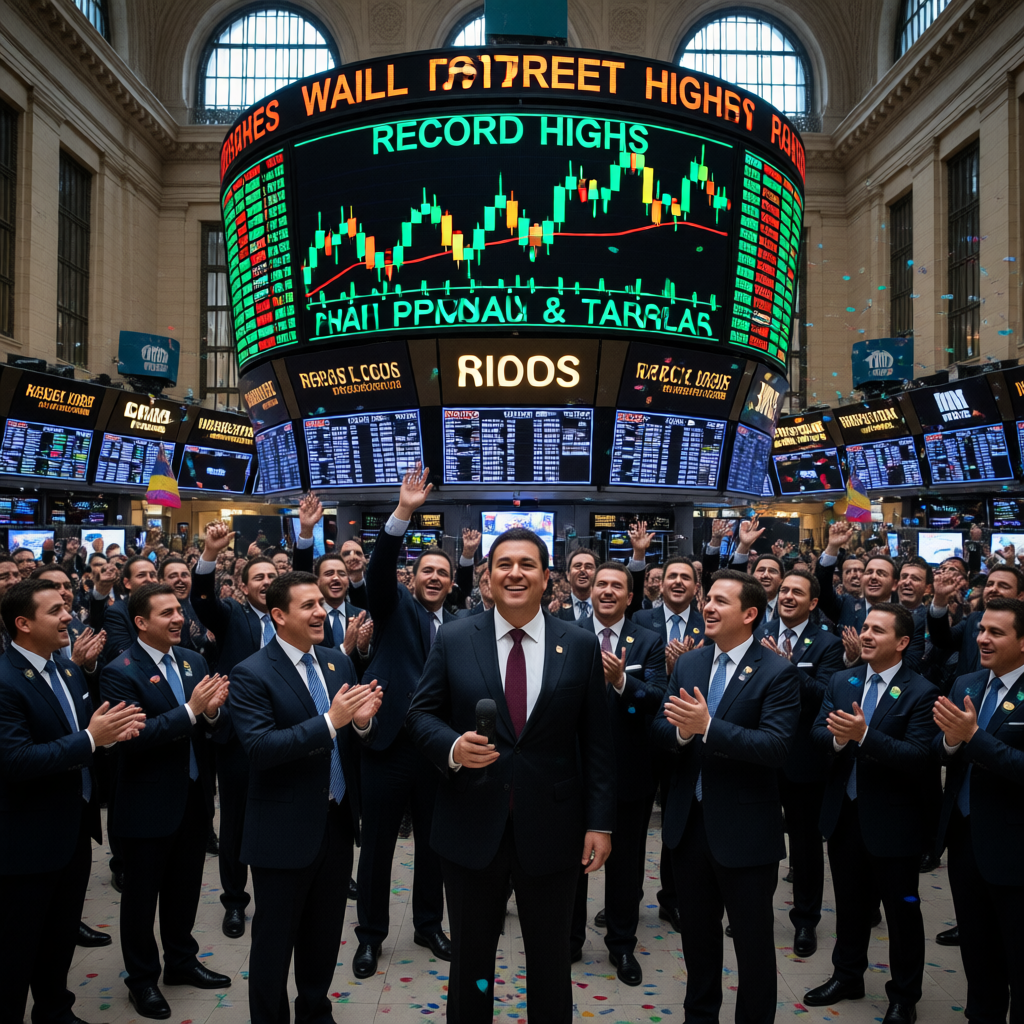
Wall Street kicked off the holiday-shortened week with a second consecutive record session, but the more telling story is what the bond market is doing underneath. The Dow Jones Industrial Average added 412 points, or 0.80 percent, to close at 52,083 on Tuesday, building on Monday’s 51,671 close and the first-ever print above 51,600. The S&P 500 climbed 0.55 percent to 7,596, the Nasdaq Composite added 0.7 percent to 26,870, and the Russell 2000 extended its record streak to a fourth consecutive all-time high. The real action was in rates: the 2-year Treasury yield fell 4 basis points to 3.92 percent and the 10-year dropped 3 to 4.15, leaving the 2s10s spread bull-steepening at 23 basis points. That is the cleanest soft-landing signal the market has put on tape in two years, and it lands directly on the eve of the Federal Reserve’s June policy decision.
Manufacturing Roars Back as the ISM Reclaims 51
The single biggest driver is a manufacturing print that almost no one had on their bingo card. The Institute for Supply Management reported Tuesday that its manufacturing index for May rose 2.4 points to 51.2, crossing back above the 50 expansion line for the first time since December. New orders climbed 3.1 points to 52.5, employment added 1.8 to 49.1, and the prices-paid subindex fell 5.8 points to 56.3 — a rare configuration in which the factory sector is both heating up and seeing input costs ease. A second consecutive month above 50 in June, due in early July, would give the Fed cover to hold rates steady in September and still leave the door open to one cut before year-end. The market is now pricing 60 percent odds of a September cut, up from 38 percent a week ago.
Oil Below $80 Changes the Math on the Fed
The second narrative is the energy unwind, which is now doing the Fed’s job for it. West Texas Intermediate settled at $79.40 a barrel on Tuesday, down another 1.7 percent on the day and roughly 15 percent below the May peak, as traders priced in the reopening of the Strait of Hormuz to commercial shipping under the U.S.–Iran memorandum of understanding announced late Sunday. Brent fell in tandem, and European wholesale gas dropped another 4 percent. Every $10 decline in WTI shaves an estimated 0.2 percentage points off headline CPI within three months, and a sustained move below $80 would pull the year-over-year print back toward 2.3 percent by September. That is precisely the band at which Chair Jerome Powell has said the committee could begin to consider rate cuts without signaling a recessionary intent. The Houston-based oil-services names gave back another 6 percent on Tuesday as the supply-side relief registered.
The Bond Market Endorses the Soft-Landing Trade
Fixed income is the loudest voice in the room. The 2-year Treasury yield dropped 4 basis points to 3.92 percent and the 10-year fell 3 to 4.15, leaving the 2s10s spread bull-steepening at 23 basis points, a textbook soft-landing signal. The 5-year breakeven inflation rate held at 2.34 percent, a sign traders are not yet pricing in a second wave of price pressures. The MOVE index fell to its lowest level since February. Investment-grade corporate spreads tightened 3 basis points to 92 over Treasuries, and high-yield spreads compressed 5 to 285, both within a basis point of their post-2014 tights. The credit complex is telling the same story as the curve: the expansion is real, the disinflation is real, and the carry trade is back.
The Dollar’s Quiet Bid Tells the Real Story
The U.S. dollar index slipped 0.2 percent to 103.9 on Tuesday, extending a week-long pullback that has the DXY now 1.8 percent below the May high. The euro firmed to 1.0920, the yen held at 156.1, and the pound broke back above 1.28. The cross-asset signal is consistent: the dollar is giving up safe-haven premium as the war trade unwinds, even as rate differentials still favor the greenback. That combination — falling real yields, falling DXY, and rising risk assets — is the configuration that historically marks the mid-cycle phase of a soft-landing expansion. Gold gave back another 0.4 percent to $4,280 an ounce, copper added 0.8 percent to $4.89 a pound, and the risk-on rotation is global, not just an American story.
What to Watch Into the FOMC Decision
The setup for the Wednesday policy statement is unusually clean. The Fed can hold rates at 3.50 to 3.75 percent, update the dot plot to show one cut this year instead of two, and lean on the ISM rebound, the softer oil print, and the Iran deal as evidence the disinflationary path remains intact. The market will look for two phrases: first, whether the statement drops the word “resolute” from its commitment to return inflation to 2 percent, which would signal an opening for a September cut, and second, whether Powell’s press conference acknowledges the energy move. The data calendar is back-loaded: the May Producer Price Index on Thursday, the University of Michigan consumer sentiment preliminary on Friday, and a full slate of Fed speakers. If the Fed follows the script the market has now priced, the cyclical rotation that has led the tape since March has more room to run before the next test in early July, and the tape is speaking in more than one voice.