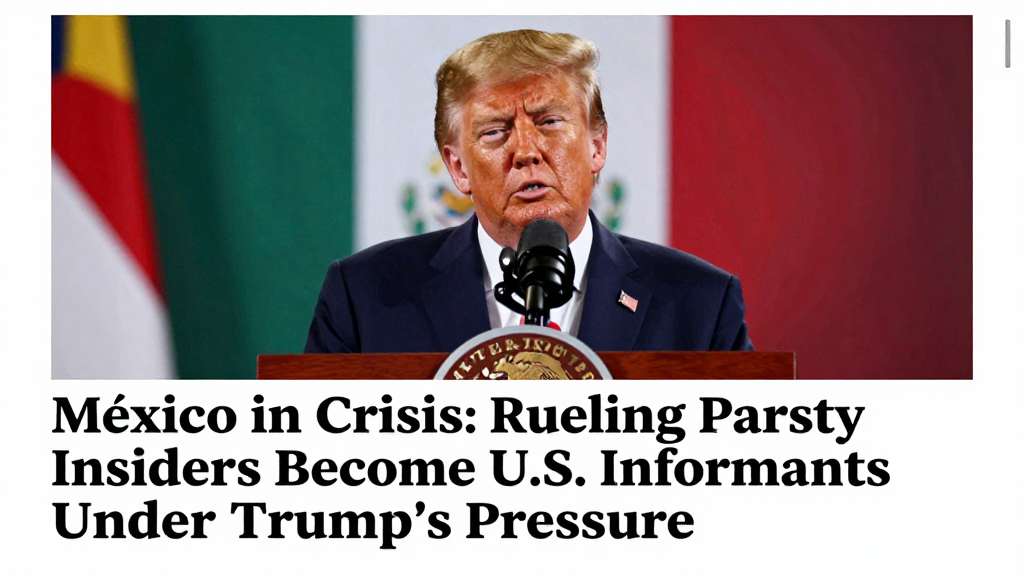
Mexico is facing its most severe diplomatic and political crisis in years after The New York Times revealed on June 27 that at least a dozen high-ranking Mexican officials, predominantly from the ruling party Morena, have been secretly acting as informants for the United States government under the Trump administration. The bombshell investigation describes an unprecedented intelligence network in which governors, legislators, and state officials bypass traditional diplomatic channels to pass sensitive information directly to Washington — a dynamic that has sent shockwaves through Mexico City and exposed deep fractures within President Claudia Sheinbaum’s governing coalition.
The revelations could not have come at a more delicate moment. Sheinbaum has spent months publicly refusing to cooperate with what she calls Washington’s “illegal pressure tactics,” repeatedly insisting that Mexico will not bow to foreign interference in its internal affairs. The existence of a covert informant network operating at the highest levels of her own party undermines that message entirely and threatens to split her coalition apart.
Trump Administration Pressure and the informant Network
According to sources familiar with the operations, the informant network was dramatically expanded under intense geopolitical pressure. The Trump administration has leveraged economic sanctions, aggressive tariffs, and the threat of visa revocations to coerce cooperation from Mexican officials — particularly those ensnared in U.S. investigations into Sinaloa cartel activity and narcotics trafficking.
“At least a dozen elected officials in Mexico — including governors and members of Congress, many from the ruling party — have sought to discuss the handover of information about other politicians,” The New York Times reported. “Several have already initiated conversations with the United States.”
The report names Sinaloa Governor Rubén Rocha Moya among those facing U.S. scrutiny, alongside Senator Enrique Inzunza and former Culiacán Mayor Juan de Dios Gámez. Three former Sinaloa officials — Gerardo Mérida, Enrique Díaz, and Marco Antonio Almanza — have already surrendered to U.S. authorities and are cooperating with prosecutors, according to the investigation. The network is said to include figures from at least four additional Mexican states beyond Sinaloa.
A Crisis of Sovereignty for Sheinbaum
The political fallout inside Mexico has been swift and devastating. Analysts say the revelations strike at the very foundation of Sheinbaum’s sovereignty-first platform, under which she has repeatedly rejected any external pressure as an unacceptable infringement on Mexican independence.
“The closing of ranks in favor of sovereignty that the president is requesting from the top has not found an echo from below,” said Carlos Bravo Regidor, a Mexico City-based political analyst quoted by The New York Times. “Because some people inside the system, instead of supporting the president, are rushing to the United States to save their own skins.”
Ariadna Montiel, the head of Morena’s national leadership, held an emergency press conference in Mexico City on June 28 to reject the report. “Funcionarios mexicanos colaborando con EU como informantes es una narrativa fabricada desde el exterior para destabilizar a México,” she declared, flanked by three of the lawmakers named in the article. All three subsequently issued individual statements denying any contact with U.S. intelligence agencies. The Ministry of Foreign Affairs offered a terser response, saying only that it was “reviewing the veracity of these claims.”
Threats to Joint Operations and Regional Stability
Security analysts have sounded the loudest alarm. The exposure of this network is likely to severely disrupt ongoing joint operations against transnational drug syndicates that have been active for years. At least four active U.S.-Mexican anti-cartel operations have been compromised since the story broke, security sources told the Times, with multiple informants now believed to be in physical danger.
“This is not just a political scandal — it is an operational catastrophe,” said a former senior U.S. Drug Enforcement Administration official who spoke on condition of anonymity. “You cannot run informants inside a cartel-linked government apparatus and then have that network blown open by a newspaper story. People will die.”
Markets reacted with unusual speed. The Mexican peso fell 1.4 percent against the dollar in early trading on June 29 before recovering most of its losses by midday. The country’s diplomatic missions in Washington have requested urgent briefings, according to two people familiar with the planning. Sheinbaum has not made a public statement since June 28.