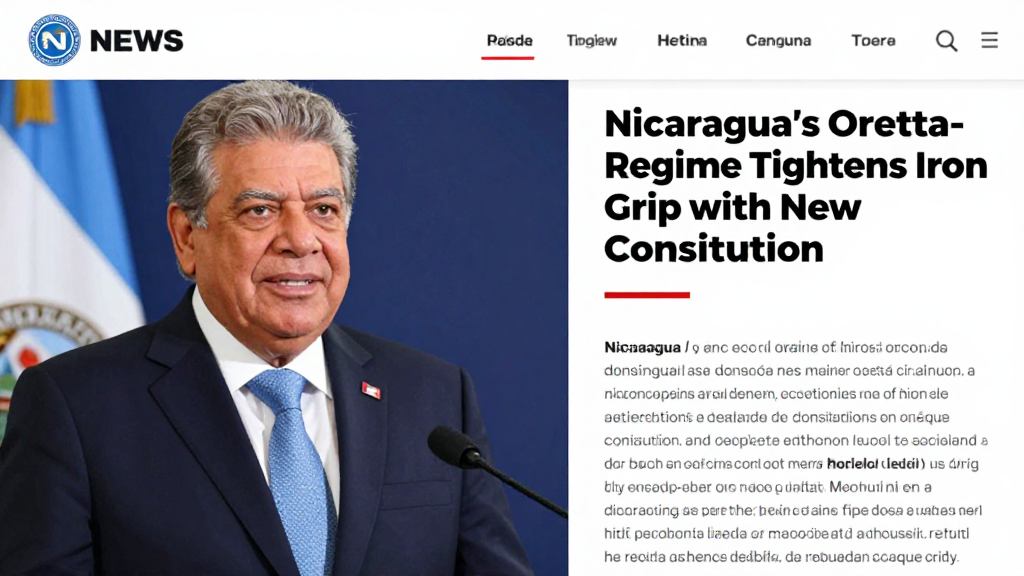
Managua, Nicaragua — In a move that critics say has effectively erased the last vestiges of democratic governance in Central America, the Ortega-Murillo government has rammed through a new constitution that grants the ruling duo unlimited power, dissolves term limits, and turns state institutions into instruments of personal control. The document, quietly enacted in the weeks following massive protests that the regime crushed with lethal force, is being described by human rights organizations as the final nail in the coffin of Nicaraguan democracy.
The constitution eliminates the office of the attorney general, abolishes the constitutional right to challenge presidential succession, and grants the military a permanent, unmonitored budget. It also strips dual citizenship from thousands of Nicaraguans, a direct attack on the diaspora community that has long opposed the dictatorship from abroad.
A Constitution Written Entirely in Ortega’s Hand
The new charter was drafted behind closed doors by a committee loyal to both Ortega and his wife, Vice President Rosario Murillo. No opposition lawmakers were consulted — most have been imprisoned, exiled, or disqualified from office. Independent journalists have been systematically expelled or silenced. The result, observers say, is a document that exists solely to entrench one family’s rule.
There is no precedent for this kind of centralized control in modern Latin American history, said Manuel Orozco, a senior fellow at the Inter-American Dialogue. What Ortega has built is not merely an authoritarian government — it is a dynastic dictatorship with the institutional trappings of a police state.
Exile and Repression as Tools of Control
The human cost of the regime’s consolidation has been staggering. More than 350,000 Nicaraguans have fled the country since 2018, when security forces opened fire on protesters demanding Ortega’s resignation. Those who remain face a choice between silence or exile. The regime has authorized police to detain citizens based on unsubstantiated allegations or hearsay from informants — a legal framework that Human Rights Watch describes as a blank check for political persecution.
Universities have been shuttered or placed under direct state control. Civil society organizations have been forced to disband. The Roman Catholic Church, once a voice of moderate opposition, has seen its properties confiscated and its clergy expelled.
International Sanctions and the Erosion of Civil Liberties
The United States and European Union have responded with escalating rounds of sanctions targeting Ortega, Murillo, and their inner circle. In February 2026, the U.S. State Department sanctioned twelve members of the regime’s security apparatus, including senior police commanders linked to the 2024 crackdown on student protesters. The EU has frozen the assets of forty-three Nicaraguan officials.
Despite the international pressure, the regime shows no sign of moderating. It has deepened alliances with Russia, China, Iran, and Cuba — countries that share its hostility to Western democratic norms and provide it with diplomatic cover at the United Nations. For ordinary Nicaraguans, the daily reality is one of mounting hardship and fear.