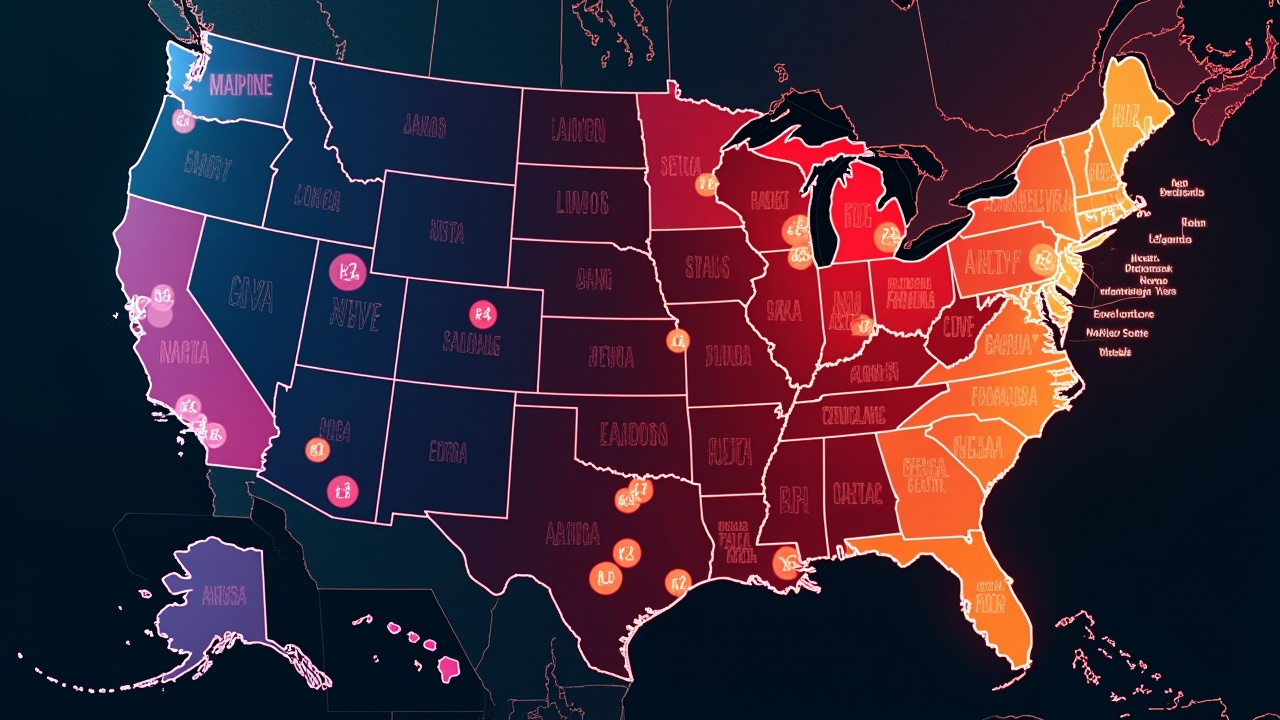
With 34 Senate seats in play and six races rated as pure toss-ups, the path to a 51-seat majority runs through Maine, Michigan, Pennsylvania, Nevada, Wisconsin, and Arizona. Here is where each race stands and what is at stake for both parties.
Democrats currently hold 47 seats in the Senate. Republicans hold 53. With all 34 seats up this cycle, the mathematics of majority control are stark: Democrats need a net gain of four seats to reach 51, while Republicans need to simply hold their defensive lines — a structurally favorable position that party leaders acknowledge is their most significant structural advantage in a generation.
Six races are currently rated as toss-ups by nonpartisan forecasters, and those half-dozen contests will almost certainly determine whether Majority Leader John Thune remains in control or hands the gavel to Senate Minority Leader Chuck Schumer. The remaining 28 seats are rated Likely or Safe for their respective parties, with limited room for upsets.
Republican incumbent Susan Collins is seeking her sixth term in a state that voted Democratic by 10 points in 2024. Collins has survived in Maine for three decades by running well ahead of her party in federal races, a brand of institutional moderation that has insulated her against national tides. Democrats have struggled for years to recruit a top-tier challenger, but this cycle the national environment — and the prospect of a potential Democratic wave in a D+10 state — has changed the calculus. If the national mood is D+6 or wider, even Collins’s legendary incumbency advantage may not be enough.
Democrat Debbie Stabenow’s retirement leaves Michigan’s open Senate seat as one of the most competitive races on the board. The seat is currently held by Democrats, but the winner of the November election will be a first-term senator in a state that remains genuinely competitive. Both parties view Michigan as a must-hold for Democrats and a prime pickup target for Republicans. The primary is set for August, and both parties have multiple declared candidates. Fundraising totals and early polling suggest a competitive general election regardless of which nominees emerge.
Republican incumbent Dave McCormick is defending his seat in a state that voted Democratic in 2024 and 2020, a persistent structural challenge for Republicans downballot. McCormick won in 2024 by fewer than two points in a cycleboosted by Donald Trump’s presence at the top of the ticket. With Trump off the ballot, Democrats believe Pennsylvania’s suburban voters — who drifted Republican in the Trump era — will drift back. McCormick’s polling and fundraising numbers suggest a competitive but defensible race for Republicans, but the national environment will be the decisive variable.
Democratic incumbent Jacky Rosen won her 2022 race , a large tourism and service-sector workforce with unpredictable turnout patterns, and a growing population that does not always translate into durable Democratic margins. Rosen’s campaign is building a broad coalition, but Republicans are investing heavily in a state they believe is winnable with the right candidate and the right environment.
Democratic incumbent Tammy Baldwin won in 2018 by 11 points in a cycle that favored Democrats broadly. Wisconsin in 2026 will be a much harder lift. The state voted Republican in 2024 and 2016, and its political environment has been shaped vironment and a well-funded Republican challenger makes this race one of the cycle’s most uncertain.
Democrat Ruben Gallego is running for the seat left open by fellow Democrat Kyrsten Sinema’s retirement, making this an open-seat race with no incumbent. Arizona’s political trajectory has been trending competitive — it voted Democratic in 2020 and 2024 — but its non-college voter population and border geography create durable Republican crossover appeal. Gallego, a former Marine and congressman, enters as the Democratic frontrunner but will need to clear a competitive primary before facing a Republican nominee who has not yet been determined. The race is emblematic of Arizona’s broader identity struggle as a swing state in transition.
One additional variable is testing whether the map could shift in unexpected ways: former Democratic Senator Sherrod Brown of Ohio, who lost re-election in 2024 to Republican Bernie Moreno by four points, is running again in a special election for the seat vacated when JD Vance became Vice President. Jon Husted, appointed to fill Vance’s seat, is the Republican incumbent. If Brown wins, Democrats would gain a seat that was not on the original 2026 map — a potential game-changer that would alter the arithmetic for both parties significantly.
Senate Minority Leader Chuck Schumer has aggressively recruited Brown, signaling that Democrats view Ohio as a top-tier pickup opportunity. The race will be decided in November alongside the other 33 seats, and its outcome may not be known for days after election night due to Ohio’s mail ballot counting procedures.
Compounding the Senate map complexity: 36 governor’s races are also on the ballot in 2026, including in six of the seven key presidential battleground states. These races will not directly determine Senate control, but they will shape the redistricting battles of the decade ahead and provide early signals about the broader electoral mood. Democrats scored notable wins in New Jersey and Virginia governor’s races in 2025; 2026 will test whether that momentum holds or reverses as Trump fatigue — or Trump enthusiasm — dominates the narrative in each state.
The 2026 Senate map presents Democrats with their most structurally challenging defensive landscape in decades: 20 seats in play against just 14 for Republicans. A net gain of four seats requires Democrats to hold every seat they currently occupy in states Trump won — including Wisconsin, Michigan, Nevada, and Pennsylvania — while simultaneously flipping at least four Republican-held seats in states that voted Democratic. The Sherrod Brown special election in Ohio adds an unexpected variable that could simplify or complicate that path depending on its outcome. In a cycle where the national environment will likely be the dominant variable, the six toss-up races will determine not just control of the Senate but the trajectory of the Trump administration’s second-term agenda in the legislative arena.
Written by Victoria Hayes, Senior Analyst
Victoria Hayes
Victoria Hayes is a senior analyst covering policy and institutional dynamics.