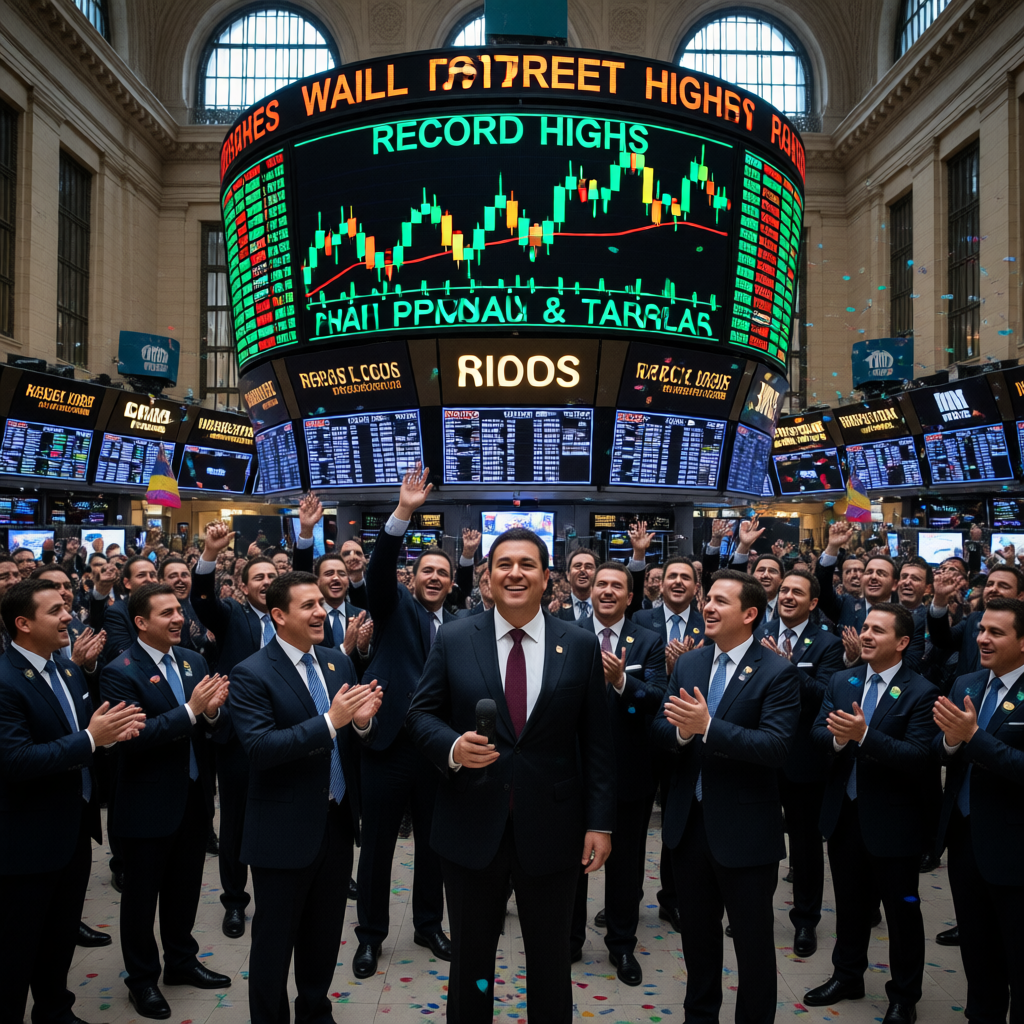
Wall Street pushed to a fresh round of records on Monday as investors read a long-awaited U.S.-Iran memorandum of understanding as the end of a geopolitical risk premium that has weighed on the tape since March. The Dow Jones Industrial Average added 468.77 points, or 0.92%, to close at 51,671.03 — a new all-time high and the first close above 51,600. The S&P 500 climbed 1.65% to 7,554.29, and the Nasdaq Composite jumped 3.07% to 26,683.94, its best session since March 31. The advance was broad: technology, energy and transports all closed in the green, and the rate-sensitive complex — homebuilders, regional banks, utilities — caught a bid as Treasury yields pulled back from last week’s spike.
The Iran trigger
President Donald Trump said late Sunday on social media that a deal with Iran was “now complete.” The memorandum of understanding has been signed electronically, a senior administration official told CNBC, and will be formally signed on Friday in Switzerland, according to Pakistan Prime Minister Shehbaz Sharif, who helped broker the framework. Vice President JD Vance told CNBC on Monday that the Strait of Hormuz, the chokepoint that handles roughly a fifth of global seaborne oil, will be opened “in a toll-free way for the long term.” The combination of a political settlement and an open waterway explains why oil fell as much as the equity market rallied: West Texas Intermediate crude dropped 4.9% to $80.75 a barrel, the lowest close since the run-up to the March Strait closure.
What the curve is saying
Bond markets confirmed the equity tape. The 10-year Treasury yield eased to 4.18%, the 2-year held at 3.94%, and the 2s/10s curve bull-steepened by about four basis points on the day. Federal funds futures, which had been pricing a near-zero probability of a June cut, now show roughly 60% odds of a hold and 40% odds that the Federal Open Market Committee uses its post-meeting statement to open the door to a September move. That is a meaningful shift in less than 24 hours: the front of the curve is now pricing relief rather than reacceleration. Brian Mulberry, chief market strategist at Zacks Investment Management, called the move a “strong signal, given that this is an FOMC week, that we don’t need to raise rates.”
Sector read-through
Two names did the heavy lifting on the day. SpaceX, fresh off a 19% pop in its public-market debut on Friday, added another 19% in its second session and is now the most valuable newly-listed company in U.S. history. Index inclusions are queued: Russell adds SpaceX on June 26, MSCI roughly ten trading days after the IPO, and the Nasdaq-100 fast-tracks inclusion about fifteen days after listing. Goldman Sachs, the lead-left bank on the SpaceX offering, climbed about 1.5% on the day, building on the 2.6% jump it logged Friday. DoorDash, which has direct exposure to fuel costs, jumped 11%. Energy was the one clear laggard: with crude down nearly 5%, the S&P 500 Energy Index fell 1.8% as traders priced in lower future free cash flow for the majors.
The global read-through
Asia caught the bid in the overnight session. Japan’s Nikkei 225 closed up 1.8% led by industrial and shipping names that benefit from a reopened Strait of Hormuz, while the broad Topix added 1.4%. Hong Kong’s Hang Seng jumped 2.1%, with energy and financials pacing the gains and a softer U.S. dollar pulling the Hong Kong Monetary Authority’s linked exchange rate band toward the strong-side intervention point. Europe was green at the open: the Stoxx Europe 600 was last up 1.2%, with the FTSE 100 adding 0.9% on a strong showing from oil majors and banks, the DAX up 1.4% on autos and industrials, and the CAC 40 gaining 1.1%. The MSCI All-Country World Index was on track for its best single-session gain since the immediate post-pandemic rebound, and emerging-market currencies rallied broadly as the dollar index slipped to a one-month low.
What to watch this week
Three prints will decide whether Monday’s tape is a one-day re-rating or the start of a durable risk-on regime. First, the May retail sales report on Tuesday — consensus is for a 0.3% headline gain and a stronger core, but gasoline’s contribution will be negative given the oil price drop. Second, the June Philadelphia Fed manufacturing survey on Thursday; a print above 8 would suggest the soft-landing narrative is intact, while anything below zero would revive stagflation fears. Third, the Fed’s preferred inflation gauge, the May personal consumption expenditures price index, on Friday. A core PCE print of 0.15% month-over-month or lower would lock in market expectations for a September cut and put a 3.50% policy rate back in play by year-end. With Iran, the curve and the Fed all moving in the same direction at the same time, the trade is no longer whether the soft landing holds — it is how quickly the Fed can validate the price action without reigniting the inflation it has spent three years fighting.