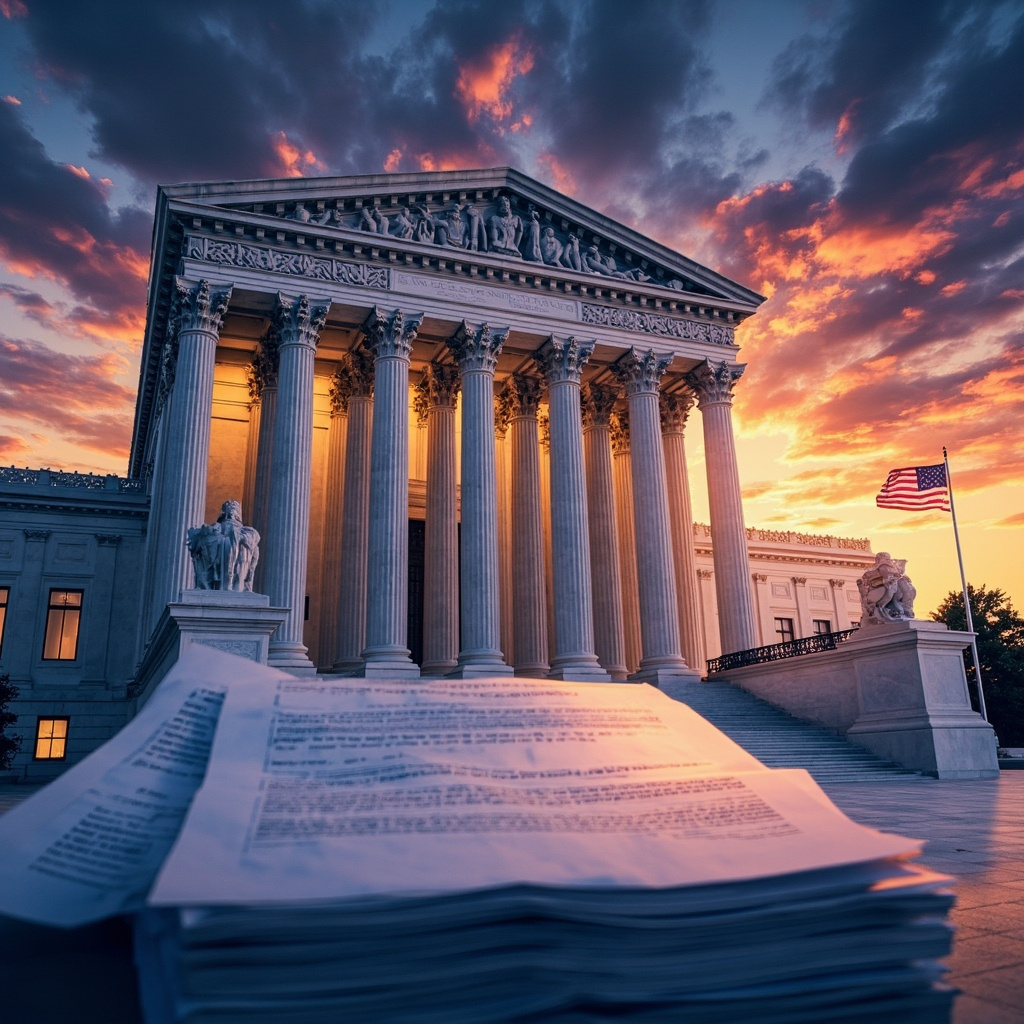
A 6-3 Majority Strips Protections for 350,000 Haitians and 6,100 Syrians
The Supreme Court delivered two sweeping victories to President Donald Trump on Thursday, clearing the way for his administration to terminate Temporary Protected Status for hundreds of thousands of immigrants from Haiti and Syria in rulings that could reshape the legal landscape for humanitarian immigration protections across the entire country.
By a 6-3 vote in Mullin v. Doe, the justices reversed lower courts that had temporarily blocked the administration’s actions, ruling that federal law broadly bars judicial review of TPS termination decisions made by the Secretary of Homeland Security. The court’s three liberal justices — Elena Kagan, Sonia Sotomayor, and Ketanji Brown Jackson — dissented in sharp terms.
The decision authored by Justice Samuel Alito found that the TPS statute’s prohibition on reviewing “any determination . . . with respect to the . . . termination” of a TPS designation is “plain” and “very broad,” covering not just the final decision but every step in the chain of events leading up to it. The ruling explicitly rejected equal protection challenges from Haitian TPS holders who argued the termination was motivated by racial animus, in violation of the Fifth Amendment’s guarantee of equal protection under the law.
“The current administration, which has terminated every TPS designation that has come up for renewal, simply opposes the TPS program, at least as it has been implemented in the past,” Alito wrote, saying that rationale alone was enough to defeat the racial animus claim without reaching the question of whether it was a motivating factor in Noem’s decision.
What the Dissenting Justices Said
Justice Kagan, writing for the dissent, was unsparing in her critique of the majority’s approach. She noted that the TPS beneficiaries were not asking the court to block the termination outright — only to allow them to remain in the United States while their legal challenges continue.
“They are entitled to that relief, and should not instead be consigned to devastating, and indeed life-threatening, injury,” Kagan wrote, in an opinion joined by her two colleagues on the left of the bench. “At this stage of the litigation, the Haitian and Syrian TPS beneficiaries ask for only one thing: that they may stay in this country while they continue to litigate their claims.”
The TPS program, enacted by Congress in 1990, allows the Department of Homeland Security to permit foreign nationals to remain and work legally in the United States when conditions in their home countries — natural disasters, armed conflicts, or other extraordinary circumstances — make their return unsafe. Haiti received its designation in January 2010 following a magnitude 7.0 earthquake that killed more than 300,000 people and caused catastrophic damage across the island nation. Syria was added in 2012 as civil war engulfed the country under President Bashar al-Assad. Both designations were repeatedly extended over the years until former Homeland Security Secretary Kristi Noem announced their termination in 2025, declaring that continued protection was “contrary to the national interest.”
Broader Implications for the Immigration System
The rulings carry implications far beyond Haiti and Syria. The court’s sweeping interpretation of the judicial review bar means similar challenges to TPS terminations for any of the 17 countries currently or formerly designated under the program would face the same nearly insurmountable barrier. Trump had already secured a court order last year allowing the termination of TPS for hundreds of thousands of Venezuelan immigrants, and administration officials have signaled they intend to press forward with ending designations for additional countries in the coming months.
Beyond TPS, the rulings reinforced a broader pattern of judicial deference to the executive branch on immigration matters. A second decision authored by Alito on Thursday upheld the administration’s authority to revive a policy known as “metering” — turning away asylum seekers at the U.S.-Mexico border when federal officials determine the system is too overwhelmed to process additional claims. The administration had used metering during Trump’s first term before President Joe Biden discontinued the practice early in his administration.
For the hundreds of thousands of Haitian and Syrian TPS holders already in the United States — many of whom have lived and worked in the country for more than a decade, built businesses, raised families, and established deep community ties — the rulings mean their legal status is now in immediate jeopardy. Unless Congress moves to shield them through legislation, they will eventually face deportation to countries still beset by endemic violence, political instability, and, in Haiti’s case, a near-complete collapse of central governance following years of intensifying gang warfare. What comes next for the TPS program as a whole remains one of the most consequential open questions in American immigration law, and the Supreme Court’s rulings Thursday suggest that Congress — not the courts — will have to be the one to answer it.