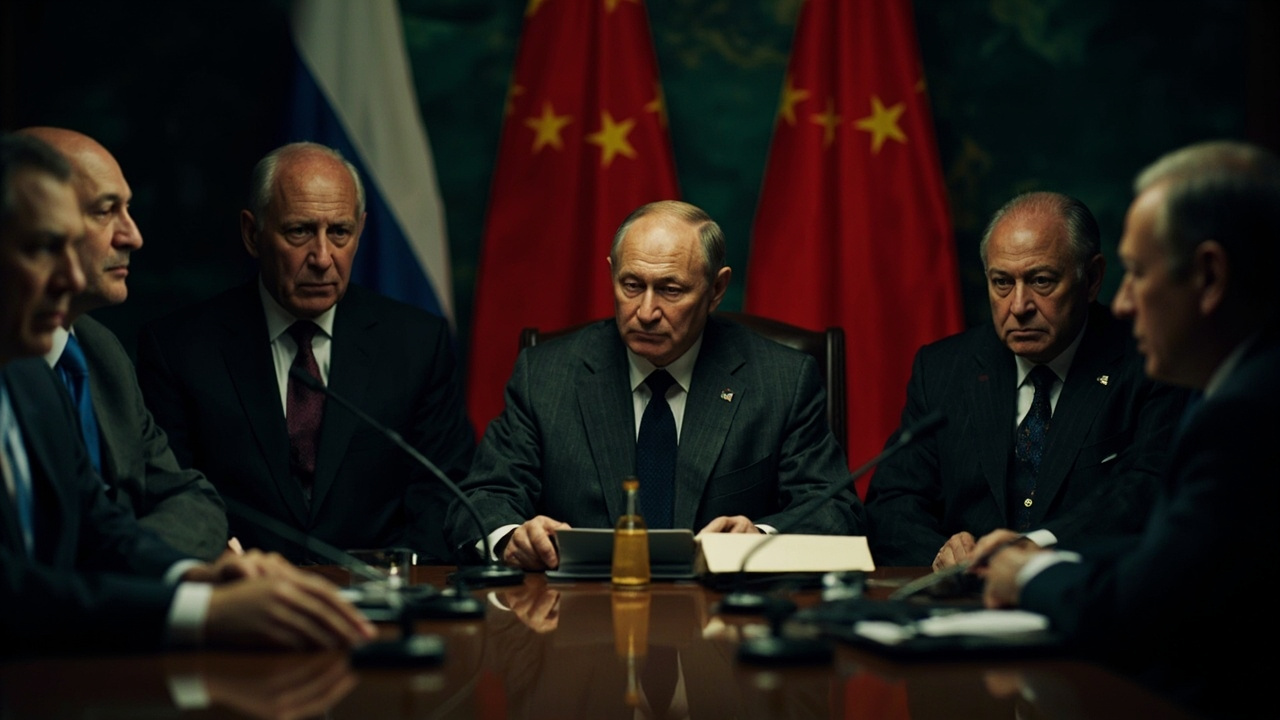
By spring 2026 three nations with very different histories have found common cause in a shared opposition to American hegemony. Russia, China, and Iran have quietly built a web of economic, military, and diplomatic ties that is reshaping the international order in ways that go far beyond their stated grievance with Washington.
The numbers are striking. Russian-China bilateral trade reached 245 billion dollars in 2025, up from 140 billion in 2020. Iranian oil flows to China through an expanding network of intermediary companies. Russian military equipment to Iran includes air defense systems and fighter aircraft components. Iran provides Russia with drones, missiles, and intelligence. China provides the financial infrastructure through banks and payment systems, bypassing American sanctions enforcement.
The Architecture of the Alignment
The Russia-China-Iran alignment is not a formal military alliance. It has no Warsaw Pact equivalent, no unified command structure, no shared ideology. What it has is a constellation of overlapping interests that reinforce each other at every pressure point where American foreign policy applies leverage. Russia opposes NATO expansion. China contests American naval dominance in the Indo-Pacific and technology restrictions on Huawei and semiconductor access. Iran opposes American sanctions and the regional security architecture in the Middle East.
The BRICS grouping has become the primary multilateral vehicle. The expanded BRICS now includes Egypt, Ethiopia, Iran, and the UAE alongside Brazil, Russia, India, China, and South Africa. It represents 37 percent of global GDP and 45 percent of the world population. The new BRICS payment system, launched at the Kazan summit in October 2024, provides a SWIFT-independent channel for cross-border transactions. In the first six months it processed 180 billion dollars in trade settlements.
The architecture of a multipolar world is not being built from scratch. It is being assembled from existing materials: dollar-independent payment systems, regional security arrangements, supply chains that bypass American technology, and diplomatic coalitions that can sustain a veto in the Security Council.
— Dr. Fyodor Lukyanov, Chairman, Council on Foreign and Defense Policy, Moscow, 2026
Energy as the Glue
Energy is the most concrete element binding this alignment. Russia is the world largest natural gas exporter. Iran holds the second-largest natural gas reserves and fourth-largest oil reserves. China is the world largest energy importer. The 30-year gas contract signed between Russia and China in 2024, valued at an estimated 400 billion dollars over its lifetime, created the most significant long-term energy linkage between the two countries. It guarantees Russia a stable eastern market while giving China a hedge against disruption risk from American naval power.
The era in which America could shape outcomes simply by controlling the dominant currency and the primary security guarantor is drawing to a close. What replaces it is not a new hegemon but a more contested and turbulent international order where the rules that govern trade, security, and technology are decided through competition rather than American decree.
— Dr. Li Wei, Center for International Strategy and Development, Peking University, 2026
The Limits of the Alignment
Despite its growing significance this alignment has genuine limits. China is deeply integrated into the American economy through trade and investment flows that dwarf its Russian and Iranian business combined. Beijing has been careful not to provide weapons to Russia for use in Ukraine. China is playing a longer game than Russia or Iran, one that benefits from maintaining functional economic relations with Europe and Southeast Asian markets even as it hedges against American containment.
Russia and Iran have a more transactional relationship. They cooperate where interests overlap but have fundamentally different strategic cultures, resources, and time horizons. Russia is a great power pursuing regional dominance in Eastern Europe. Iran is a revolutionary regional power with ambitions confined to the Middle East but a willingness to accept costs and risks that more cautious powers will not absorb. Their alignment is real but it is not a marriage. It is a tactical partnership that will fray when the common enemy recedes or when their interests diverge.
The Bottom Line
The Russia-China-Iran alignment represents the most significant challenge to American global leadership since the Cold War. It is not an existential threat to American power. The United States retains enormous advantages in technology, military capability, and the attractiveness of its society and economy. But the era in which American preferences could be translated into international rules through unilateral action and the dollar reserve currency status is ending. What comes next requires a more sophisticated American grand strategy: one that competes where it must, cooperates where it can, and rebuilds the domestic foundations of American power that have been eroding for two decades.
David Foster is a Senior Analyst for Media Hook, specializing in geopolitical analysis, economic trends, and the forces reshaping the global order.