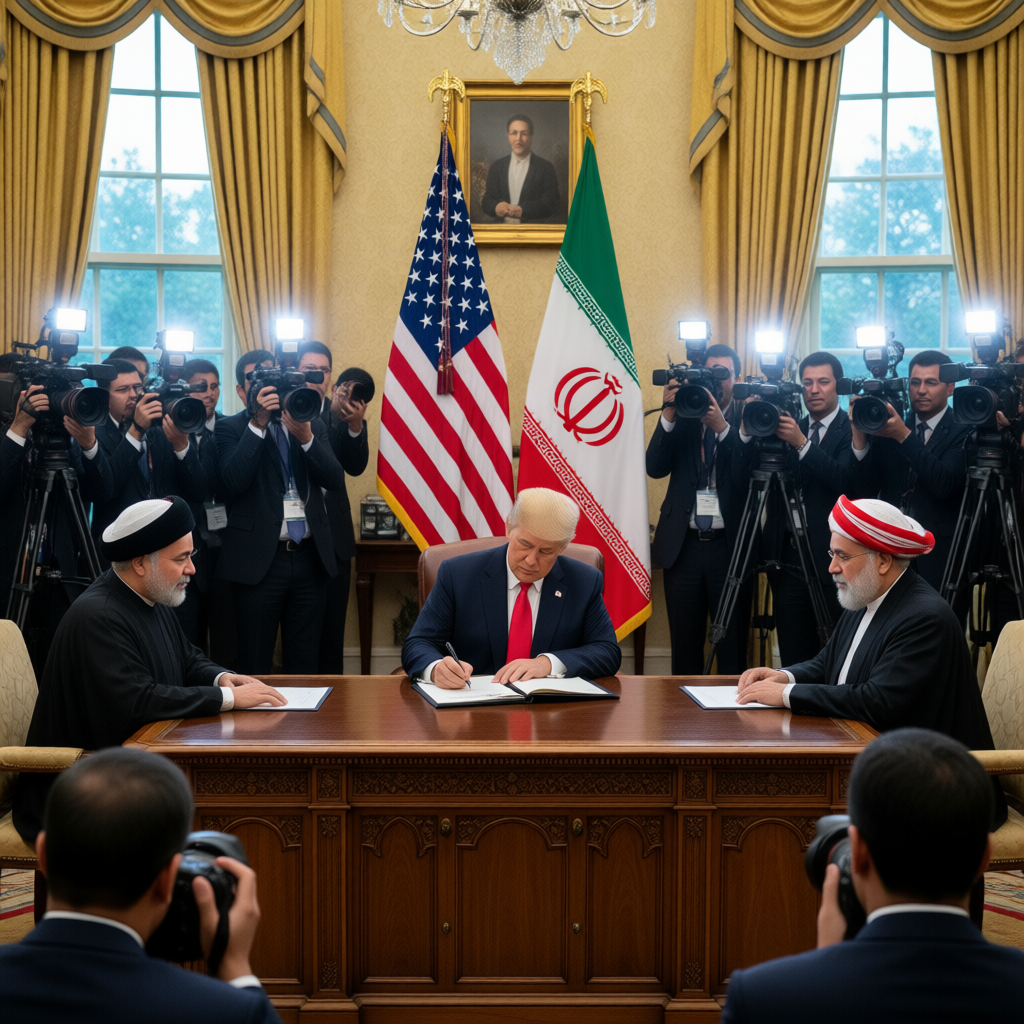
Trump says the war is over. Iran says almost the same thing. The text isn’t signed yet.
A U.S.-Iran memorandum of understanding announced late Sunday has put the four-month war on what both governments are calling a glide path to formal peace, but the agreement that shook global markets on Monday is, in concrete terms, still a deal about a deal. The memorandum has been finalized but not signed. It has not been released in full. The Strait of Hormuz — the chokepoint through which roughly a fifth of the world’s oil moves — remains formally closed. And the country that has been bombing alongside the United States since the first night of the war, Israel, is not a party to the framework at all.
President Donald Trump used Truth Social on Sunday night to declare a toll-free reopening of the strait and the “immediate removal” of the U.S. naval blockade, telling shippers around the world to “start your engines.” Iran’s deputy foreign minister, Kazem Gharibabadi, confirmed the same set of commitments in a parallel statement, saying the text had been finalized and would be signed Friday in Geneva under Pakistani mediation. Both governments have agreed to extend the existing ceasefire for 60 days to create a working framework for the harder negotiations that follow: Iran’s nuclear program, the release of frozen Iranian funds, regional security architecture, and the disposition of Iranian-backed militias from Lebanon to Yemen.
What the deal actually commits to — and what it doesn’t
What the two sides have agreed to, on the record, is narrow: a permanent and immediate end to hostilities on all fronts, a Friday reopening of the strait, the stand-down of the U.S. naval blockade, and a 60-day window for follow-on talks. What they have not agreed to is anything on paper about Iran’s uranium enrichment capacity, the fate of the $6 billion to $9 billion in Iranian funds frozen in third-country accounts, or the future of the IRGC’s regional proxy network. Trump told The New York Times on Sunday that the United States reserved the right to resume strikes if the nuclear track fails. Gharibabadi said the 60-day nuclear track could not begin at all until the frozen funds are released. The U.S. side publicly dismissed that condition.
The result is a deal whose strongest provisions are about de-escalation and whose hardest provisions are deferred. Verisk Maplecroft’s Torbjorn Soltvedt called the structure “an extension of the ceasefire, not yet a settlement.” That distinction matters enormously for the oil market, which repriced the strait reopening within minutes of the Sunday announcement, and for Capitol Hill, which is being asked to take the diplomatic track on faith while the underlying confrontation is, in the working language of the administration itself, merely paused.
The Friday signing in Geneva — who shows up will tell us a lot
Tehran has not released an attendee list. Iranian Foreign Minister Abbas Araghchi, who led the negotiating team under Pakistani mediation, is the most likely senior signatory. Iranian parliamentary speaker Mohammad Bagher Ghalibaf has been mentioned in Tehran press, but his presence would be a tell: hardliners in the Majles have publicly opposed any deal that leaves the IRGC under sanctions. A Ghalibaf no-show would narrow the domestic Iranian political base for the agreement to Araghchi and the foreign ministry alone, which has historically been a fragile foundation for sustaining concessions to Washington.
On the U.S. side, the working assumption inside the State Department is a sign ceremony led by Special Envoy Steve Witkoff and a senior Iranian counterpart, with the Pakistani and Qatari foreign ministers flanking as mediators. Qatar on Monday formally welcomed the deal, citing freedom of navigation in the strait. That gives the signing the look of a four-party diplomatic event, with the United Nations informed but not in the lead. The danger of a low-wattage Geneva signing is that it gives critics in both Washington and Tehran ammunition: hawks will say there is no enforceable text, and Iranian hardliners will say the foreign minister overstepped his mandate.
Israel is the wild card — and it is not at the table
Israel has been a combatant in this war since the first U.S. and Israeli strikes on February 28. It is not a signatory to the memorandum. Israeli Defense Minister Israel Katz said Monday that the Israel Defense Forces would remain in the security zones they hold in southern Lebanon, Gaza, and Syria, and that Israel would retaliate against any Iranian response to Israeli operations in Lebanon. Gharibabadi claimed Sunday that the “permanent and immediate end to the war” he announced includes Lebanon; Israel has not accepted that formulation. Earlier in the war, Israeli strikes on targets in Lebanon repeatedly tested the ceasefire’s tolerance.
The structural problem is that any U.S.-Iran deal premised on quiet on the Iran-Lebanon border assumes an Israeli restraint Israel has not agreed to. The Trump administration will need to either bring the Netanyahu government into the diplomatic frame in the next 60 days or build a quiet bilateral channel to keep Israeli operations from collapsing the nuclear track. Neither has been confirmed. If Israel strikes a Hezbollah target in the next week, the Friday signing in Geneva could be signing a document the Middle East has already made obsolete.
What the next 60 days actually have to deliver
Three things have to land inside the 60-day framework for the deal to be more than a market rally. First, a verifiable understanding on enrichment — not a final agreement, but a working inspection regime that the IAEA can sign off on. Second, the unfreezing of the Iranian funds, with a release mechanism that survives a Treasury Department sanctions review. Third, an Israeli understanding, formal or informal, on the operational limits in Lebanon during the negotiation window. None of the three has a public working group yet.
What is also not in the text is anything on the U.S. domestic political reaction. The administration is briefing Congress this week. House Intelligence and Foreign Affairs members from both parties have been publicly skeptical of any deal that leaves Iran’s enrichment capacity intact, and the Senate Foreign Relations Committee has signaled it will want a formal read-out before Friday. The 60-day clock starts when the memorandum is signed in Geneva. If Congress treats that clock as a deadline rather than a working window, the leverage shifts back to the hardliners on both sides — and the Strait of Hormuz, which the markets have already priced as open on Friday, becomes the first casualty of a deal that could not survive its own extension.