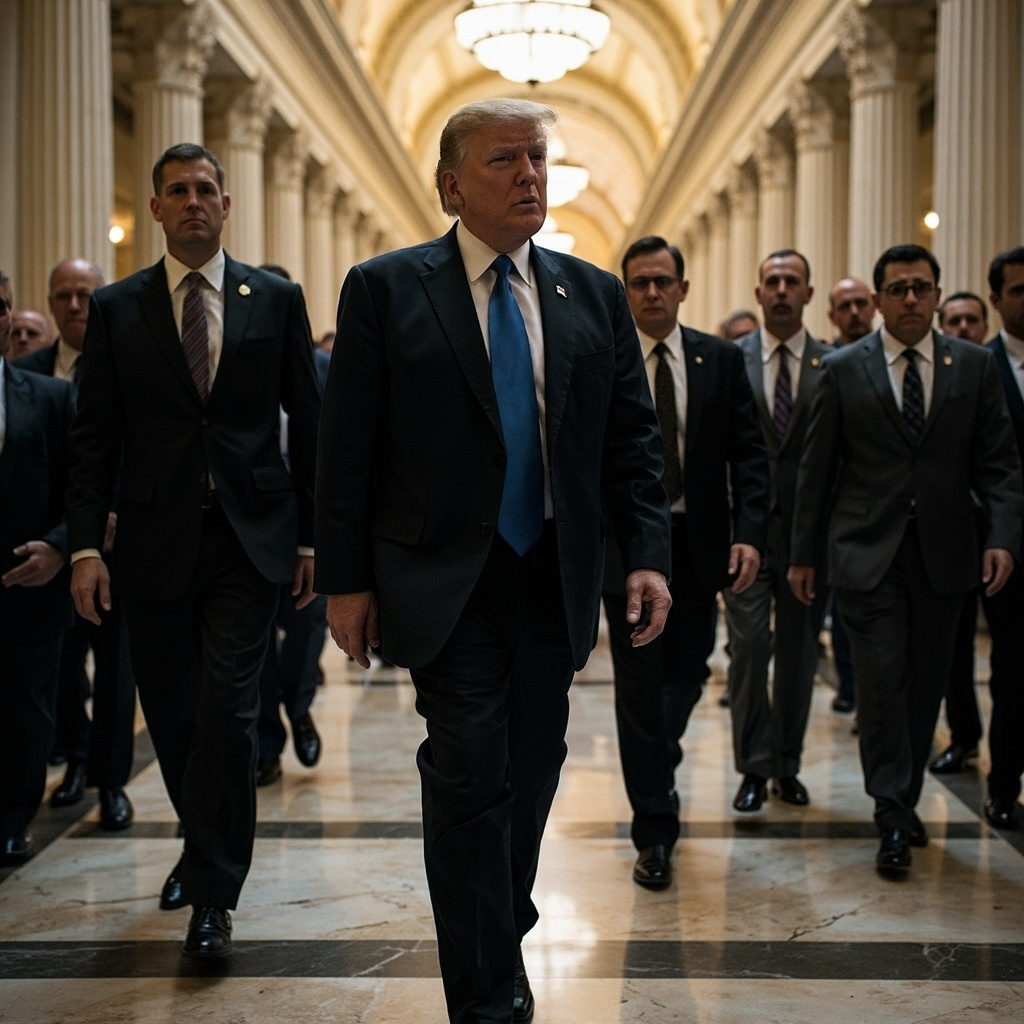
The United States Senate descended into open confrontation Wednesday evening as President Donald Trump descended on Capitol Hill for a closed-door lunch with Republican senators, transforming what was supposed to be a discussion of a bipartisan housing bill into a bitter clash over the Iran war and Congress’s constitutional authority to check executive military power. Within hours, the Senate voted 47-50-1 to block a war powers resolution championed by Democratic Senator Tim Kaine of Virginia — a dramatic reversal from a procedural vote just days earlier that had briefly signaled bipartisan resolve to restrain the White House. The outcome delivered Trump a significant political victory and underscored the extraordinary pressure the president is willing to apply to keep his caucus in line.
A Lunch That Erupted Into a Shouting Match
The day’s most remarkable scene unfolded inside the Senate Republican conference lunch, where Trump arrived expecting to discuss the SAVE America Act and a bipartisan housing package. Instead, the conversation quickly turned to Iran — a conflict the administration launched in January that has now dragged on for four months without achieving its original stated objectives. Louisiana Republican Senator Bill Cassidy, who had been one of the architects of the earlier war powers resolution, stood up and confronted the president directly. He recounted telling Trump that the war was supposed to last four weeks, had now lasted four months, and that the administration’s original objectives had not been achieved. Cassidy acknowledged that he lost his temper during the exchange. When pressed by reporters whether Trump had called him a lunatic, Cassidy offered a resigned response: “Can I imagine that the president called me things that would be said on the school, on the playground? Yeah, I can imagine that.”
Trump did little to dispel the confrontation narrative on his way out. He told reporters they had a really great meeting and liked everyone in the room, then added: “I don’t like a few people, but that’s OK.” The president made clear he wanted Republican senators to abandon the Kaine resolution, a measure that would have directed the removal of U.S. forces from hostilities in or against Iran unless explicitly authorized by Congress. The White House dismissed the earlier Senate vote advancing the resolution as a matter of no significance, but the administration’s aggressive lobbying effort suggested a deeper concern about the precedent Congress was attempting to set.
Two Republican Senators Reversed Course Under White House Pressure
The two Republican defections that sealed the resolution’s defeat were themselves a measure of how thoroughly Trump had reasserted control. Bill Cassidy, who had co-sponsored the war powers measure and voted to advance it in a prior procedural vote, received a private briefing at the White House from Vice President JD Vance and Special Envoy Steve Witkoff. He returned to the Senate floor and voted against the resolution. He posted on social media afterward: “I want to thank Vice President Vance and Special Envoy Steve Witkoff for the thorough briefing this afternoon on Iran. I appreciate the quick invitation to the White House to address many of my concerns.”
Senator Rand Paul of Kentucky switched from a yes vote to present. Paul said his change was designed to give Trump diplomatic breathing room. He posted on X: “My opinion on the debate over war and executive power has not changed and I have voted that way several times. But since hostilities seem to be over and the President asked me to give consideration to his negotiating position, I will do so. My vote of present is a way to give the President more space and leverage to negotiate a lasting peace.” The only Democrat to break ranks was Senator John Fetterman of Pennsylvania, who voted against the resolution. All other Democrats supported it. Republican Senators Susan Collins and Lisa Murkowski continued their support, breaking with the rest of their conference. The Senate’s final tally of 50-47, with one present vote, fell short of what would have been needed in the House.
Congressional Democrats Vow the Fight Is Not Over
Senator Tim Kaine condemned the reversal in blunt terms. “The president tried to browbeat Republican senators for upholding their oaths of office,” he said. “To appease his temper tantrum, Republicans agreed to defeat a superfluous motion to proceed to a separate War Powers Resolution currently pending before the Senate. The vote is of no consequence and does not undo the expressed position of Congress that further war against Iran is illegal unless Congress votes for it.” Kaine’s language reflected a broader Democratic argument that Wednesday’s vote did not resolve the underlying constitutional question of whether the executive branch can sustain military operations without explicit congressional authorization under the War Powers Resolution of 1973.
The vote came as the Senate prepared to adjourn for a two-week recess. For the White House, the reversal reinforces Trump’s ability to move votes through personal engagement. For critics in both parties, it signals that even a narrow bipartisan opening on war powers can be closed quickly under sufficient political pressure. What happens when Congress returns — and whether another resolution, new intelligence briefings, or shifting battlefield conditions changes the political math — remains the central unresolved question surrounding America’s ongoing role in the Iran conflict.