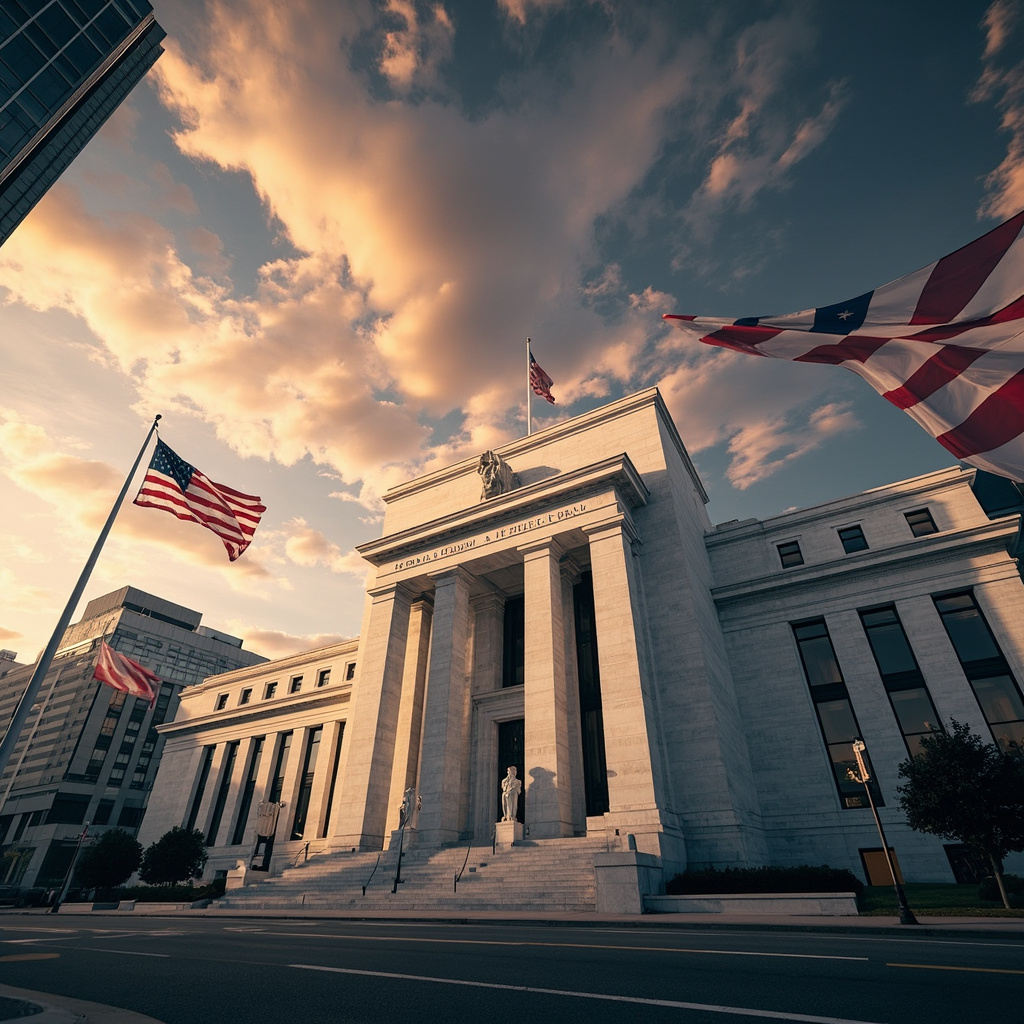
The United States economy expanded at an annualized rate of 1.8 percent in the second quarter of 2026, the Bureau of Economic Analysis reported Wednesday, a deceleration that confounded Wall Street expectations and intensified debate over whether the Federal Reserve should be cutting interest rates to forestall a more pronounced slowdown.
The reading marked the third consecutive quarter of below-trend growth and came alongside data showing the unemployment rate ticked up to 4.3 percent, the highest since early 2022. PCE inflation, the Fed’s preferred gauge, held steady at 2.7 percent on an annual basis, leaving policymakers in a difficult position: an economy that is losing momentum but with price pressures still running above the central bank’s 2 percent target.
Markets Sell Off on Growth Scare
Equity markets fell sharply following the data release, with the S&P 500 dropping 2.1 percent and the Nasdaq Composite losing 2.8 percent as investors reassessed the economic outlook. The yield on the two-year Treasury note fell to 3.94 percent from 4.12 percent the previous day, as traders priced in a higher probability of an emergency rate cut or an outsized reduction at the September FOMC meeting.
“The U.S. economy is not in freefall, but the forward momentum has clearly shifted,” said Jerome Lansner, chief U.S. economist at Barclays. “If the labor market continues to soften at this pace, the Fed will face mounting pressure to act preemptively rather than wait for a full-blown recession.”
Fed Faces Growing Dilemma
The Federal Reserve held its benchmark interest rate steady in the 5.25 percent to 5.50 percent range at its most recent meeting, with Chairman Kevin Warsh signaling that the central bank needed more confidence that inflation was returning to target before cutting borrowing costs. The FOMC statement acknowledged “solid” job gains but added language noting that “the direction of the data has become less clear.”
Federal Reserve Bank of Atlanta President Raphael Bostic told reporters that he remained comfortable with holding rates steady for now, citing the resilience of consumer spending and the strong labor market as reasons for patience. “We are in a data-dependent posture and we will continue to weigh all incoming information carefully,” Bostic said, adding that he saw no compelling case for moving rates in either direction at the present time.
Trade Tensions Compound Uncertainty
The below-trend growth reading arrives against a backdrop of escalating trade tensions. The Trump administration imposed sweeping new tariffs on imports from the European Union, China, Japan, and South Korea earlier this year, prompting retaliatory measures from trading partners. The EU has targeted approximately $360 billion in U.S. exports, while China has restricted imports of American agricultural goods and technology components.
The Peterson Institute for International Economics estimated that the current tariff regime, if sustained, could subtract between 0.4 and 0.7 percentage points from U.S. GDP growth over the next twelve months. “The cumulative drag from trade policy uncertainty and higher input costs is beginning to show up in the hard data,” said Maryln Wentz, a senior fellow at PIIE. “Businesses are postponing investment decisions and consumers are pulling back on big-ticket purchases.”
Outlook for Monetary Policy
Futures markets are now pricing in roughly a 62 percent probability of a 25 basis-point cut at the September meeting, up from 38 percent before the GDP release, according to the CME FedWatch Tool. A growing contingent of analysts is arguing that the risks to the economy are now skewed toward doing too little rather than too much.
“The Fed has a narrow window to cut rates and still be seen as proactive,” said David Kert, chief economist at Deutsche Bank. “If they wait until the labor market is clearly deteriorating, they will have to move more aggressively and that could unsettle financial markets even further.”
Core PCE is expected to remain sticky in the near term, with particular upward pressure from shelter costs and services inflation that has proven resistant to the cumulative tightening of recent years. The Fed’s own projections, last updated in June, showed the median FOMC member expecting two rate cuts by year-end, but those forecasts are now being reassessed in light of the growth slowdown.
The next scheduled FOMC meeting is in seven weeks, giving policymakers time to absorb two additional monthly employment reports and another inflation reading before deciding on the appropriate course of action.