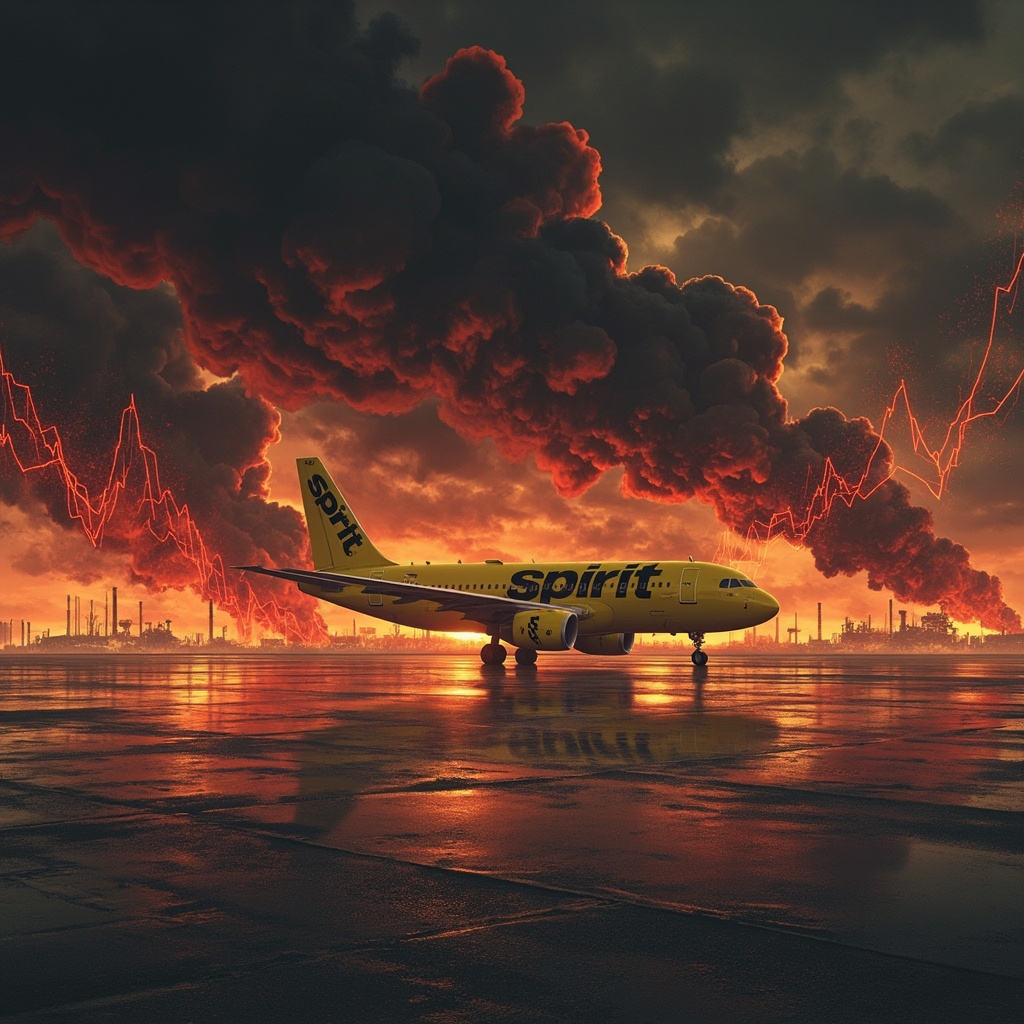
Spirit Airlines, the pioneering American budget carrier known for its bright yellow planes and rock-bottom fares, ceased all operations at midnight on Friday after failing to secure an emergency bailout from the Trump administration, becoming the most visible corporate casualty of the Iran war fuel crisis.
The End of an Era
The shutdown was confirmed in the early hours of Saturday when Spirit app displayed a stark message to passengers: We regret to inform you that all Spirit Airlines flights have been canceled, effective immediately. The airline final flight, NK1833 from Detroit to Dallas Fort Worth International Airport, touched down shortly after midnight local time.
Chief Executive Dave Davis issued a statement thanking employees and acknowledging the Trump administration, particularly Commerce Secretary Howard Lutnick, for their efforts to save the airline. For more than 30 years, Spirit Airlines has played a pioneering role in making travel more accessible and bringing people together while driving affordability across the industry, Davis said.
The sudden and sustained rise in fuel prices in recent weeks ultimately has left us with no alternative but to pursue an orderly wind-down of the company, Davis continued. Sustaining the business required hundreds of millions of additional dollars of liquidity that Spirit simply does not have and could not procure.
How the Iran War Killed Spirit
Spirit demise was months in the making, but the final blow came from the Middle East. Since the US and Israeli military strikes on Iran on February 28, jet fuel costs have doubled in some markets, according to industry data. For Spirit, which operated on razor-thin margins and relied on high-volume, low-cost operations, the spike was lethal.
The airline had been in its second bankruptcy filing since November 2024 and had hoped to emerge from court protection by mid-2026. Its lawyer, Marshall Huebner, told a New York bankruptcy court on April 23 that Spirit cash is not going to last for very much longer. The fuel price spike turned a difficult restructuring into an impossible one.
Spirit collapse illustrates a broader pattern of economic fallout from the Iran war that extends far beyond the direct military theatre. The Strait of Hormuz blockade has disrupted global oil shipments, sending crude prices to four-year highs and cascading through industries that depend on affordable energy. Airlines, already squeezed by post-pandemic debt and rising labour costs, have been among the hardest hit.
17,000 Jobs Lost Overnight
The human cost is staggering. Spirit confirmed that 17,000 direct and indirect employees have lost their jobs, from pilots and flight attendants to ground crew, maintenance workers, and corporate staff at its Miramar, Florida headquarters. The layoffs will ripple through airport economies across the country, particularly at Spirit hub cities of Fort Lauderdale, Orlando, Las Vegas, and Detroit.
The airline said it would automatically refund customers who purchased flights using credit or debit cards. But for employees, the future is uncertain. Airline industry job fairs have already been announced in Fort Lauderdale and Las Vegas, with competitors including JetBlue, Southwest, and Frontier expected to absorb some displaced workers.
The Bailout That Wasnt
The Trump administration had entered talks to broker a bailout for Spirit in recent weeks, with Commerce Secretary Lutnick personally involved in negotiations between the airline and its bondholders. But the talks collapsed when bondholders demanded concessions that the administration was unwilling to grant.
The failed bailout has political ramifications. Congressional Democrats have seized on the shutdown as evidence of the economic damage caused by the Iran war, while Republicans face pressure to explain how a major American employer collapsed on their watch despite controlling both the White House and Congress.
Spirit failure has triggered a domino effect. Frontier Airlines and Avelo have jointly requested 2.5 billion dollars in federal relief from higher fuel prices, warning that without government assistance they could face similar fates. The request puts the administration in a difficult position: bail out the airlines and face accusations of corporate welfare, or let market forces play out and risk further job losses.
What It Means for Travellers
Spirit exit from the market is expected to push fares higher on routes where it was the primary low-cost competitor. Even a diminished Spirit exerted downward pressure on prices at airports where it had a presence. Other carriers are expected to add capacity, but industry analysts warn the loss of a dedicated ultra-low-cost carrier will reduce competition, particularly for price-sensitive travellers who relied on Spirit for affordable domestic flights and connections to Latin America and the Caribbean.
The shutdown also raises questions about the viability of the ultra-low-cost carrier model itself. Spirit struggles predated the Iran war, rooted in a failed merger with JetBlue, shifting consumer preferences toward more comfortable travel, and aggressive competition from larger carriers. Whether the model can survive in an era of volatile fuel costs is now an open question.
The Broader Economic Shadow
Spirit Airlines is the largest, but unlikely to be the last, corporate casualty of the Iran war economic fallout. The blockade of the Strait of Hormuz has disrupted roughly 20 percent of the world oil supply, and the resulting price spike is working its way through the global economy with a lag that economists warn has not yet fully materialised. From shipping companies to manufacturers, the ripple effects of sustained high energy prices threaten to claim more victims before the conflict ends.