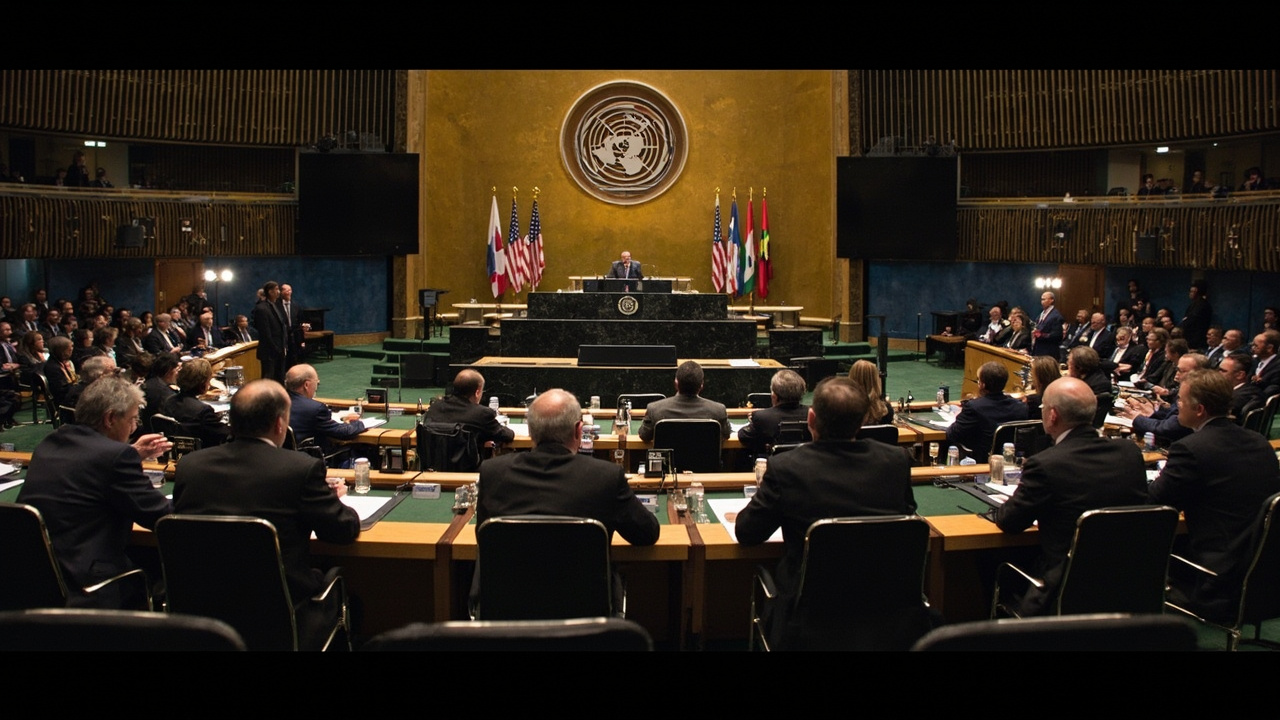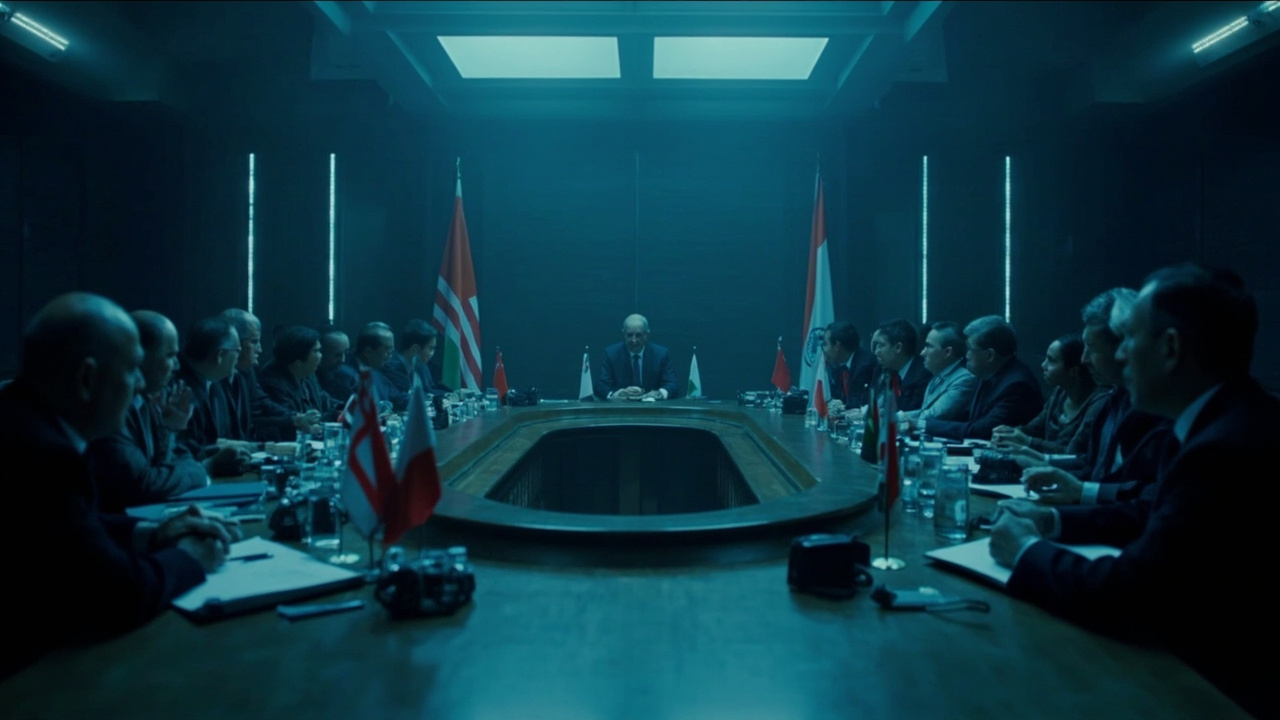
When the assembled foreign ministers of the world’s thirty largest economies gathered in the Palais des Nations in Geneva on April 28, 2026, the choreography was familiar: the handshakes, the formal communiqués, the promises of renewed multilateral cooperation. Beneath the surface, the architecture of the post-war international order was quietly, and perhaps irreversibly, coming apart.
The Geneva summit — convened under the auspices of the United Nations and formally titled the Review of the Rules-Based International Order — was intended to be a reset moment. Instead, it became an exhibit of everything that has gone wrong with global governance in 2026. The United States arrived without its Secretary of State, sending instead a mid-level deputy. China arrived with a detailed list of grievances against the Western sanctions regime. Russia was not invited — the General Assembly voted 142 to 12 to exclude Moscow over its invasion of Ukraine — but sent a pointed message through its foreign ministry threatening to walk out of every arms control framework still in place.
The Structural Breakdown in Geneva
“> “The multilateral system was designed for a world that no longer exists. We are operating with institutional infrastructure from 1945 in a world of 2026 power dynamics, and the gap is becoming unbridgeable.” — Senior European diplomat, speaking off the record”
The Geneva summit’s failure to produce a meaningful communiqué was, in itself, unremarkable. The G20 and UN summits of recent years have generated more platitudes than progress. But the specific dynamics on display in Geneva in late April were qualitatively different. For the first time in the post-1945 era, the question of whether the multilateral system itself has a future was raised explicitly and without diplomatic camouflage — in the corridors, in the bilateral meetings, and in the formal plenary sessions.
The immediate trigger was the collapse of the ceasefire talks in the Iran conflict. Iranian Foreign Minister Abbas Araghchi, speaking to reporters on the margins of the summit, told journalists that Tehran was “two weeks from a comprehensive response” to what he described as American violations of the agreed framework. The statement sent shockwaves through the assembled diplomats. Oil markets, which had priced in a ceasefire probability of roughly 60 percent just two weeks earlier, repriced sharply. The Brent crude price moved above $147 per barrel within hours of Araghchi’s statement.
The structural dimension of the breakdown runs deeper than any single crisis. The United Nations Security Council, designed to give the great powers a stake in the system through their veto, has been effectively paralysed on every major issue since Russia’s 2022 invasion of Ukraine. The WTO’s appellate body has been non-functional since the United States blocked judicial appointments in 2019. The International Criminal Court has issued arrest warrants that its own member states cannot — or will not — enforce. Each of these failures was once treated as an anomaly. In 2026, they are beginning to look like the new normal.
“> “The tragedy is not that the multilateral system is failing. It is that there is no alternative to it that serves the interests of the world’s most vulnerable people. Fragmented great-power spheres do not protect the weak — they abandon them.” — Professor Priya Mehta, Geneva Graduate Institute, April 2026”
The Great-Power Fracture and Its Consequences
The geopolitical competition between the United States and China — what analysts now openly describe as a new Cold War, though one with much more complex supply chain dependencies than the original — has created structural obstacles to multilateral cooperation that did not exist even five years ago. The two powers now view most international institutions through the lens of strategic competition. When China blocked a World Bank climate finance initiative in March 2026, it was not because Beijing opposed climate finance in principle, but because the proposed governance structure gave the United States a blocking role that Beijing was unwilling to accept.
The result is a proliferation of parallel institutions: the BRICS New Development Bank, the China-led Asian Infrastructure Investment Bank, the Belt and Road financing mechanisms, and a growing network of bilateral trade agreements that deliberately bypass the WTO framework. For the developing world, this proliferation creates genuine strategic options — but it also fragments the rules that govern global commerce, investment, and security in ways that are difficult to reverse.
“The specific mechanism of breakdown in 2026 is the simultaneous erosion of three pillars that previously sustained the system: security guarantees (NATO’s credibility crisis), economic governance (the WTO’s paralysis), and normative frameworks (the ICC’s enforcement gap). When any one of these weakens, the others absorb additional pressure. In 2026, all three are weakening simultaneously — and the institutional capacity to respond does not exist.”
The Developing World’s Dilemma
The countries most exposed to the breakdown of the multilateral order are, paradoxically, the ones with the least capacity to shape its reform. Across sub-Saharan Africa, South Asia, and the Pacific Islands, governments are being asked to choose between competing great-power frameworks — the American liberal order, the Chinese development model, the Russian security alternative — in ways that carry real costs regardless of which they choose.
In Geneva, the African Union’s High Representative for Institutional Reform, Senegalese diplomat Mariama Sow, delivered what delegates described as the summit’s most powerful intervention. She told the assembled foreign ministers that the continent of 1.4 billion people was being asked to pay twice: once through the security failures of a dysfunctional global order, and again through the conditionalities attached to every proposed reform. “We did not create this system,” she said. “We are being asked to rescue it. That is not partnership. That is mobilisation.”
The Road Ahead: Reform or Fragmentation
Whether the current moment represents a temporary dislocation or a terminal structural failure is the subject of intense, and genuinely divergent, expert opinion. Former UN Secretary-General Ban Ki-moon, speaking at a side event at the Geneva summit, argued that the system has survived existential crises before — the Cold War, decolonisation, the 1990s financial crises — and can survive this one, provided great powers develop the political will to reform it. His proposal: a new compact between the permanent Security Council members and the G77, under which the P5 accept limits on their veto in exchange for universal participation in Security Council decision-making.
Sceptics note that the P5 have shown no appetite for accepting limits on their veto, and that the current American administration’s stated position — that the United Nations is “not fit for purpose” — suggests the opposite direction of travel. If the United States and China cannot agree on the basic rules of engagement, the argument runs, then the system’s reform is not merely stalled — it is impossible.
What is certain is that the architects of the post-war order did not anticipate a world in which the system’s most powerful beneficiaries would become its most active saboteurs. Geneva in April 2026 was not the end of that story. But it may have been the chapter in which the ending became visible.