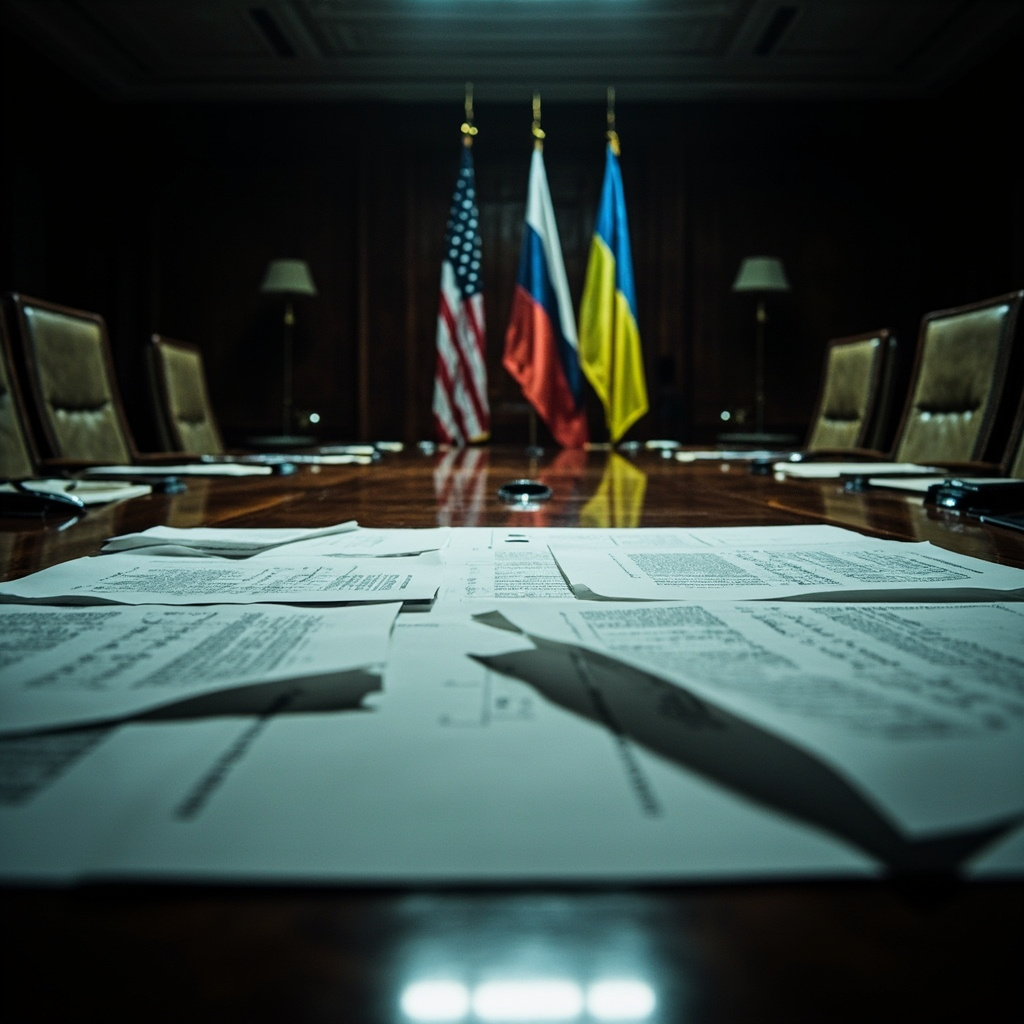
Trump Announces Three-Day Ceasefire as Both Sides Trade Fire Within Hours
President Donald Trump announced on May 8, 2026, that Russia and Ukraine had agreed to a three-day ceasefire mediated by the United States, timed to coincide with Russia’s May 9 Victory Day celebrations. Within hours, both Kyiv and Moscow accused each other of violations, illustrating the fragility of an accord that had barely survived its first day.
The Kremlin confirmed the ceasefire shortly after Trump’s statement, with spokesperson Dmitry Peskov calling it “a gesture of good faith” tied to the historical significance of Victory Day. Ukrainian President Volodymyr Zelensky, speaking from Kyiv, said Ukraine had agreed to the pause but warned that any Russian escalation would be met with a “proportional and immediate response.” Within 90 minutes of the ceasefire taking effect at midnight local time, Ukraine’s military reported that Russian forces had struck positions near Kramatorsk in eastern Ukraine. Moscow, in turn, accused Ukrainian drones of crossing into Russian territory near Belgorod.
“We have agreed, together with Russia and Ukraine, on a ceasefire. A three-day ceasefire, beginning tonight. I want to thank both sides for coming to the table. This is a very important moment.” — President Donald Trump, May 8, 2026
The timing of the announcement, coming just hours before Victory Day commemorations in Moscow, underscored the geopolitical choreography underlying the agreement. Russian officials had long sought international recognition for the Soviet Union’s role in defeating Nazi Germany, and a US-mediated ceasefire framed around Victory Day offered Moscow a propaganda victory at minimal military cost. For Trump, the accord provided a tangible foreign policy achievement heading into midterm campaign season, following a period defined by escalating tensions with Iran and a bruising trade war with the European Union.
The Iran Factor: How the Hormuz Crisis Is Complicating the Ceasefire
The Russia-Ukraine ceasefire announcement arrived against the backdrop of the most severe disruption to global energy markets since the 2023 Red Sea crisis. Just days earlier, the United States had launched precision strikes against Iranian military facilities in response to Iran’s seizure of a commercial oil tanker in the Gulf of Oman. Iran had reopened the Strait of Hormuz to commercial shipping in April 2026 before reversing course under intense domestic pressure, launching a campaign of interdictions that has disrupted roughly 18 percent of global oil shipments.
Senior administration officials, speaking on condition of anonymity, told reporters that the timing of the Russia-Ukraine ceasefire was not coincidental. “We are fighting on three fronts simultaneously — energy, European security, and the Indo-Pacific,” one official said. “The ceasefire in Ukraine is part of a broader effort to stabilize the European flank so we can focus on the Gulf.” Critics in Congress were less charitable. Senator Maria Reyes (D-CA), a senior member of the Armed Services Committee, called the announcement “a ceasefire written in disappearing ink,” noting that similar truces had collapsed within days throughout the war.
European allies, who have supplied the bulk of military and economic support to Ukraine since 2022, reacted with cautious optimism. French President Édouard Laurent called the agreement “a necessary first step” while urging Washington to use the three-day window to negotiate a longer cessation of hostilities. German Chancellor Friedrich Merz, whose government has faced domestic pressure to reduce arms shipments, warned that Berlin would resume weapons deliveries to Kyiv “immediately and without restriction” if the ceasefire broke down.
On the Ground: Soldiers and Civilians Brace for Uncertainty
In the trenches and shattered apartment blocks of eastern Ukraine, the ceasefire announcement was met with deep skepticism. Soldiers in the Donetsk and Luhansk regions, who have endured relentless Russian glide bombs and drone attacks for months, described the three-day pause as “a chance to breathe, not a reason to relax.” A Ukrainian medic named Olena, reached by phone near Bakhmut, said her unit had already received instructions to maintain combat positions regardless of the declared truce. “We have heard promises before. We will hold our lines and watch the sky,” she said.
Civilians in frontline towns like Pokrovsk and Toretsk, many of whom have refused evacuation despite constant bombardment, expressed weary hope tinged with caution. In Pokrovsk, where the local population has dwindled from 60,000 to under 10,000 since 2023, the news of a ceasefire brought residents briefly to the streets before local officials urged people to remain indoors pending confirmation that fighting had actually ceased.
The humanitarian dimension of any pause in hostilities remains acute. The United Nations Office for the Coordination of Humanitarian Affairs reported that approximately 3.2 million Ukrainians in occupied and contested territories have received no international aid deliveries since March 2026, when Russian forces disrupted overland supply routes from Poland. A three-day ceasefire would theoretically allow aid convoys to reach hard-hit areas in Zaporizhzhia and Kherson oblasts, but logistical negotiations between Moscow and Kyiv over crossing points remained unresolved as of publication time.
What Comes After Three Days? The Diplomatic Minefield Ahead
The immediate question confronting US mediators is whether the three-day ceasefire can be extended beyond its May 11 expiration. Russian officials have been clear that any extension would require concrete concessions from Kyiv, including the formal recognition of annexed Ukrainian territories as Russian. Ukraine, backed by European allies, has rejected any such condition, with Zelensky stating that “the sovereignty and territorial integrity of Ukraine is not negotiable at any table where Russia sits.”
US Secretary of State Marco Rubio, who participated in the negotiations leading to the ceasefire announcement, said the United States would use the three days to “explore the contours of a durable peace.” In a separate briefing, National Security Advisor John Ratcliffe outlined a framework under which a longer ceasefire would be tied to a freeze on current battle lines, the exchange of all prisoners of war, and the establishment of a demilitarized zone monitored by international observers.
“We are not naive. Three days is a test. Both sides know it. The question is whether they choose peace over the permanent war that benefits only arms manufacturers and political strongmen.” — EU High Representative for Foreign Affairs, May 8, 2026
Energy markets reacted with cautious optimism to the ceasefire news, with Brent crude futures retreating from a 14-month high of $97 per barrel to $91 in early Asian trading. The spike had been driven by the Hormuz disruptions, which threatened to cut off the approximately 21 million barrels per day that transit the strait daily. Analysts at Goldman Sachs estimated that a sustained ceasefire in Ukraine would reduce European energy price pressures by 8 to 12 percent.
Outlook: A Fragile Pause in the Longest War in Europe Since WWII
The three-day ceasefire represents the most serious attempt to halt the Ukraine war since direct US-Russian talks collapsed in Geneva in late 2024. Whether it holds — and whether it can be converted into something more lasting — will depend on factors ranging from battlefield dynamics to the outcome of domestic political calculations in Kyiv, Moscow, and Washington. The first violations have already been reported, testing the good faith of both parties within hours of the accord being announced.
For Ukraine, the ceasefire is simultaneously an opportunity and a risk. An opportunity because it provides a window to resupply, regroup, and potentially negotiate from a stronger position. A risk because any prolonged cessation of hostilities could fracture the Western unity that has sustained Kyiv since 2022. For Russia, the pause offers the chance to consolidate gains in occupied territories while weathering the combined pressure of Western sanctions and the ongoing Hormuz-linked energy disruption that has squeezed Moscow’s oil revenues. For Trump, the ceasefire is a political bet that a deal — even a fragile and temporary one — is better than another month of war headlines heading into a difficult midterm cycle.
The world will be watching closely over the next 72 hours to see whether this ceasefire is the opening of a genuine peace process or another chapter in a conflict that has reshaped global alliances, energy markets, and the architecture of European security for a generation.