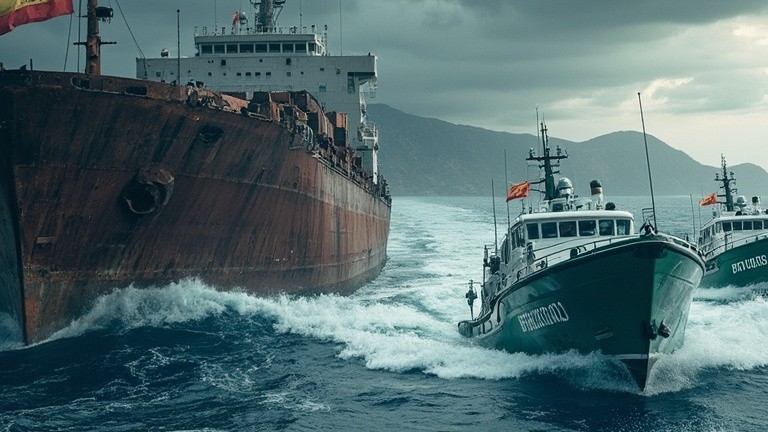
Historic Drug Bust in the Atlantic: Record Haul Detained Before Reaching European Shores
Spanish authorities have seized approximately 30,000 to 45,000 kilograms of cocaine from a cargo vessel intercepted off the Canary Islands — Europe’s largest-ever drug seizure at sea. Twenty crew members have been arrested in connection with the operation.
Spanish law enforcement agencies have intercepted a cargo vessel carrying an estimated 30,000 to 45,000 kilograms of cocaine off the coast of Gran Canaria, marking what authorities are calling the largest single seizure of the drug in European history. The operation, which unfolded in early May 2026, resulted in the arrest of twenty crew members and underscored Spain’s emerging role as a critical frontline state in the transatlantic drug trade.
The vessel, whose flag state and ownership structure remain under investigation, was boarded by Spain’s Civil Guard and Customs officers after a tip-off coordinated through international intelligence-sharing networks. Officials said the ship had been tracked for several days before being intercepted in international waters south of the Canary Islands archipelago, a major transit point for South American drug shipments destined for European markets.
Interior Minister Fernando María-Madrigal described the operation as “unprecedented in scale and execution” and credited cooperation between Spanish, Europol, and U.S. Drug Enforcement Administration investigators. “This is not simply a seizure — it is a significant disruption of a supply chain that spans three continents,” he told reporters in Madrid on May 7. “The volume of cocaine we have seized represents millions of individual doses that will now never reach European streets.”
Inside the Operation: How Spain Pulled Off the Largest-Ever European Drug Bust at Sea
Spain’s emergence as Europe’s primary gateway for Andean cocaine has accelerated dramatically over the past three years, with the Canary Islands serving as an increasingly prominent entry point for shipments originating from Colombia, Ecuador, and Peru. The archipelago’s geographic position — sitting at the crossroads of Atlantic shipping routes connecting South America to continental Europe — has made it a focal point for both criminal networks and the law enforcement agencies pursuing them.
The May 2026 operation, coordinated under the code name Operation Tidal Shield, involved weeks of meticulous intelligence work. Sources familiar with the investigation, speaking on condition of anonymity, said analysts cross-referenced shipping manifests, satellite tracking data, and signals intelligence to identify the vessel as a probable narcotics transporter before it entered European waters.
When boarding teams moved in, they found the cocaine stowed beneath layers of legitimate cargo — a technique drug traffickers have employed for years to avoid detection by X-ray scanners at major ports. What made this shipment unusual, however, was its sheer scale. Officials noted that previous record seizures in European waters had rarely exceeded 10,000 kilograms, making the current haul nearly triple that figure.
A Canary Islands Case Study: How Europe’s Drug Corridors Are Shifting
The Canary Islands have increasingly featured in European law enforcement briefings as a transit zone of concern. In 2025 alone, Spanish authorities seized more than 22 tonnes of cocaine at sea and in island-based operations — a 340 percent increase from five years earlier. The trend reflects a broader shift in trafficking routes, as criminal organizations seek to bypass tighter port security at traditional entry points such as Rotterdam, Antwerp, and Algeciras.
Criminal analysts note that the rise of direct-to-Canary routes from South America — cutting out mainland European ports entirely — has allowed trafficking groups to reduce the number of handoffs their shipments pass through before distribution, limiting exposure to law enforcement and increasing profit margins.
Europol’s European Migrant Crime Centre issued a briefing note in April 2026 warning that the Canary Islands route had become “the most dynamic” cocaine corridor into Europe, with at least six major interdiction operations recorded in the first quarter of the year. The agency flagged concerns that trafficking groups were increasingly using violence and intimidation against local fishing communities to secure logistical support, a dynamic more commonly associated with West African smuggling routes in the 2010s.
Twenty Arrested: The International Dimension of the Investigation
All twenty crew members detained during the operation remain in custody pending formal charges. Spanish prosecutors have indicated they intend to seek extradition proceedings for at least four individuals believed to hold senior operational roles within a South American trafficking syndicate. The nationalities of those detained have not been officially confirmed, but Spanish media outlets, citing judicial sources, reported that the crew included nationals of Venezuela, Colombia, and the Philippines.
The investigation is expected to extend well beyond the Canary Islands. Spanish judicial authorities have issued European Investigation Orders targeting bank accounts and property holdings in Portugal, the Netherlands, and the United Arab Emirates, indicating prosecutors believe the network behind the shipment operated financial infrastructure across multiple jurisdictions.
U.S. State Department officials confirmed that the DEA had provided intelligence support ahead of the interdiction and said they expected a formal request for evidence-sharing under the U.S.-EU Mutual Legal Assistance Treaty. A department spokesperson said Washington viewed the seizure as evidence of “the continued effectiveness of international law enforcement cooperation, even when criminal networks operate at this scale.”
What the Record Seizure Means for Europe’s Drug Markets and Security Policy
Public health researchers and policy analysts have offered mixed assessments of what a seizure of this magnitude means for European cocaine markets. While acknowledging that single interdictions — however large — rarely structurally disrupt drug pricing in the short term, several analysts said the May 2026 operation could have measurable effects over a six-to-twelve-month horizon if followed by sustained pressure on trafficking networks.
“A 30-tonne seizure is significant, but European demand for cocaine is so large and so established that markets absorb these disruptions,” said Dr. Leila Hartmann, a researcher at the European Monitoring Centre for Drugs and Drug Addiction. “What matters more is whether the operational infrastructure of these networks — the boats, the supply contacts, the corrupt port officials — is also being dismantled. That’s a harder and slower process.”
Others pointed to the geopolitical dimension. Several EU member states have in recent years sought to condition bilateral security assistance on recipient countries demonstrating concrete progress on counter-narcotics cooperation — a dynamic that, analysts say, makes large seizures like this one politically valuable for Madrid in its broader European diplomacy.
Spain’s Prime Minister Pedro Sánchez addressed the operation in remarks to parliament on May 8, calling the seizure “a clear message to those who believe European waters are beyond the reach of the law” and announcing a government proposal to expand Spain’s maritime surveillance capabilities through a new €120 million investment in radar and patrol vessel infrastructure.
For now, the 20 detained crew members await trial under Spanish anti-narcotics law, which carries sentences of up to 20 years for those convicted of large-scale drug importation. Spanish prosecutors have requested pre-trial detention for all twenty, arguing that the risk of flight and continued criminal activity outweighs any individual circumstances. A preliminary hearing is scheduled for May 20.
Rachel Torres is the International Affairs Correspondent for Media Hook. She covers global security, organized crime, and transatlantic relations from the Europe desk.
