U.S. Equities
Wall Street endured a sharply divided session on Friday as the Dow Jones Industrial Average managed a modest gain of 156 points, or 0.3%, closing at a fresh record high of 50,541.22 — capping a volatile week driven by conflicting signals from the Federal Reserve and escalating geopolitical risk in the Persian Gulf. The blue-chip index’s resilience stood in stark contrast to the tech-heavy Nasdaq, which plummeted 2.8% to 18,204.67, its lowest close in three months, as investors rotated aggressively out of high-multiple growth stocks amid mounting recession fears. The S&P 500 fell 1.4% to 5,892.34, with all eleven sectors finishing in negative territory except for energy and utilities, reflecting a classic risk-off dynamic that has characterized trading since Iran struck Bahrain and Kuwait on June 25. Market breadth was decidedly negative, with advancing issues trailing declining stocks by roughly 2-to-1 on the New York Stock Exchange, as the small-cap Russell 2000 also fell 1.1% to 2,091.45, signaling that domestic-orientedsmall-cap companies are not immune to the global confidence shock rippling through markets. The Cboe Volatility Index (VIX) surged 4.2% to 22.47, its highest reading since the initial Iran conflict escalation in late May, as options traders scrambled to hedge portfolio exposure against further downside.
“The market is caught between two powerful forces — a Fed that is signaling patience on rate cuts because inflation is still sticky, and a Middle East conflict that is tightening financial conditions through higher energy prices even as physical oil prices collapse on supply relief,” said Robert Conzo, CEO of Wealth Alliance, in a note to clients.
Nvidia led tech decliners, falling 4.2% as semiconductor stocks broadly sold off on reports that the Commerce Department was considering expanded chip export restrictions to additional countries in the Gulf region. The Philadelphia Semiconductor Index (SOX) dropped 3.6% on the session, bringing its weekly decline to 7.2%, the worst weekly performance for the sector since March 2023.
Fixed Income
Treasury markets staged a notable rally on Friday as investors fled risk assets and piled into the relative safety of U.S. government bonds, sending the benchmark 10-year Treasury note yield down 14 basis points to 4.32% — the largest single-day decline in three months. The move was amplified by data showing that the University of Michigan consumer sentiment index fell to a 14-month low in June, with households citing renewed concerns about food and gasoline prices as the primary driver of deteriorating optimism. The 2-year Treasury yield, which is most sensitive to Federal Reserve policy expectations, fell 11 basis points to 4.71%, as traders trimmed bets that the Fed would cut rates at its July meeting following a string of hawkish comments from central bank officials. Fed Governor Michelle Waller stated Thursday that the committee needed “several more months” of favorable inflation data before considering any adjustment to the policy rate, a view echoed by New York Fed President John Williams who emphasized that the central bank remained “data-dependent” and could not pre-commit to a timeline. Markets are now pricing just 28% odds of a July rate cut, down from 52% a week ago, according to the CME FedWatch Tool. The yield curve modestly steepened, with the spread between the 10-year and 2-year notes widening to negative 39 basis points from negative 42 basis points the prior session, suggesting that long-term investors are beginning to price in a scenario where the Fed keeps rates elevated to combat inflation while short-term rates fall as growth slows. Corporate credit spreads also widened, with the option-adjusted spread on high-yield bonds rising 12 basis points to 412 basis points, the highest since October 2023, as risk aversion in equity markets bled into debt markets.
Energy Markets
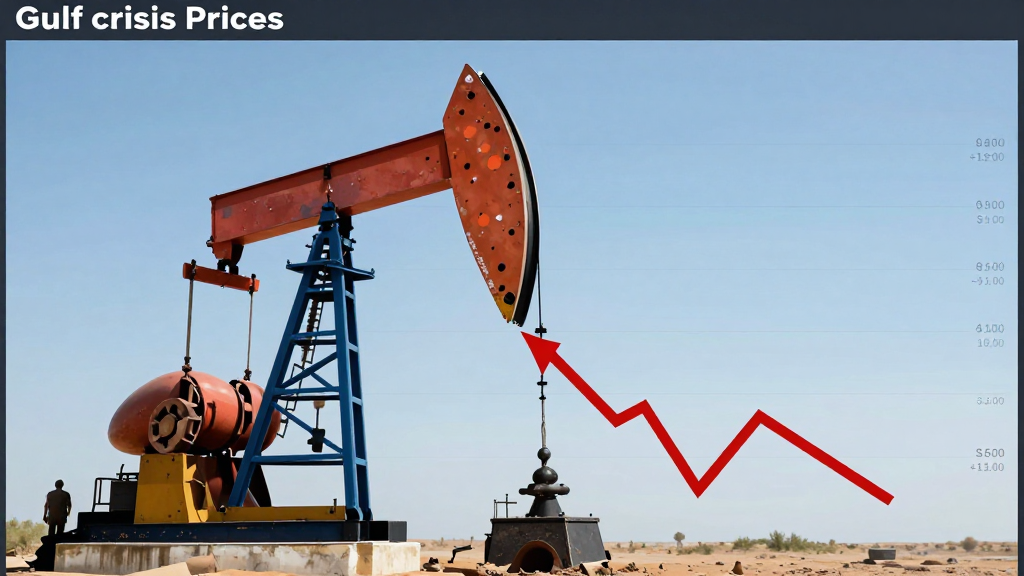
Oil prices suffered their worst weekly decline in over a year as the market grappled with a sudden surplus of supply from the Persian Gulf region, reversing nearly all of the geopolitical risk premium that had pushed Brent crude above $100 per barrel in late May. West Texas Intermediate (WTI) crude futures fell $2.67 on Friday, or 3.7%, to settle at $69.23 per barrel — the lowest close since mid-April — while international benchmark Brent crude declined $2.61, or 3.5%, to $72.60 per barrel. For the week, WTI plummeted 13.7%, marking the steepest weekly loss since April 2020, while Brent fell 12.4%. The sharp reversal was triggered by Qatar’s first crude oil export tender since the Iran conflict began, with the Gulf state tendering three million barrels for July loading — a signal that Strait of Hormuz shipping lanes have substantially reopened following the U.S.-brokered de-escalation ceasefire that took effect on June 26. The reopening of the Hormuz corridor, through which roughly 21 million barrels per day of oil flow, was further confirmed by satellite tracking data showing a tripling of tanker traffic at Ras Laffan port over the past 72 hours, according to tanker tracking firm Vortexa.
“The market is now absorbing the reality that the supply shock from the Gulf conflict was temporary, and that with Hormuz reopened, we could see a meaningful builds in crude inventories over the next four to six weeks,” said Ann-Louise Hittle, senior vice president of oil markets at Macquarie.
U.S. crude inventories rose by 4.1 million barrels last week according to the Energy Information Administration, slightly ahead of the 3.6 million barrel gain expected by analysts, as domestic production held steady at 13.5 million barrels per day despite the pullback in prices. Natural gas futures fell 1.9% to $3.28 per million British thermal units, pressured by forecasts for mild weather across the U.S. Northeast and a larger-than-expected injection in weekly storage data.
Currencies & Commodities
The U.S. dollar index (DXY) rose 0.6% to 104.7 on Friday, extending a weekly gain of 1.1%, as the confluence of geopolitical risk and hawkish Fed comments bolstered demand for dollar-denominated safe-haven assets. The euro fell to $1.0823, its lowest level in six weeks, after European Central Bank President Christine Lagarde signaled that the ECB remained on track for a September rate cut despite inflation remaining above target in several member states. The Japanese yen strengthened modestly to 158.2 per dollar as risk-off flows provided support, though the currency remains near multi-decade lows against the greenback. Gold futures fell $18.40, or 0.8%, to $2,312.60 per troy ounce, as the stronger dollar and lower inflation expectations weighed on the precious metal — traditionally a hedge against geopolitical instability — even as conflict in the Gulf remained unresolved. The decline in gold contrasts with its typical role as a risk-off asset and reflects that the current market environment is more consistent with a “risk liquidation” dynamic than sustained flight-to-safety buying, where investors are reducing all exposures including gold to raise cash. In cryptocurrency markets, Bitcoin fell 1.4% to $107,842 according to CoinMarketCap data, while Ethereum declined 1.1% to $4,203 — both digital assets struggling to find direction as traditional risk assets sold off. The crypto market’s correlation with equities, as measured by the 30-day rolling beta between Bitcoin and the S&P 500, has risen to 0.68, its highest level since early 2024, suggesting that digital assets are increasingly trading as risk-on/risk-off proxies rather than independent stores of value. “When you have a macro-driven selloff in equities, crypto no longer serves as an uncorrelated hedge — it becomes just another risk asset that gets liquidated when leverage ratios come under pressure,” said Ohris M. Greyoon, blockchain and crypto analyst at Intellectia.AI, in a market note.
Forward Look
All attention now turns to the Federal Reserve’s semi-annual Monetary Policy Report, scheduled for delivery to Congress next week, where Chair Jerome Powell is expected to face sharp questions about the Fed’s reaction function amid dual pressures of persistent inflation and slowing growth. The collision of these forces — an inflation that remains above the 2% target and an economy that is showing signs of deceleration — leaves the Fed in a highly constrained position, unable to ease even as financial conditions tighten materially. Former Treasury Secretary Lawrence Summers warned Friday that the U.S. economy faced a ” narrowing path” between overheating and recession, noting that the current stance of monetary policy was “appropriately restrictive” but that the margin for error was slim. Markets are pricing a full 25 basis point rate cut at the September FOMC meeting, with just one cut expected for all of 2026, a dramatic shift from the four cuts priced at the start of the year. The upcoming earnings season for the second quarter will provide critical insight into whether corporate America can maintain margins in an environment of slower revenue growth and persistently high input costs. With energy prices having pulled back sharply, there is cautious optimism that consumer spending could receive a modest tailwind at the pump in the coming weeks — a development that could shift the Fed’s calculus and potentially bring a rate cut back onto the table sooner than currently expected.