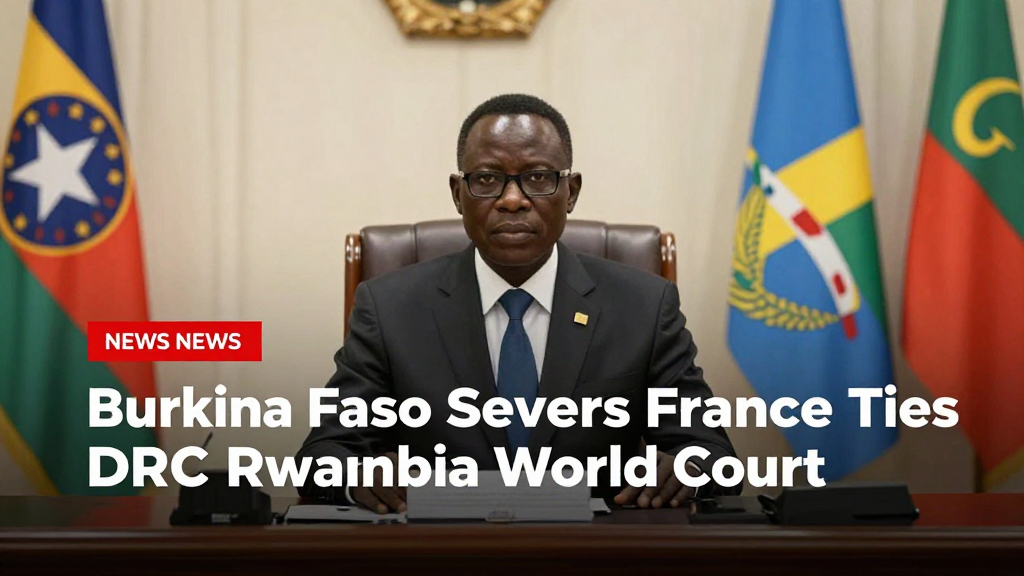
Two seismic diplomatic ruptures shook Africa on Friday as Burkina Faso announced the severance of its diplomatic relations with France and the Democratic Republic of the Congo filed a landmark case against Rwanda at the International Court of Justice, reshaping the continent’s geopolitical landscape in a single day and exposing the deepening fractures between military-ruled states and their former Western partners.
Burkina Faso Breaks with France
Burkina Faso’s military junta announced on Friday that it had cut diplomatic ties with France, marking the most dramatic rupture in relations between the West African nation and its former colonial ruler in recent memory. The announcement, read aloud on national television by Communications Minister Gilbert Ouedraogo, said the decision had been taken after a formal review of bilateral relations with Paris and reflected what the government called a systematic pattern of French interference in Burkina Faso’s internal affairs.
“The government of Burkina Faso hereby informs the national and international community that it has decided to sever diplomatic relations with France with effect from today, June 26, 2026,” the statement declared. Ouedraogo further charged that France harboured “neo-colonial ambitions, made evident by its active support for subversive networks and the terrorists who are plunging our country and the Sahel into mourning.” France’s foreign ministry said it “took note” of the decision and said its embassy in Ouagadougou would continue to handle consular affairs for French nationals still in the country.
The break follows years of deteriorating relations since Captain Ibrahim Traore seized power in September 2022 and progressively aligned Burkina Faso with Russia while expelling French military advisers. French troops officially withdrew from the country in early 2023 after the junta demanded their departure. Analysts say the move completes a full strategic pivot away from Paris and leaves France with significantly diminished influence across the Sahel, following similar ruptures in Mali and Niger.
DRC Takes Rwanda to the World Court
Hours after the Ouagadougou announcement, the Congolese government filed an application with the ICJ in The Hague accusing Rwanda of direct responsibility for three decades of atrocities in eastern DRC. The filing covers abuses spanning from 1996 to the present day, including massacres, sexual violence, and the forced displacement of hundreds of thousands. The court confirmed it had received the application and said it would proceed with its preliminary examination.
“The civilian populations of eastern DRC have been victims of massacres, extrajudicial executions, acts of torture, sexual violence, forced displacement, and discrimination,” the Congolese government stated, describing suffering of “exceptional magnitude” that it said was directly attributable to Rwandan armed forces and their proxy militias operating inside Congolese territory.
The application names the M23/AFC alliance and the Alliance of Democratic Forces for the Liberation of Congo-Zaire among the groups it says have conducted unlawful military operations on behalf of Kigali. M23 rebels captured the strategic cities of Goma and Bukavu in early 2025, displacing hundreds of thousands and overwhelming humanitarian response capacity. Rwanda has consistently denied backing M23, characterising its military activities inside DRC as proportionate self-defence against armed groups, including the FDLR, a Hutu militia whose origins trace to the 1994 Rwandan genocide.
Escalating Crisis Across Two Fronts
The simultaneous diplomatic upheavals underscore a broader pattern of African states increasingly turning to international legal institutions and alternative partnerships rather than relying on traditional Western-mediated dispute resolution. The DRC case at the ICJ is particularly significant given the court’s limited enforcement powers and Rwanda’s documented history of non-participation in previous ICJ proceedings. Legal observers say a ruling in the DRC’s favour would be largely symbolic unless the African Union or the UN Security Council moves to enforce it.
The conflict has also compounded a humanitarian catastrophe in eastern DRC, where the World Health Organization has warned of a “catastrophic collision” between ongoing fighting and a rapidly spreading Ebola outbreak. With M23 forces controlling key urban centres and the Congolese government’s authority barely clinging to outer districts, aid organisations have warned that the window for an effective humanitarian response is closing fast. The US-brokered peace deal signed in June 2025 and a subsequent Qatari-mediated ceasefire both collapsed without halting the violence, leaving the ICJ filing as the DRC’s remaining formal avenue for international recourse.