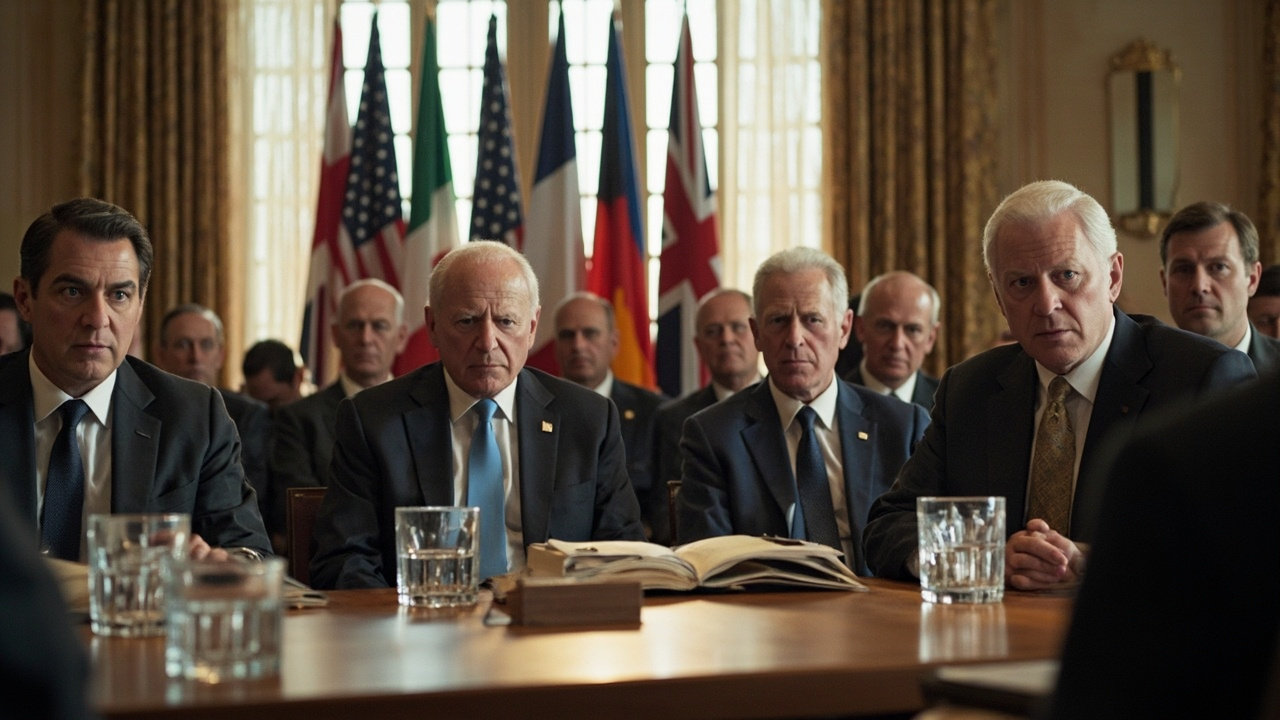
G7 leaders issued a joint statement on Wednesday affirming their unwavering support for Ukraine and welcoming the breakthrough US-Iran agreement that reopened the Strait of Hormuz, but the communiqué concealed mounting fractures over how to sustain the momentum on both fronts as battlefield dynamics shifted and diplomatic timelines compressed.
The three-day summit in Évian, France, brought together the leaders of Canada, France, Germany, Italy, Japan, the United Kingdom, and the United States alongside the President of the European Council. The closing statement ran to 47 paragraphs and covered Ukraine, the Middle East, the Indo-Pacific, and energy security, yet several substantive disagreements were settled with vague language that diplomats said masked irreconcilable positions.
Ukraine: New Momentum, Familiar Strains
The G7 affirmed continued military support for Ukraine, agreeing to accelerate deliveries of air defence systems, long-range capabilities, and interceptors. The leaders commended Ukraine’s recent battlefield gains and acknowledged what the statement called “new momentum” in Kyiv’s efforts to push back Russian forces.
Yet senior officials from two member states, speaking on condition of anonymity because summit deliberations are private, said the group clashed over whether to condition future weapons deliveries on Ukraine’s willingness to enter ceasefire negotiations. The United States and one other government favoured linking arms flows to diplomatic progress; France, Germany, and the United Kingdom opposed any such linkage, the officials said.
“The disagreement is real and it is not small,” one senior European diplomat told reporters at a briefing on the sidelines of the summit. “We are not going to strand Ukraine at the moment it has the opportunity to change the map.” The officials did not identify which delegations held which positions.
The statement ultimately sidestepped the dispute, saying only that the G7 was “ready to consider extending to Ukraine the benefit of licenses to allow for an increase in Ukraine’s military production.” Kyiv has pressed for exactly that provision for months, arguing that domestic manufacturing capacity, not foreign supply chains, is what determines long-term staying power.
Hormuz Reopening: A Fragile Ceiling
The most concrete diplomatic achievement of the summit was the G7’s formal endorsement of the US-Iran agreement signed in Geneva on June 19, under which Iran agreed to dismantle its advanced uranium enrichment infrastructure and allow international inspectors full access to its nuclear sites. In exchange, the United States and its partners agreed to lift secondary sanctions and unfreeze approximately $60 billion in Iranian assets held abroad. The deal also included a parallel understanding, not publicly documented, under which Iran halted its campaign of attacks on commercial shipping through the Strait of Hormuz.
President Trump called the Hormuz understanding “the most important naval agreement in a generation” and said US forces would protect merchant vessels transiting the waterway under a multinational escort arrangement led by France and the United Kingdom. The G7 statement endorsed that defensive initiative, calling it a mechanism to “facilitate the resumption of maritime traffic” and “support verification that all mines are removed.”
But the statement omitted any reference to the roughly 200 mines that the US Navy has publicly confirmed were found attached to commercial vessels in the weeks before the ceasefire. A senior US defence official, speaking to reporters in Geneva, said de-mining operations were “ongoing and proceeding faster than expected,” without providing a timeline for completion. Two shipping industry sources, reached by telephone, said insurance premiums for Hormuz transits remained elevated and that several major tanker operators had not yet resumed normal routing through the strait.
The G7 also agreed to accelerate diversification of energy supply routes to reduce Europe’s dependence on shipments that pass through the Hormuz, a goal that has featured in European communiqués for more than a decade but has produced limited results. The statement singled out Canadian liquefied natural gas as a potential contributor to that effort, a nod to Canada’s offer to expand export capacity, though analysts noted that new Canadian LNG infrastructure would take years to build.
Ceasefire Gambit and Remaining Risks
Despite the surface unity, the summit exposed fault lines that observers said could widen quickly. The Hormuz ceasefire depends on Iran honouring commitments that are, in the words of one senior Western official, “deeply unpopular inside Tehran” and subject to challenge by hardliners who oppose any accommodation with Washington.
A second G7 leader, also speaking anonymously, said the real test would come within weeks, not months. “The hardliners in Tehran are watching what happens in the Republican primary, what happens with Congressional sanctions votes, what happens with the price of oil,” the official said. “If any of those variables move the wrong way, we could be back to strikes on shipping within 60 days.” The official declined to specify what constituted “the wrong way” on any of those variables.
The statement’s language on Lebanon and Gaza similarly avoided binding commitments. The G7 called for an immediate ceasefire in Lebanon and the disarmament of Hezbollah, and said it would “accelerate humanitarian and reconstruction efforts” in Gaza, but set no timelines and pledged no new funding. The absence of a credible enforcement mechanism for either objective drew criticism from regional analysts, who said the language offered more aspiration than actionable policy.
Looking ahead, the most consequential upcoming deadline is a scheduled review of Iranian compliance by the International Atomic Energy Agency, expected to deliver its first report under the new monitoring framework by late July. The G7 statement said member states were “ready to contribute to implementation” of the nuclear accord but provided no detail on the verification mechanism or on what happens if violations are found. That gap, diplomats said, is where the agreement is most likely to unravel first.