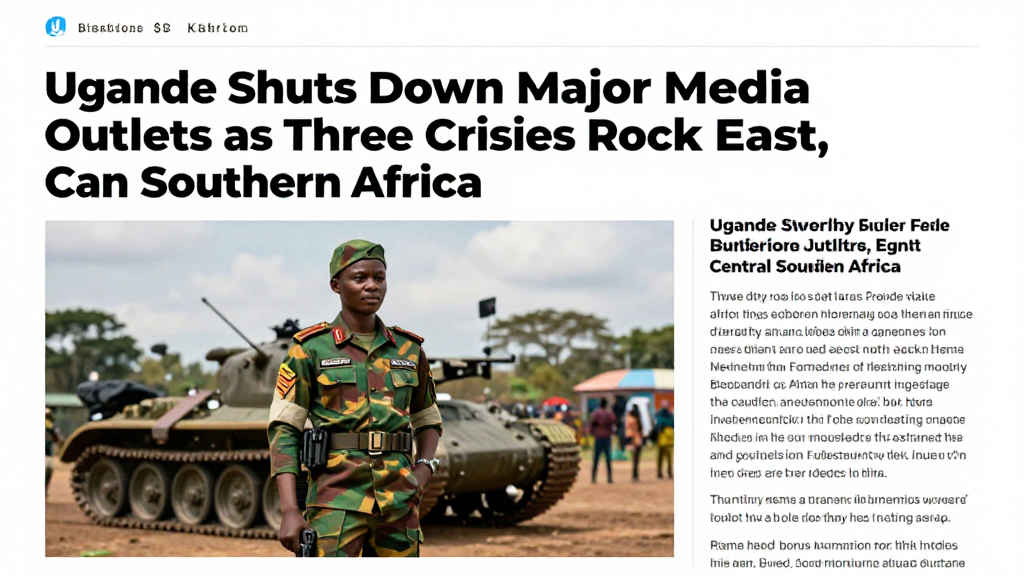
Uganda’s military chief Muhoozi Kainerugaba ordered the immediate closure of two of the country’s largest independent media outlets on Sunday, deploying armed personnel to the headquarters of the Daily Monitor and NTV Uganda in Kampala and telling journalists that all future coverage would require his approval. The announcement came as South Africa faces a deadline of June 30 for undocumented migrants to leave the country or face the threat of national strike action, and as the Democratic Republic of Congo confirmed that a deadly Ebola outbreak has now infected more than 1,300 people across two nations.
Uganda Military Chief Orders Shutdown of Nation Media Group
Kainerugaba, who is the president’s son and widely seen as the likely successor to Yoweri Museveni after 40 years in power, confirmed the closures in a series of posts on social media platform X on Sunday. “In Uganda, I do not believe in a free press!” Kainerugaba wrote. “From now on ALL bad stories about Uganda have to be cleared by my office!”
Armed security personnel were deployed outside the Nation Media Group Uganda headquarters in Namuwongo, Kampala, with staff reporting that no one was being allowed to enter or leave the building. NTV Uganda, Spark TV and other broadcasters owned by Nation Media Group went off air across the country on Sunday. The closures mark the latest assault on press freedom in a country where the military chief has held shutdown authority over media outlets since 2017, when his father granted him the power. The Daily Monitor was previously shut down for 10 days in 2013, and NTV Uganda was taken off air for months in 2007 following government criticism of its coverage.
The Committee to Protect Journalists said it was deeply alarmed by the shutdown orders. “The Ugandan military’s takeover of independent newsrooms and forcible silencing of journalists is an egregious attack on press freedom and the public’s right to information,” the organisation said in a statement. Uganda’s National Association of Broadcasters said it was closely monitoring the situation and described the closures as a serious threat to rights enshrined in the constitution.
Ebola Outbreak Surpasses 1,300 Cases as Regional Death Toll Climbs
Health officials in the Democratic Republic of Congo confirmed on Tuesday that the ongoing Ebola outbreak has now reached 1,307 confirmed cases, including 377 deaths, with the rare Bundibugyo strain spreading rapidly through communities in both the DRC and Uganda. The figures make this the second-largest outbreak of the Bundibugyo strain ever recorded, surpassed only by the 2012 epidemic in the DRC, according to the Africa Centres for Disease Control and Prevention.
“This is the most significant resurgence we have seen in years, and without immediate and coordinated international support, we risk the outbreak spreading well beyond the region,” the director-general of Africa CDC warned. The World Health Organization and Africa CDC jointly announced a $518 million emergency response plan covering the period from June through November, aimed at emergency coordination, surveillance, testing, infection prevention and community engagement across both DRC and Uganda.
South Africa Deadline Looms as Anti-Immigrant Violence Intensifies
In South Africa, thousands of migrants spent the weekend fleeing major cities as a June 30 ultimatum issued by anti-immigrant groups approaches. As of Monday, more than 8,000 Malawian citizens had departed the city of Durban, heading back to their country, while the governments of Ghana, Nigeria and Mozambique have all reported hundreds of their nationals seeking emergency evacuation following waves of attacks on foreign-owned businesses and homes.
At least five Mozambicans have been killed in violence that erupted in the coastal town of Mossel Bay, with local officials confirming that entire families were displaced as armed mobs set fire to migrant settlements. “People came to my house, knocked on the door and then took all my belongings,” said Lado Amido, a 49-year-old Mozambican migrant who arrived in South Africa in February. President Cyril Ramaphosa has called for calm but faces growing pressure from both his own security cabinet and international human rights groups demanding action before the June 30 deadline expires.
Regional leaders are now calling for an emergency African Union summit to address the compounding crises, as the continent faces simultaneous health, security and political emergencies stretching from Kampala to Kinshasa and Johannesburg.