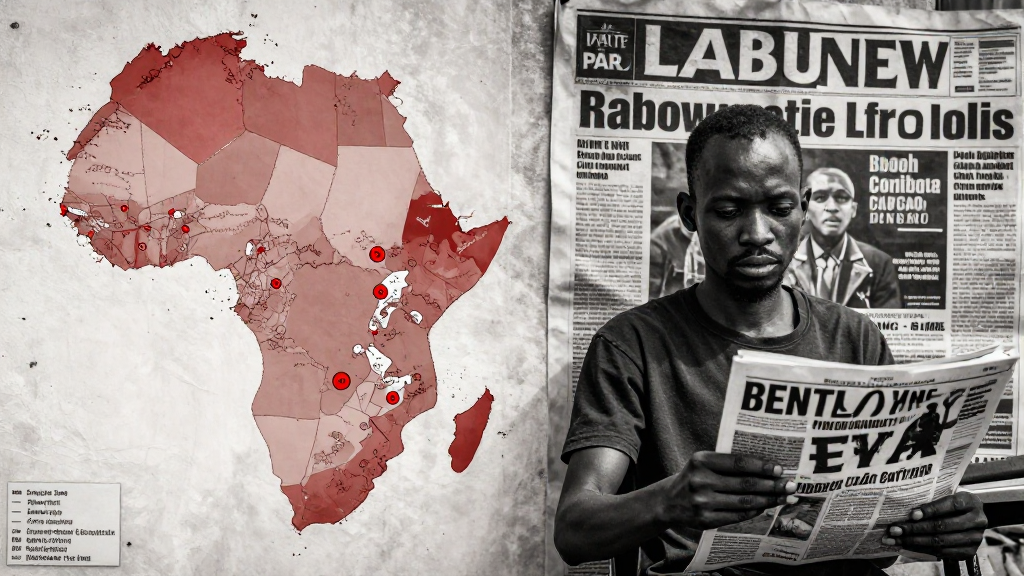
Four African regions are in simultaneous crisis as a major Ebola outbreak spreads in Central Africa, diplomatic ties fracture across the Sahel, Uganda shuts down its leading media group, and South African communities brace for anti-migrant protests, all unfolding within 72 hours of each other and demanding urgent international attention.
West Africa: Burkina Faso Severs Ties with France
The transitional government of Burkina Faso announced on Saturday the severance of diplomatic relations with France, ending decades of formal bilateral engagement and closing the French embassy in Ouagadougou. The announcement, read on state television by government spokesperson General Ayoubacar Mandougou, said France had supported “forces hostile to the revolution” and accused Paris of arming and financing terrorist cells operating inside Burkina Faso. France immediately rejected the allegations as “false and defamatory,” with the foreign ministry in Paris summoning the charge d'affaires to protest the “baseless accusations.” France had already evacuated its embassy staff in early June after another West African state expelled French forces.
The Ouagadougou junta has deepened its strategic alignment with Russia since 2023, signing military cooperation agreements that have brought Russian private military contractors into the country. The latest diplomatic break follows months of escalating anti-French sentiment in Burkina Faso, where public protests demanding French withdrawal have become a recurring feature of political life. Regional analysts say the move is likely to accelerate the complete replacement of French diplomatic infrastructure with Russian-backed alternatives.
France maintains that its forces operated in Burkina Faso solely at the invitation of the previous government and denies any involvement in supporting insurgent groups. The severed relations mark a new low in Franco-African military cooperation that once underpinned security policy across the Sahel.
Central Africa: Ebola Outbreak Prompts Mass Gathering Ban
The Democratic Republic of Congo declared a ban on all public gatherings in three eastern provinces on Sunday as the Ebola outbreak in the Bundibugyo strain reached 1,274 confirmed and suspected cases, with 96 health workers among those infected. The order covers markets, places of worship, sporting events, and all political rallies across North Kivu, Ituri, and South Kivu provinces. The Africa Centres for Disease Control and Prevention warned that cross-border transmission to Uganda, Rwanda, and South Sudan is “highly likely” given the mobility of populations in the region.
The World Health Organization said it has deployed 340 additional responders and established screening checkpoints at 27 border crossings, though it acknowledged that insecurity in parts of North Kivu is preventing health workers from accessing several affected communities. The current outbreak is the second-largest ever recorded for the Bundibugyo strain, surpassed only by the original 2007 emergence. The International Committee of the Red Cross warned that the combination of conflict and disease is overwhelming an already fragile health system.
“We are dealing with a cascading emergency,” said Dr. Matshidiso Moeti, WHO Regional Director for Africa. “Communities in eastern DRC are caught between armed groups and a fast-moving outbreak, and the health system simply does not have the capacity to absorb this scale of crisis without immediate international support.” The United Nations has called for $75 million in emergency funding to scale up the response.
East Africa: Uganda Military Chief Shuts Down Nation Media Group
Uganda military intelligence directorate ordered the immediate closure of the Nation Media Group television station, radio network, and digital platforms on Saturday, accusing the broadcaster of “disseminating content that threatens national security and spreads panic.” The shutdown affected NTV Uganda, one of the country's most-watched independent news outlets, and several radio stations affiliated with the group. Military vehicles were deployed to the broadcaster's headquarters in Kampala, and staff were escorted from the building.
The Committee to Protect Journalists condemned the shutdown, calling it “a grave assault on the right to information at a moment when Uganda's citizens need independent reporting more than ever.” CPJ Africa Program Coordinator Muthoni Muriithi said the military's action “underscores the accelerating collapse of press freedom in Uganda under the NRM government.” Reporters Without Borders ranked Uganda 124th out of 180 countries in its 2025 World Press Freedom Index, noting a sharp deterioration in media conditions over the past three years.
The shutdown came amid heightened tensions in Uganda following the deaths of two U.S. Agency for International Development contractors in a suspected terrorist attack near the DRC border last week. The attack, blamed on an Allied Democratic Forces incursion from DRC territory, has prompted a major Ugandan military deployment to the region and accusations that armed groups are using the border zone as a sanctuary.
Humanitarian Crisis Deepens Across Four Regions Simultaneously
The convergence of four distinct but geographically distributed crises across Africa within a 72-hour window has prompted urgent calls for a coordinated international response. The United Nations Resident Coordinator for Africa warned that “no region of the continent is untouched” by the current wave of instability, citing the compound effects of conflict, public health emergencies, and democratic backsliding across the Sahel, the Horn, Central Africa, and Southern Africa simultaneously.
African Union Commission Chairperson Moussa Faki Mahamat issued a statement calling for “maximum restraint” across all four regions, urging governments to prioritise civilian protection and to uphold their obligations under African human rights frameworks. The statement called specifically for the restoration of press freedom in Uganda, for humanitarian corridors to be established in Ebola-affected areas of DRC, and for a diplomatic resolution to the Burkina Faso-France dispute that does not further destabilise the Sahel region.
Human rights organisations warned that the simultaneous nature of the crises creates a risk of international attention being spread too thin, leaving populations in each region underserved. “Donors and the international community face a difficult challenge,” the International Crisis Group said in a briefing note, “but Africa cannot afford a tiered response that treats some crises as more deserving than others.”
With the African Union calling an emergency session and the United Nations coordinating a cross-agency response framework, the international community faces an immediate test of whether it can match the speed and scale of what is now a continent-wide convergence of emergencies.