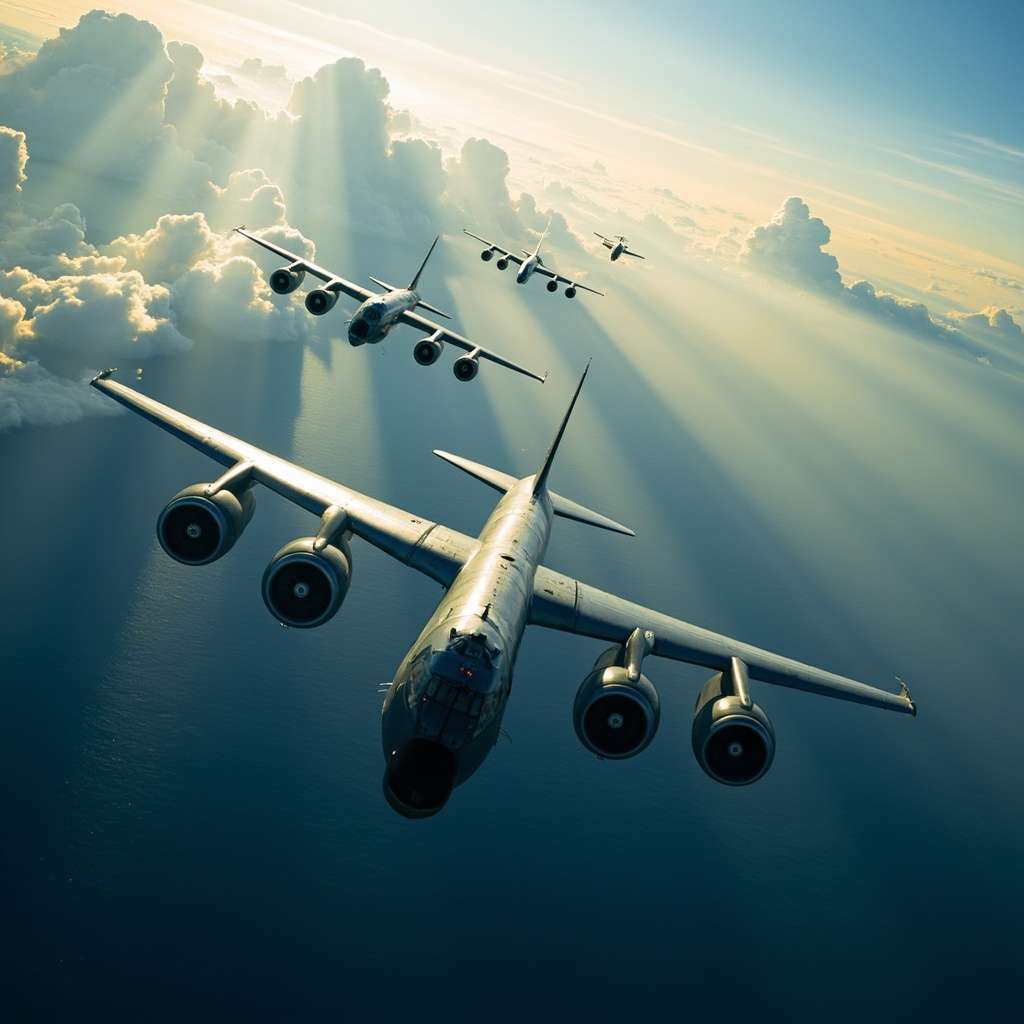
China and Russia sent more than 10 military aircraft on a joint patrol near Japan and South Korea on Saturday, drawing formal diplomatic complaints from both capitals in the latest demonstration of deepening military cooperation between Beijing and Moscow, according to a Japan Joint Staff news release.
Two Russian Tu-95 strategic bombers and two Tu-142 maritime patrol aircraft flew alongside two Chinese H-6 bombers west of the Korean Peninsula between Saturday morning and afternoon. The formation was temporarily joined by two Chinese J-16 fighter jets and one Russian Sukhoi Su-35 fighter jet. The aircraft entered and exited the Korea Air Defense Identification Zone over the East Sea, also known as the Sea of Japan, and the East China Sea. South Korea scrambled an undisclosed number of Air Force fighter jets to conduct tactical response measures, according to the South Korea Joint Chiefs of Staff. Japan similarly protested the flights through diplomatic channels, calling them a threat to regional stability.
“The Chinese and Russian air forces conducted their 11th joint strategic air patrol in the airspace over the Sea of Japan, the East China Sea, and the western Pacific Ocean, demonstrating shared determination and capability to safeguard regional peace and stability,” according to a report Saturday on China Military, an official Chinese news website. The flights came as a deliberate signal to the United States and its Indo-Pacific allies, analysts said, reflecting an accelerating pattern of coordinated Chinese-Russian operations across multiple domains.
South Korea Scrambles Fighters as Patrol Deepens Regional Tensions
The joint patrol came the same weekend that South Korean Defence Minister Ahn Gyu-back and his Japanese counterpart Shinjiro Koizumi met in Seoul and reaffirmed their commitment to the denuclearisation of the Korean Peninsula, agreeing to revive joint search-and-rescue maritime drills for the first time since 2017. The timing of the Beijing-Moscow flights, coinciding with the Seoul-Tokyo defence meeting, was not lost on regional strategists. The parallel timelines reflect a broader pattern: as U.S. allies deepen their own security coordination, China and Russia are conducting operations specifically designed to test and challenge that emerging architecture.
“Both ministers shared the view to continue cooperation for maintaining regional peace and stability amid a grave security environment,” South Korea’s defence ministry said in a joint statement. The ministers also agreed to continue fostering exchange between their air forces’ respective aerobatic teams — South Korea’s Black Eagles and Japan’s Blue Impulse — in a symbolic but notable gesture of warming bilateral ties that would have been unthinkable a decade ago.
Allied Nations Respond as Trilateral Architecture Takes Shape
The United States, which has been encouraging closer security ties between its two key Asian allies, welcomed the renewed Seoul-Tokyo engagement. South Korea and Japan, with U.S. encouragement, have been working to develop closer ties since 2022 and overcome historical differences rooted in Japan’s past colonial rule of the Korean Peninsula. In 2019, Seoul moved to end the GSOMIA intelligence-sharing pact with Japan after Tokyo restricted exports of semiconductor materials and removed South Korea from its preferential trade list. The tension passed, but the underlying grievances simmered until the 2025 rapprochement under then-Prime Minister Shigeru Ishiba and President Lee Jae Myung.
By 2025, Japan’s then-Prime Minister Shigeru Ishiba and President Lee Jae Myung had agreed to closer security and economic ties, and the defence ministers committed to working with Washington against North Korea’s nuclear threat and Pyongyang’s growing military ties with Russia, including cooperation on AI and unmanned systems and annual trilateral drills. Takaichi and Lee agreed in January 2026 to deepen shuttle diplomacy and in May expanded cooperation on energy. The momentum has now carried into June with the Seoul defence meeting producing the most concrete deliverables in years.
The joint flights underscore the compounding challenge facing allied nations in the Indo-Pacific: as China and Russia expand their operational coordination across air, sea, and cyberspace, the United States and its partners are simultaneously accelerating the architecture of their own trilateral and multilateral defence frameworks to fill the same strategic space. Regional analysts say the result is a more volatile, more contested security environment in which both sets of partnerships are hardening simultaneously, leaving less room for middle-ground nations to hedge.