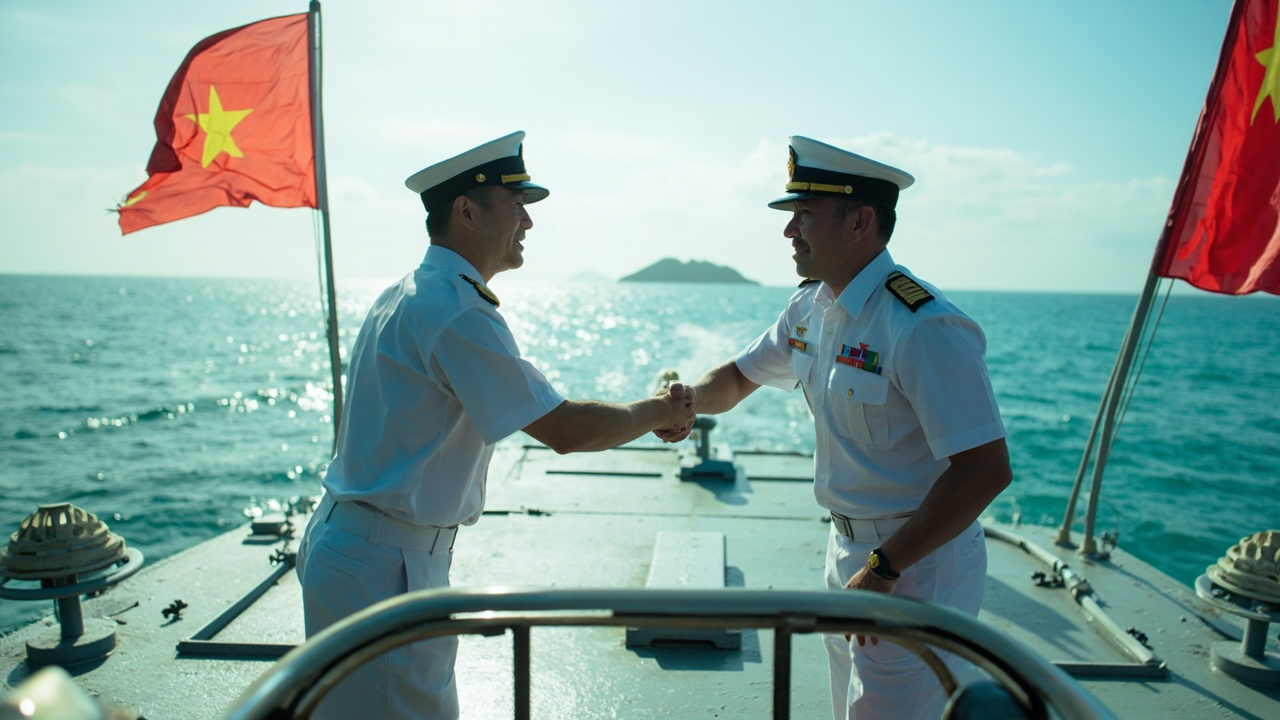
MANILA — The Philippines and Vietnam have elevated their bilateral defense relationship to an enhanced strategic partnership, signing fresh deals to jointly address escalating tensions in the South China Sea as both nations face mounting pressure from Beijing’s expanding maritime claims and its increasingly aggressive coast guard operations across contested waters.
President Ferdinand R. Marcos Jr. and visiting Vietnamese President To Lam signed the accord in Manila on June 1, 2026, renewing a 2010 defense cooperation agreement and unveiling new maritime security measures designed to coordinate responses to Chinese vessel incursions. The agreement comes as China intensifies live-fire exercises around the Paracel Islands and as the Philippines chairs the Association of Southeast Asian Nations this year.
South China Sea Peace Declared Non-Negotiable
“As fellow claimant states, we reaffirm that maintaining peace, stability, and the freedom of navigation and overflight in the South China Sea remains non-negotiable,” Marcos said at a joint press conference with Lam. The two leaders also signed agreements on combating transnational crime, including internet fraud, human trafficking, and illegal gambling through enhanced intelligence-sharing and law enforcement coordination across their borders and maritime domains.
Vietnam, which like the Philippines faces separate but overlapping maritime stand-offs with China in different parts of the sea, has consistently backed adherence to international law and the 1982 United Nations Convention on the Law of the Sea (UNCLOS). Both nations explicitly referenced the 2016 South China Sea Arbitral Award that invalidated China’s expansive “nine-dash line” claim over most of the contested waters — a ruling Beijing continues to reject and ignore. Vietnam was not a party to that arbitration but has cited UNCLOS as the governing legal framework for all maritime disputes in the region.
“We stand resolute in our commitment to the peaceful resolution of disputes, grounded firmly in international law, particularly the 1982 UNCLOS and the 2016 South China Sea Arbitral Award,” Marcos said, echoing language that has become standard in Philippine diplomatic statements but carries particular weight when delivered alongside another ASEAN claimant state. The joint statement issued after the talks commits both nations to pursuing a binding code of conduct in the South China Sea — a process that has stalled for years under Chinese pressure.
Australia and Japan Expand Defense Architecture
Separately, Australia and Japan on May 4, 2026 announced next steps to enhance their already deep defense and security cooperation, building on the 2022 Joint Declaration on Security Cooperation, the 2023 Reciprocal Access Agreement, and last December’s Framework for Strategic Defence Cooperation. Prime Minister Anthony Albanese met Prime Minister Takaichi Sanae in Canberra and issued a joint statement committing to co-development and co-production of defense capabilities, advanced weapons testing, enhanced training exercises, and closer collaboration to secure supply chains and critical maritime routes.
“In a complex strategic environment, cooperation between Australia and Japan is essential to maintaining a peaceful, stable and prosperous region,” Albanese said. Deputy Prime Minister Richard Marles, who also serves as Defense Minister, said the agreement means “our forces can train, plan and operate together with greater sophistication — strengthening our combined capability and supporting deterrence.” Foreign Minister Penny Wong framed the partnership as a direct response to an era of global uncertainty in which middle powers must step up to preserve regional stability.
The Australia-Japan accord includes a landmark decision for Australia to procure upgraded Mogami-class frigates from Japan — a significant transfer of military technology that underscores how the two nations are integrating their naval industrial bases. The announcement followed Japan’s own security pivot announced earlier in 2026, which increased defense spending to historic levels and expanded the roles Japan’s Self-Defense Forces can play in regional security operations.
Regional Architecture Reshapes Indo-Pacific Balance
The twin announcements reflect a broader realignment in the Indo-Pacific as middle powers accelerate security partnerships to counter growing Chinese maritime assertiveness. The Philippines, which signed its own enhanced strategic partnership with Vietnam in 2025, has been rapidly expanding its network of security partners, including a trilateral patrol framework with the United States and Japan that began operations in early 2026. That framework brings together the world’s oldest democracy, its oldest Asian ally, and one of Southeast Asia’s most strategically located nations, representing a direct challenge to Beijing’s assertion of dominance over the waterway through which an estimated one-third of global maritime trade passes annually.
Australia’s commitment to co-develop frigates with Japan and to expand its Pacific presence adds weight to an arc of allied nations ringing the South China Sea and the broader Indo-Pacific. Japan has deepened ties with both Seoul and Manila, forming new defense architectures that would have been unthinkable a decade ago when historical grievances between Japan and South Korea, and between Japan and many Southeast Asian nations, constrained security cooperation. The Australia-Japan-Philippines axis is now being woven together with separate trilateral frameworks involving the United States, South Korea, and Australia to create an interlocking structure of partnerships that Beijing views as a containment strategy.
Beijing has condemned the expanding web of US-allied partnerships as provocative and destabilizing. Chinese state media has accused Washington of “fomenting discord” through its allies in the region, and a Foreign Ministry spokesperson said China “reserves the right to take all necessary measures” to protect its core interests in the South China Sea. The language has grown sharper in recent months as US Navy vessels continue freedom-of-navigation operations near contested features and as allied nations conduct joint patrols in waters China claims as its own exclusive economic zone.