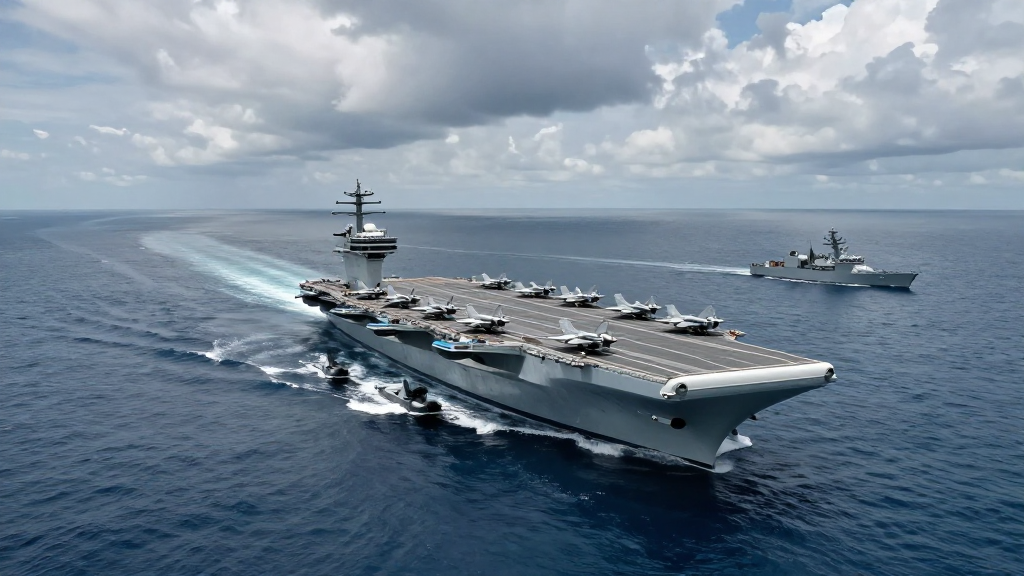
China’s newest aircraft carrier, the Fujian, steamed through the Taiwan Strait this week for the first time since December, a transit that coincided with Taiwan’s own five-day military exercises and a wave of US-led drills sweeping across the Pacific. The simultaneous movements of Chinese and American military assets have turned the western Pacific into a chessboard of competing demonstrations of force, with allies of Washington carrying out their own coordinated operations at the same time Beijing was flexing its carrier capabilities.
Chinese Carrier Transit Coincides With Taiwan, US Exercises
Taiwan’s Ministry of National Defense reported the Fujian’s transit on Tuesday, releasing aerial photographs of the carrier passing through the 110-mile-wide waterway that separates the island from mainland China. The transit came one day after Taiwan began its own weeklong combat readiness exercise, which included command-and-control, logistics, battlefield maneuvering and live fire drills.
“The military is closely monitoring the situation using joint intelligence, surveillance, and reconnaissance methods,” Taiwan’s Ministry of National Defense said in a news release. China’s Taiwan Affairs Office spokesperson Zhang Han described Taiwan’s drills as a “sinister intention to seek independence through force,” according to the state-sponsored Global Times.
The Fujian is China’s third aircraft carrier and the first built entirely domestically. Unlike the Liaoning and the Shandong, which use ski-jump launch systems, the Fujian is equipped with electromagnetic catapults — a technology only previously deployed on the US Navy’s USS Gerald R. Ford. The carrier last transited the Taiwan Strait on December 16, just over a month after its commissioning on November 5.
While Beijing was projecting power through the Taiwan Strait, the US and its allies were conducting their own show of force elsewhere in the Pacific. The Rim of the Pacific exercise, featuring approximately 25,000 personnel from a record 31 nations, began around Hawaii and runs through July 31. The US-led Valiant Shield exercise in the western Pacific — with forces from Australia, Canada, Japan and New Zealand — ran concurrently. Separately, the US Marine Corps and Japan’s Ground Self-Defense Force conducted their Resolute Dragon joint exercise.
The US Navy’s George Washington Carrier Strike Group and Japan Maritime Self-Defense Force ships sailed in formation in the Philippine Sea to make an early start to Valiant Shield.
South Korea and Japan Restart Joint Naval Exercises After Nine Years
In a move that analysts say carries as much strategic symbolism as operational weight, South Korea and Japan resumed their biennial joint maritime search-and-rescue exercise — the first such drill in nine years. The exercises were suspended after 2017 as relations deteriorated over historical disputes and a series of military incidents, including a 2018 confrontation over fire-control radar lock-on allegations near Japan’s Noto Peninsula.
“The two governments agreed to resume the drills during defense ministers’ talks in January and finalized plans during meetings on the sidelines of the Asia Security Summit last month,” Japan’s Ministry of Defense said.
South Korea deployed the 4,900-ton landing ship ROKS Cheon Ja Bong, while Japan contributed the 7,250-ton Aegis-equipped destroyer Kongo and a maritime patrol helicopter. The training included vessel rescue, shipboard firefighting, emergency medical treatment and helicopter operations in international waters southeast of Jeju Island.
Competing Visions for Regional Order Converge on the Pacific
The overlapping exercises reflect competing visions for the Indo-Pacific’s future. China has conducted its own dual carrier drills in the South China Sea in recent months, testing new deployment patterns and expanding the operational envelope of its carrier air wings. Beijing views Taiwan as a breakaway province that must be reunified with the mainland — by force if necessary — and has ramped up military pressure on the island in recent years.
The South Korea-Japan rapprochement unfolds against that backdrop. Both nations are treaty allies of the United States, and the exercises reflect a broader realignment of security architecture across the Pacific. The resumption of SAREX is the most visible military symbol of that reset, coming after years in which historical grievances — rooted in Japan’s 1910-1945 colonial rule over Korea — paralyzed defense cooperation at every level.
Regional analysts say the timing is not coincidental. As China’s military footprint grows in the East China Sea, South China Sea and now the Taiwan Strait, the three US treaty allies are moving toward a more integrated posture. The exercises this week, running in parallel rather than sequentially, reflect a new phase in which allied nations are demonstrating collective resolve through simultaneous, coordinated operations spanning thousands of miles of Pacific waters.