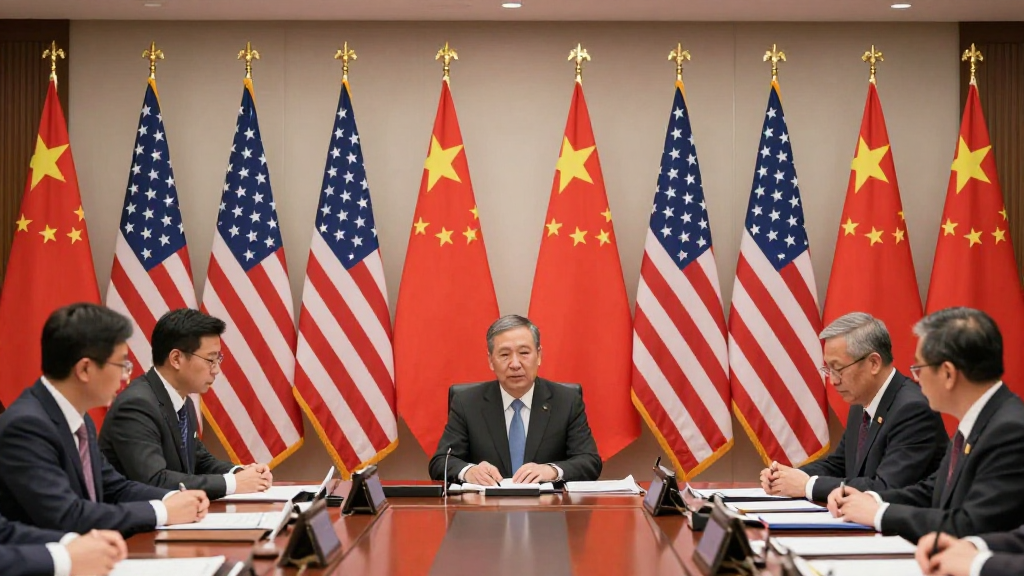
China and the United States have agreed to establish a new monitoring and communication channel to manage rising tensions across multiple flashpoints, senior officials from both governments confirmed Wednesday, marking the most concrete diplomatic breakthrough in months of back-channel negotiations conducted in Doha. The agreement, reached after three rounds of talks over six weeks, comes amid heightened military activity near Taiwan and in the South China Sea that had pushed both sides to the edge of a dangerous standoff.
Agreement Reached After Months of Doha Talks
The deal, described by one senior State Department official as “a hotline with guardrails,” will allow military and diplomatic officials from Beijing and Washington to communicate directly during crises without going through formal embassy channels. The agreement covers potential flashpoints in the Taiwan Strait, the South China Sea, and the Korean Peninsula. It is the first such bilateral communication mechanism China has agreed to with any country since its 2022 talks with India broke down over disputed border protocols.
“We have established a direct line of communication that both sides can use when things get complicated,” the official said in a statement. “This is not a partnership. It is a mechanism to prevent miscalculation.”
Chinese Foreign Ministry spokesperson Mao Ning confirmed the development at a regular press briefing in Beijing, saying the two sides had “reached an important consensus on establishing a communication mechanism for the sake of regional peace and stability.” She added that the channel would be “operational in the coming weeks.”
What the Monitoring Channel Covers
The new framework is narrower than earlier U.S. proposals for a broader strategic dialogue. It does not include economic or trade issues, which remain subject to separate tariff negotiations. Instead, it focuses exclusively on military-to-military communication during incidents at sea or in the air.
Under the terms of the agreement, both sides will designate liaison officers available around the clock. When a potential incident occurs — such as a near-collision between naval vessels or an unscheduled military aircraft intercept — the liaison officers will be able to speak within minutes rather than the hours or days required by traditional diplomatic channels.
The deal also includes a commitment to notify the other side within 24 hours of any major military exercises in close proximity to the other’s territory or claimed waters. That provision is aimed directly at preventing the kind of surprise drills that have repeatedly raised alarm in Taiwan and the South China Sea over the past two years. U.S. defense officials said the notification window could be shortened to 12 hours for exercises involving live ammunition.
Ceasefire Framework in Separate Track
The monitoring channel is distinct from the ceasefire negotiations that have been taking place separately, U.S. officials emphasized. Those talks, which have involved Russian and Ukrainian intermediaries in Istanbul and Riyadh, remain focused on ending the conflict in Ukraine and have not yet produced a formal agreement. The Doha channel was negotiated entirely separately and has no operational overlap with the Ukraine process.
The Doha channel, by contrast, is a bilateral U.S.-China mechanism. It does not include Russia, Ukraine, or any other party. Officials on both sides were careful to frame it as a confidence-building measure, not a peace negotiation. Chinese officials have been particularly sensitive to that distinction, worried that any association with the Ukraine talks could imply Beijing has a stake in their outcome.
What Happens Next
Both governments are expected to formally announce the agreement in the coming days, with senior officials from each side holding a joint press conference in Geneva. The liaison offices will be physically located in each country’s respective embassy in the other’s capital, but the communication line itself will operate independently of diplomatic channels to ensure it cannot be disrupted by broader political tensions.
The first real test of the new mechanism could come soon. U.S. and Chinese naval vessels have been operating in close proximity in the South China Sea with increasing regularity, and Pentagon officials have privately warned that the risk of an incident is elevated. The monitoring channel is designed precisely to defuse such situations before they escalate. American officials say they expect the first joint exercise notification — a kind of stress test — within 30 days of the channel going live.