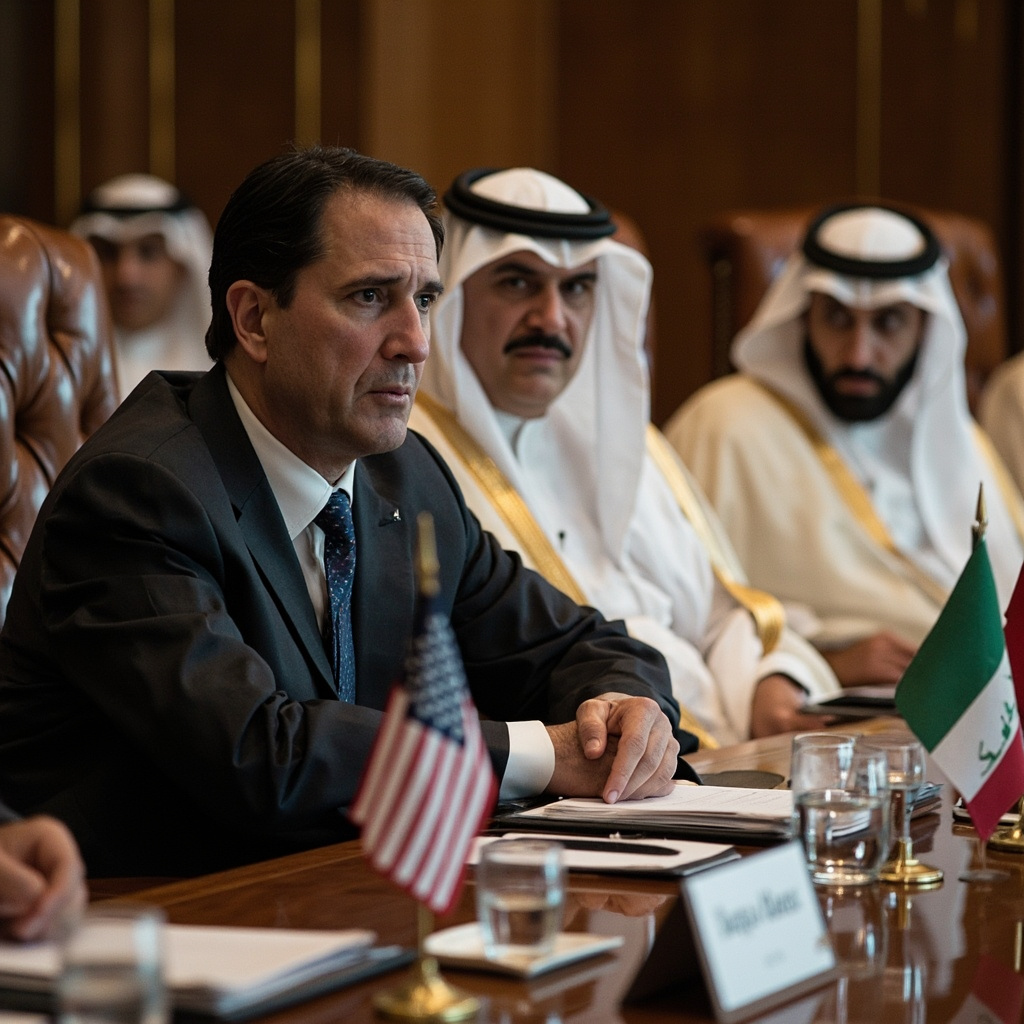
President Donald Trump announced on Monday that a meeting between the United States and Iran would take place in Doha on Tuesday, June 30, only for Tehran to deny within hours that any such session was scheduled, throwing fresh uncertainty over a fragile ceasefire and the fate of one of the world’s most critical shipping lanes.
Posting on his Truth Social platform, Trump wrote: “IRAN HAS REQUESTED A MEETING. IT WILL TAKE PLACE TOMORROW IN DOHA!” He did not specify which officials would attend or offer further details. The White House later said special envoy Steve Witkoff and senior adviser Jared Kushner would travel to Doha this week for high-level discussions. Iranian Foreign Ministry spokesman Esmaeil Baqaei rejected the claim within hours, saying there would be no negotiations with Washington “at any level” in the coming days. “We have not yet entered the stage of negotiating a final agreement,” Baqaei said. He confirmed an Iranian technical delegation would travel to Doha this week, but solely to discuss implementation of the existing Hormuz ceasefire agreement — not to sit across from American counterparts.
Ceasefire Under Strain
The competing narratives exposed the fragility of a US-Iran ceasefire signed earlier this month, which had temporarily halted the direct military exchange that followed Iran’s attacks on US facilities in Kuwait and Bahrain. Under the agreement, both sides committed to talks on reopening the Strait of Hormuz — a waterway bordered by Iran and Oman that carries roughly one-fifth of the world’s oil and liquefied natural gas shipments. Despite the ceasefire, commercial shipping through the strait has slowed sharply. Maritime tracking firm Kpler reported that only 29 commodity vessels crossed the waterway last week, a fraction of normal volumes. Oil industry executives have warned the Trump administration that the disruption is draining global inventories at a pace that could send energy prices surging in the coming weeks. Shipping sources say some vessels are diverting to longer Cape of Good Hope routes, adding up to two weeks to transit times and increasing costs across global supply chains.
Despite the drop in traffic, US Central Command confirmed it struck 10 Iranian military targets on Sunday, citing continued aggression against commercial shipping in and around the Gulf. Iran’s Islamic Revolutionary Guard Corps responded by saying Iran reserved the right to retaliate, even under the ceasefire framework, if it deemed strikes a violation of the agreement’s terms. The exchange underlined how thin the ceasefire margins remain and how quickly either side could escalate.
Hormuz Agreement Implementation
The Doha confusion unfolded against a backdrop of slow, grinding progress on the Hormuz agreement itself. Iran and Oman held their first joint committee meeting in Muscat on Monday to discuss implementation. Iran’s Deputy Foreign Minister Kazem Gharibabadi said the Joint Hormuz Committee convened to address the mechanics of a new shipping corridor and de-mining operations. France and Oman had separately announced plans for joint de-mining efforts following talks between President Emmanuel Macron and Sultan Haitham bin Tariq. Iran rejected that proposal outright. “Under the agreement, only Iran will conduct de-mining operations,” Gharibabadi said. “The situation is sensitive and complex. We strongly advise France not to complicate it further with its provocations.”
Tehran has further insisted that vessels transiting the strait use a corridor closer to its own coastline — a demand that some international shipping lawyers say conflicts with longstanding conventions on freedom of navigation. Oman, which shares sovereignty over the strait with Iran, has tried to remain neutral but faces pressure from both sides. Regional analysts say the practical details of the Hormuz agreement — who monitors compliance, who pays for de-mining, and how disputes are arbitrated — remain almost entirely unresolved.
What Comes Next
With no meeting confirmed and both sides talking past each other from Doha, mediators face mounting pressure to prevent the ceasefire from collapsing entirely. Omani officials, who have served as intermediaries throughout the conflict, are expected to host further sessions this week. A senior Omani diplomat said efforts were focused on establishing a “working channel” separate from any headline-grabbing summit. European governments are watching closely. France, Britain, and Germany issued a joint statement urging “maximum restraint” and offering to support any credible de-escalation framework. “We stand ready to assist in any way that brings both sides closer to a durable arrangement,” the statement said. For now, the strait remains open in name but degraded in practice — and the gap between Washington’s announcements and Tehran’s denials shows how little trust separates the two sides from a wider relapse into conflict.