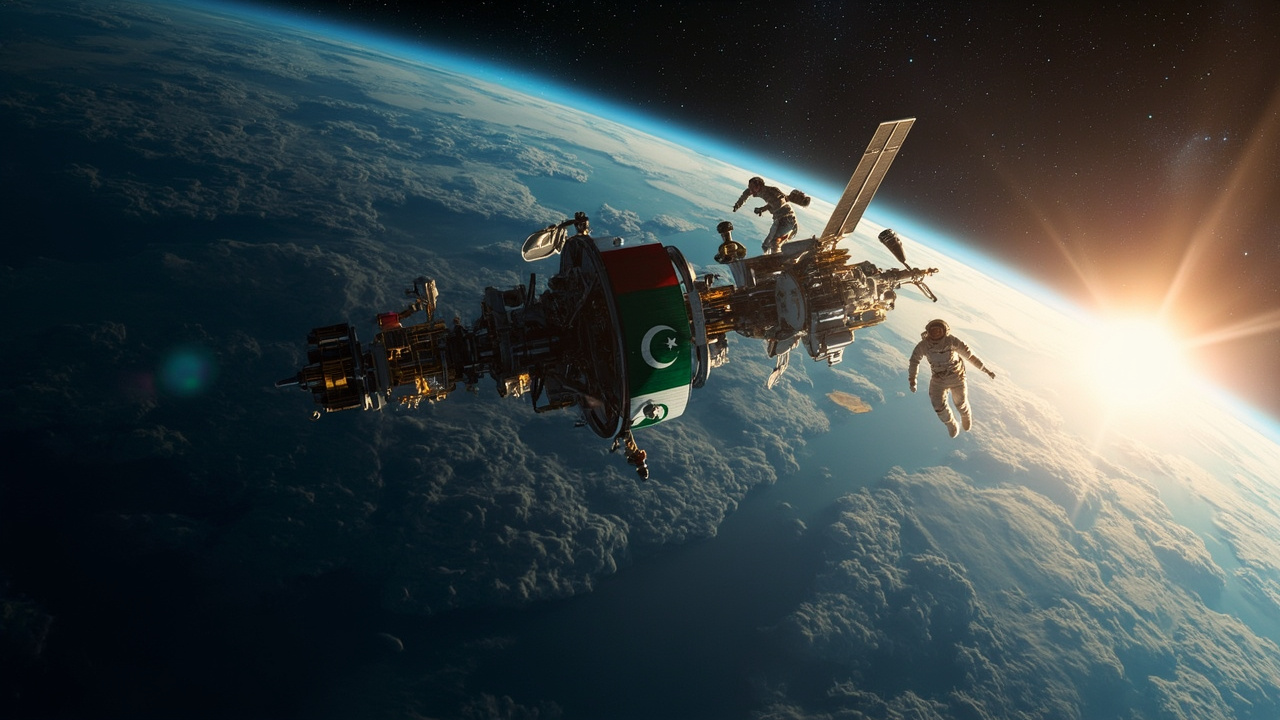
When Muhammad Zeeshan Ali and Khurram Daud suit up and board a flight to China in the coming weeks, they will carry with them more than Pakistan’s space ambitions. They will carry the weight of a geopolitical realignment that has been years in the making — one that is now reaching, quite literally, for the stars.
On April 22, 2026, the China Manned Space Agency announced that the two Pakistani candidates had been selected as the first foreign astronauts to train for missions to the China Space Station (CSS). After completing rigorous training and evaluations at the Astronaut Centre of China, one of them will fly as a payload specialist — becoming the first non-Chinese national ever to set foot aboard Tiangong. It is a milestone that transcends science, and its reverberations will be felt from Islamabad to Washington to New Delhi.
The Selection: A Year in the Making
The roots of this moment trace back to February 2025, when Beijing and Islamabad signed a bilateral agreement on astronaut recruitment, training, and participation in the CSS program during a ceremony in the Pakistani capital. What followed was a meticulous three-stage selection process — preliminary screening, secondary evaluation, and final selection — that winnowed a large pool of candidates down to just two names.
Both Ali and Daud are seasoned professionals with deep expertise in engineering and scientific research. They will travel to China as reserve astronauts, undergoing months of intensive preparation that includes underwater survival training, centrifuge exercises, and systems familiarization on Tiangong’s modules. Upon successful completion, one will be designated for a late-2026 mission to the station, where he is expected to conduct experiments in material science, fluid physics, life sciences, and biotechnology.
“The selection and training for Pakistan’s astronauts mark a milestone in China’s space history and a landmark achievement in the international cooperation efforts of CSS.” — China Manned Space Agency statement
Space as Soft Power: China’s Diplomatic Calculus
For Beijing, the decision to open Tiangong’s hatches to a foreign astronaut is not simply an act of scientific generosity. It is a calculated move in the escalating contest for global influence — one that mirrors the dynamics of Cold War space competition, but with a distinctly 21st-century twist.
The International Space Station (ISS), the longtime symbol of Western-led orbital cooperation, is approaching the end of its operational life, with NASA currently planning a controlled deorbit by 2031. As that chapter closes, China is positioning Tiangong as the successor platform — and it is offering seats at the table to strategic partners. Pakistan, China’s closest ally in South Asia and a cornerstone of the Belt and Road Initiative, was the natural first choice.
The symbolism is impossible to miss. While the United States has historically barred China from participating in the ISS program — an exclusion rooted in national security concerns dating back to the 2011 Wolf Amendment — Beijing is now extending invitations in the opposite direction. The message to the developing world is unambiguous: China shares its achievements, while the West hoards them.
The India Factor: A Strategic Signal
The selection of Pakistani astronauts also lands with particular force in New Delhi. India, which has its own rapidly advancing space program — including the successful Chandrayaan-3 lunar landing in 2023 and the Gaganyaan human spaceflight initiative — has watched China’s space partnerships with growing unease. The sight of Pakistani astronauts training for China’s space station sends a clear signal about the depth of the Beijing-Islamabad strategic alliance, one that extends far beyond military hardware and economic corridors.
Indian strategic analysts have noted that the timing is deliberate. Relations between New Delhi and Beijing remain strained following the deadly Galwan Valley clash in 2020 and ongoing tensions along the Line of Actual Control in Ladakh. Meanwhile, Pakistan’s deepening space partnership with China adds a new dimension to the triangular rivalry that defines South Asian geopolitics.
“It is no coincidence that the country chosen for this inaugural foreign astronaut program is Pakistan — China’s most reliable strategic partner and India’s most persistent adversary. This is space diplomacy with a purpose.” — Dr. Rajeswari Pillai Rajagopalan, Director of the Centre for Security, Strategy and Technology, Observer Research Foundation
What It Means for the Global Space Order
The implications extend well beyond South Asia. By choosing Pakistan as its first international partner for human spaceflight, China has established a template for future collaborations. Several nations in Africa, Southeast Asia, the Middle East, and Latin America have already signed agreements or expressed interest in conducting experiments aboard Tiangong. The Pakistani mission, if successful, will serve as a powerful proof of concept — demonstrating that China can not only build and sustain a space station but also safely transport and host foreign personnel.
For the United States and its allies, this development underscores a troubling reality: the era of uncontested American dominance in space is ending. As NASA pivots toward its Artemis program and commercial partners like SpaceX push the boundaries of lunar exploration, China is building an alternative ecosystem — one that appeals to nations historically excluded from the Western space architecture.
The space race of the 21st century, it turns out, will not be a sprint between two superpowers. It will be a sprawling contest of alliances, partnerships, and soft-power outreach — and China has just won an early, visible, and symbolically potent round.
Looking Ahead: The Late-2026 Mission
The timeline for the actual mission remains fluid, but officials in both Beijing and Islamabad have indicated a target launch window in late 2026. The selected astronaut will spend several weeks aboard Tiangong, conducting a suite of scientific experiments designed by Pakistani researchers in collaboration with Chinese counterparts. The areas of study — material science, fluid physics, life sciences, biotechnology — are deliberately chosen to yield practical benefits in climate resilience, food security, and industrial innovation.
SUPARCO, Pakistan’s Space and Upper Atmosphere Research Commission, has described the mission as a transformative step that places Pakistan among a small group of nations involved in human spaceflight. It is an audacious claim for a country that, until now, had no indigenous human spaceflight capability — but it is precisely the kind of leap that strategic partnerships
make possible. China provides the hardware, the training infrastructure, and the orbital platform. Pakistan provides the talent, the political loyalty, and the global showcase.
As the world watches Ali and Daud prepare for their journey, the larger story is becoming clear: the final frontier is no longer just about exploration. It is about influence, access, and the right to claim a place in the cosmos — not as a supplicant, but as a partner. For Pakistan, and for the developing world watching closely, that distinction matters enormously.
Elena Rodriguez is an International Affairs Correspondent for Media Hook, covering global diplomacy, conflict, and the emerging world order.