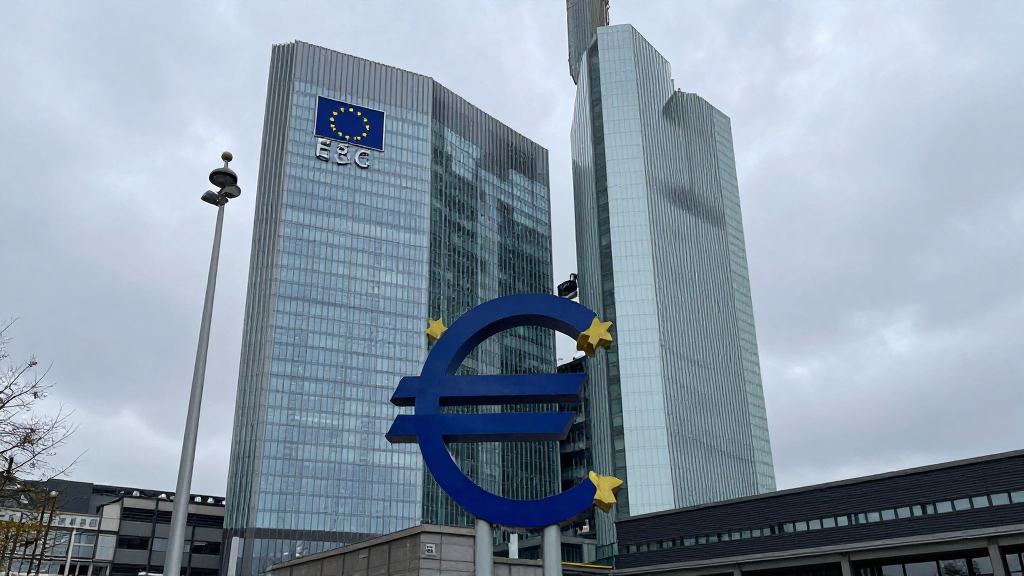
The ECB Breaks Ranks: First Rate Hike Since 2023
The European Central Bank raised its key interest rate by 25 basis points to 2.25% on Thursday, marking the first hike since 2023 and the first by any major global central bank in direct response to the energy shock triggered by the U.S.-Iran war. The decision, which markets had priced in with near-certainty, reflects the ECB’s determination to prevent the Middle East conflict from becoming entrenched in European inflation expectations. The Governing Council voted unanimously for the move, a signal of institutional resolve at a moment when geopolitical risk is testing the boundaries of central bank orthodoxy.
Christine Lagarde, the ECB president, underscored the gravity of the moment at a press conference following the decision. “The war in the Middle East is generating inflation pressures, and the decision to raise rates is robust across a range of scenarios mapping out how the shock might evolve and affect the medium-term outlook for the euro area,” she said. The ECB’s statement made clear that officials are not pre-committing to a particular rate path, leaving the September meeting as a live option for additional tightening depending on how energy prices and wage data evolve.
War-Driven Inflation vs. Stalling Growth: The ECB’s Impossible Dilemma
The ECB’s June forecast update tells the story of an economy being pulled in two directions simultaneously. Headline inflation is now projected to average 3% in 2026, revised sharply upward from the 2.3% projection in March, before cooling to 2.3% in 2027 and settling at 2% by 2028. The culprit is energy: the closure of the Strait of Hormuz and the destruction of production facilities across the Persian Gulf have created the most severe supply constraint in global energy markets since the 1970s embargo. These higher energy costs are now expected to cascade into food prices, manufactured goods, and services, pushing the peak inflation horizon further out than many economists had anticipated.
Simultaneously, the growth outlook has deteriorated. The ECB now expects eurozone GDP to grow just 0.8% in 2026, down from 1.4% projected in March, with 1.2% growth in 2027 and 1.5% in 2028. The first quarter of 2026 saw the eurozone economy expand by a mere 0.1%, flirting with contraction. Mark Wall, chief European economist at Deutsche Bank, described the June hike as “a significant moment” in a note to clients. “Not only is this the first ECB hike since 2023, it is also the first hike by one of the major global central banks in response to the energy shock,” he wrote. “The ECB is saying that a look-through strategy is not a robust response. The question is how far can this tightening cycle go? Not far, is our answer. One more hike in September and that’s it.”
The Fed’s Silence Speaks Louder Than Words
While the ECB moved decisively, the Federal Reserve held its benchmark rate steady in its June meeting, concluding a two-day policy review without signaling any imminent shift. The contrast between a central bank hiking into a war-driven supply shock and one holding steady despite three-year high inflation readings has rattled currency markets. The dollar has weakened against the euro as traders price in a narrowing rate differential, with the EUR/USD pair testing levels not seen since early 2025. This currency dynamics add another layer of complexity for multinational corporations that earn revenues in dollars but report in euros.
Markets had been positioned for the Fed to signal greater urgency on inflation, and the absence of hawkish language from Chair Jerome Powell surprised traders who had built in a higher probability of a rate move. The Fed’s dot plot, released alongside its June statement, showed a median projection of two cuts remaining on the table for 2026, but with a wider dispersion of views among committee members than in prior quarters.
Global Divergence Deepens as Central Banks Reach Inflection Points
The ECB’s move crystallizes a broader pattern emerging in global monetary policy: central banks are reaching simultaneous inflection points from opposite directions. The Bank of England, facing its own energy-driven inflation pressure alongside a softening labor market, is expected to hold rates at its July meeting before potentially cutting in September. The Bank of Japan continues its cautious normalization path, slowly unwinding its yield curve control framework while carefully monitoring yen volatility. And emerging market central banks, already squeezed by dollar strength and capital outflows, now face an additional complication: the ECB’s hawkish shift is pushing the euro higher, which relative to dollar-pegged currencies creates its own set of trade competitiveness dynamics.
Neil Birrell, chief investment officer at Premier Miton, noted that the ECB’s move is likely the opening act of a broader reassessment among G10 central banks. “Encouragingly, they don’t see much risk to GDP, although growth expectations are already muted,” he said in a note following the announcement. “This is likely to be followed by more rate hikes this year, depending on the data, but it’s hard to think this is the end of the policy move.” The yield on the 10-year German bund, the benchmark for eurozone borrowing costs, fell 2 basis points in afternoon trading as investors concluded the ECB may be nearing the end of its tightening cycle despite the hawkish rhetoric. The structural question facing global investors is whether the Iran conflict represents a permanent or transient repricing of the energy landscape. If a ceasefire opens Hormuz and brings Persian Gulf output back online, the ECB’s inflation forecasts will look overstated within months, and the current 2.25% rate will be remembered as the peak of this cycle rather than merely the floor. If the conflict deepens and spreads to other Gulf flashpoints, the supply shock becomes permanent, and central banks across the developed world will find that the genie cannot be stuffed back into the bottle without inflicting far more economic damage than the war itself has so far caused.