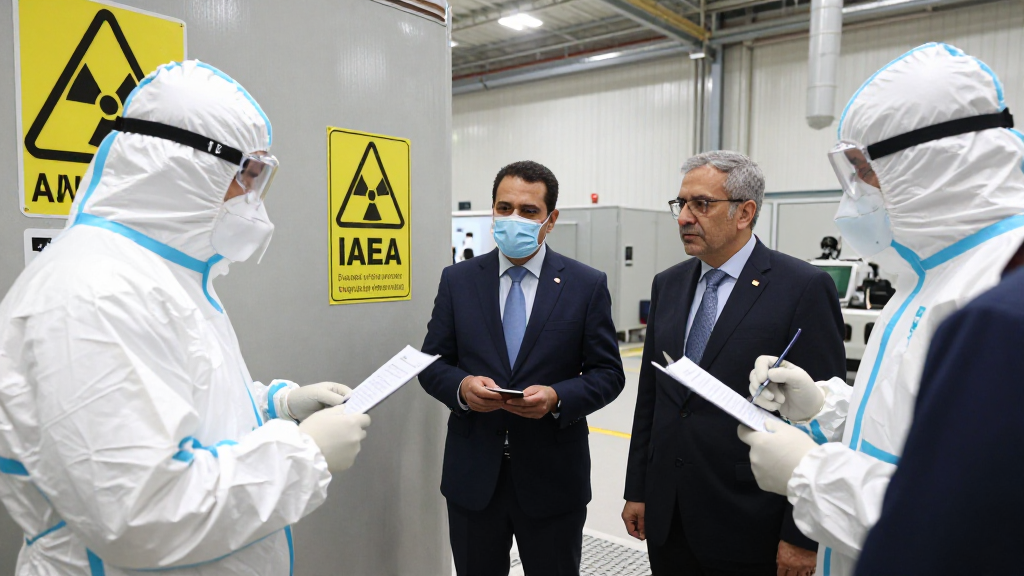
The United States and Iran remained at odds Tuesday over whether Tehran had agreed to allow United Nations inspectors to view bombed Iranian nuclear sites, a dispute that threatens to derail fragile talks aimed at ending a 15-month war and finalizing a permanent peace agreement within a 60-day window.
The disagreement surfaced publicly a day after U.S. Vice President JD Vance said during a press conference in Switzerland that Iran had agreed to grant the International Atomic Energy Agency access to nuclear facilities that the United States struck last year. Iranian officials quickly denied that any such commitment had been made, raising fresh questions about the durability of a preliminary framework signed earlier this month.
“UN inspectors were not scheduled to examine the nuclear sites bombed by the United States last year,” Iran’s Foreign Ministry spokesperson Esmail Baghaei told reporters in Tehran on Tuesday, refuting Vance’s account. President Donald Trump responded on social media that Iran had agreed to nuclear inspections extending far into the future, warning that without the concession “there would be no further negotiations!”
Conflicting Accounts From Switzerland Talks
The dispute stems from negotiations held in Switzerland between U.S. and Iranian technical teams, which produced a preliminary agreement and a 60-day roadmap for reaching a comprehensive deal. Vance, who helped lead the U.S. delegation alongside Special Envoy Steve Witkoff, said the arrangement included IAEA access to previously targeted enrichment sites. Iranian Foreign Minister Abbas Araghchi, who also attended the talks, has not publicly confirmed that characterization.
The IAEA has not responded to requests for comment about its possible role. The agency has been in and out of Iran since Israel’s 12-day war in 2025 but has not been granted access to bombed enrichment facilities. The conflicting accounts expose the deep mistrust that persists between the two sides despite the preliminary ceasefire reached earlier this month.
Technical teams from both countries are working through a series of working groups created during the Switzerland talks, covering sanctions relief, nuclear issues, reconstruction and monitoring mechanisms, according to Iran’s state-run IRNA news agency. Deputy Foreign Minister Kazem Gharibabadi said the countries also established a contact mechanism to address ship movements through the Strait of Hormuz and the ongoing fighting between Israel and Hezbollah in Lebanon.
Stranded Seafarers and a Bottlenecked Waterway
While diplomats spar over inspections, the International Maritime Organization announced Tuesday that a plan is underway to evacuate approximately 11,000 stranded seafarers through the Strait of Hormuz, the narrow mouth of the Persian Gulf through which a fifth of all globally traded oil and natural gas passed before the war began on February 28.
The operation is being conducted in cooperation with Iran, Oman, all other coastal states in the region, the United States and the maritime industry, according to IMO Secretary-General Arsenio Dominguez. “We have secured the necessary safety guarantees and have thoroughly verified the conditions for safe navigation to support these operations,” he said in a statement.
Ship traffic is beginning to resume. Data firm Kpler confirmed 39 ships crossed through the strait Monday, following approximately 92 crossings between Friday and Sunday. Prior to the war, roughly 100 ships made the journey daily. Questions remain about who controls the waterway and whether the ceasefire arrangement can sustain commercial traffic over the long term.
Lebanon Ceasefire Tested as Pezeshkian Visits Islamabad
The broader diplomatic effort faced an immediate test Tuesday when Israeli soldiers opened fire in southern Lebanon, killing two people. The incident broke two days of calm following a ceasefire brokered on Saturday and highlighted the fragility of regional de-escalation. No Israeli airstrikes or artillery shelling have been reported since Sunday, and Hezbollah has not claimed any attacks, marking the longest halt in fighting since the latest Israel-Hezbollah war erupted on March 2.
Any renewal of heavy fighting could threaten the broader U.S.-Iran talks, since Tehran has demanded that a full truce in Lebanon form part of any comprehensive agreement. Israel occupies part of Lebanon and maintains it must retain the ability to strike militants launching attacks into northern Israel.
Iranian President Masoud Pezeshkian arrived in Islamabad on Tuesday for his first visit since the war began, meeting with Pakistani President Asif Ali Zardari and Prime Minister Shehbaz Sharif. Pakistan has served as a back-channel mediator in the talks. Foreign Minister Abbas Araghchi accompanied the delegation. “The effectiveness of the talks depends on full commitment to the agreed obligations and their precise implementation,” Pezeshkian said ahead of the meetings.
What Comes Next
Both governments face a July deadline to convert the preliminary framework into a final agreement. The inspections dispute is the most immediate obstacle, but analysts say differences over sanctions relief, the scope of Iran’s civilian nuclear program and the status of frozen Iranian assets abroad all remain unresolved.
The United Nations General Assembly session in September will serve as the next major checkpoint. A senior White House official said the administration expects to present a final document to Congress by then, though that timeline faces significant legislative and diplomatic obstacles. World leaders are watching whether the competing accounts from Geneva can be reconciled before the 60-day window closes.