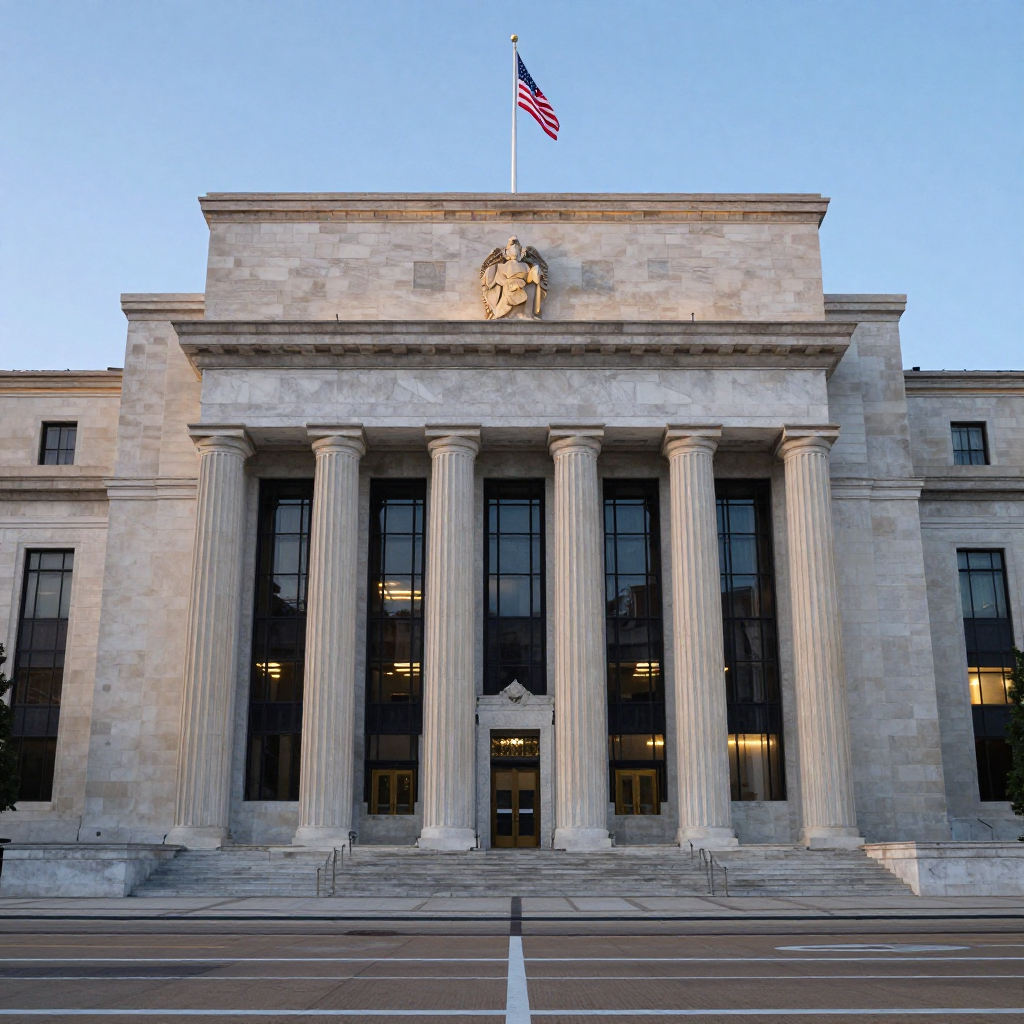
Fed Balance Sheet at $6.73 Trillion as of June 10, Down 1.4 Trillion From the 2022 Peak
The Federal Reserve’s balance sheet stood at 6.73 trillion dollars as of June 10, 2026, down 1.4 trillion dollars from the 8.96 trillion dollar peak in early 2022 and roughly in line with the 6.5 to 6.8 trillion dollar range that Chair Powell had identified as the long-run floor for the portfolio. The current quantitative tightening pace, capped at 25 billion dollars a month of U.S. Treasury runoff since June 2024 and 35 billion dollars a month of agency MBS runoff since September 2024, has been steady and predictable, and the System Open Market Account currently holds 4.21 trillion dollars of U.S. Treasuries and 2.27 trillion dollars of agency MBS, with the residual being gold, SDRs, and the TALF and other crisis-era facilities. Warsh’s first press conference on June 17, 2026 included the announcement of a balance sheet task force, which will examine the appropriate pace and composition of the runoff, with preliminary findings due in September. The market is interpreting the task force as a signal that QT could be slowed or paused sooner than the markets had expected, particularly given the rising 30-year auction term premium and the persistent reverse repo facility usage by money market funds.
Why the Balance Sheet Task Force Matters: Reserve Scarcity and the Plumbing
The balance sheet composition matters as much as the size. The Fed’s overnight reverse repo facility usage has stabilized at 280 to 320 billion dollars over the last three months, well above the 0 to 50 billion dollar range that the New York Fed considers consistent with ample reserves, and the take-up has actually increased modestly from the 240 billion dollar low in March 2026. Reserves in the banking system are at 3.12 trillion dollars, down from the 4.20 trillion dollar peak in 2022 and within the 2.8 to 3.2 trillion dollar range that most regional Fed presidents have identified as the lowest comfortable level. The plumbing is now at the point where any unexpected drawdown in reserves, from a Treasury General Account rebuild or a year-end balance sheet effect, could push the federal funds rate off the target and force the Fed to slow QT or restart purchases. Warsh’s task force is widely expected to recommend either slowing the Treasury runoff to 15 billion dollars a month from 25 billion, or pausing the runoff entirely once reserves reach 3.0 trillion dollars, both of which would be a significant easing of financial conditions relative to the current trajectory. The September preliminary report will be the first concrete signal of the new framework.
The Curve, the Dollar, and the Cross-Asset Reaction to a Slower QT
The market reaction to a slower QT path is asymmetric: the 10-year UST yield would fall 8 to 12 basis points to 4.20% to 4.24% on the announcement, and the 30-year UST yield would fall 10 to 15 basis points to 4.66% to 4.71%, as the long end captures most of the duration benefit. The 2-year UST would be relatively unchanged at 4.01% to 4.03%, as the front end is anchored by the rate path rather than the balance sheet. The 2s10s curve would steepen 8 to 12 basis points to 39 to 43 basis points, reversing most of the post-FOMC flattening. The dollar index would weaken 0.5% to 0.7% to 103.50 to 103.80, with EURUSD strengthening 0.5% to 1.0880 and USDJPY weakening 0.6% to 159.10, putting USDJPY closer to the 158.00 to 159.00 range that Japanese officials have publicly identified as the intervention trigger. Gold would rally 1.5% to 2.0% to 4,355 to 4,380 dollars an ounce as real yields fall, and the S&P 500 would rally 0.8% to 1.2% to 7,520 to 7,550, with the homebuilder ETF outperforming by 2.0% to 2.5% on the lower mortgage rate implied by the steeper curve. The cross-asset picture is one of a Fed that is still hawkish on the rate path but is preparing to ease the balance sheet trajectory, and the September task force report will be the first concrete test of whether the easing is large enough to offset the dot plot hawkishness.
What to Watch in the Next Two Weeks: The 30-Year Auction, the Beige Book, and the May PCE
Three prints will determine whether the balance sheet task force is the start of a less restrictive Fed regime or a one-off communication choice. First, the 30-year Treasury auction on June 18, where the when-issued yield at 4.84% reflects the current QT trajectory and a tail of more than 2 basis points would suggest the long end is pricing reserve scarcity, validating the task force concerns. Second, the Fed Beige Book on June 25, which will be the first regional intelligence report under the Warsh regime and will be scrutinized for any softening in the labor market that could reinforce the case for slower QT. Third, the May 2026 PCE on June 27, where a headline print below 0.1% month over month and a core print below 0.20% would soften the inflation backdrop and could allow the FOMC to combine a hold on the rate path with a slowing of the QT pace, while a hot core print above 0.27% would lock the FOMC into a hawkish stance on both the rate and the balance sheet. The combination of a soft 30-year auction, a Beige Book showing labor softening, and a soft May PCE print would create a dovish trifecta that pushes the 30-year UST below 4.70% and the 30-year mortgage rate below 7.00%, while a tail at the auction combined with a hot PCE would force Warsh to defend the current QT pace and raise the risk that the September task force report will be hawkish rather than dovish.