Fed Holds But Dot Plot Turns Hawkish as Global Growth Set to Weakest Since COVID-19
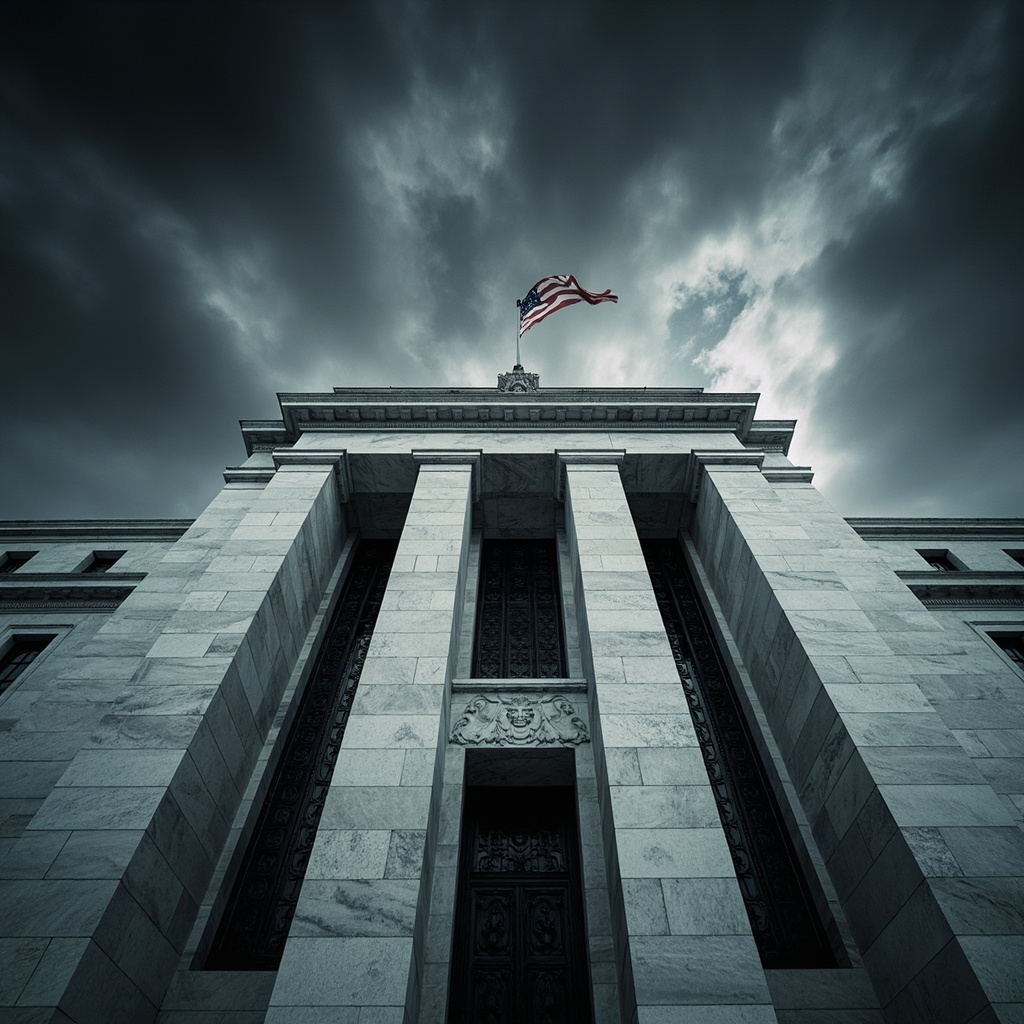
Fed Holds Rates but Dot Plot Turns Sharply Hawkish Under New Chairman Warsh
The Federal Reserve kept its benchmark interest rate steady at 3.50%-3.75% on Wednesday, but Kevin Warsh’s first meeting as chairman produced a dramatically more hawkish outlook than markets had anticipated. The central bank’s updated Summary of Economic Projections now shows officials expect the fed funds rate to end 2026 at 3.8% — implying at least one rate hike this year — compared to the prior March forecast of 3.4%, which had pointed toward a cut.
The FOMC voted unanimously to hold rates, consistent with market expectations going into the June 17 meeting. However, the post-meeting statement was radically condensed to just 130 words, down from 341 in April, and stripped of all forward guidance language that had previously signaled a two-sided bias toward either cutting or raising rates. The new statement offered only bare-bones observations about economic conditions and a vow to maintain price stability.
“The conflict has taken a toll on global activity, but every crisis also brings an opportunity,” said Ayhan Kose, the World Bank Group’s Deputy Chief Economist and Director of the Prospects Group. “This moment should be used to strengthen policy frameworks, invest in infrastructure, accelerate business-enabling reforms, and mobilize private capital to support job creation at scale.”
World Bank Slashes Global Growth to Lowest Since COVID-19 as Gulf Economies Near Zero
Separately, the World Bank delivered an even more sobering assessment on June 11, cutting its global growth forecast to 2.5% for 2026 — the weakest pace since the COVID-19 pandemic — down from 2.9% in 2025. The organization attributed the downgrade primarily to the conflict in the Middle East, which has severely disrupted energy markets through the closure of the Strait of Hormuz.
Brent crude oil prices are now projected to average $94 per barrel in 2026, a 36% increase over 2025 levels, with the worst disruptions assumed to ease in July. The knock-on effects extend well beyond energy. Fertilizer prices are forecast to surge significantly, pushing food prices higher across developing economies already struggling with elevated inflation. Global inflation is expected to reach 4.0% in 2026, up sharply from 3.3% in 2025.
The conflict’s impact on the Gulf states is severe. Economies in the region directly affected by the hostilities are expected to see growth tumble from 3.9% in 2025 to close to zero in 2026, dealng a massive blow to nations that rely on oil revenues and regional trade. The World Bank projects a recovery to around 5% growth in 2027-28 as reconstruction spending kicks in and trade routes normalize.
“Developing countries have faced a series of challenges over the last decade,” said Ajay Banga, President of the World Bank Group. “The impact differs by country, but the basic test is the same: protect people and preserve stability today, without giving up on growth and jobs tomorrow.”
Warsh Skips His Own Dot as He Vows to Overhaul Fed Communication
One of the most closely watched aspects of Wednesday’s meeting was Warsh’s absence from the dot plot — he did not submit his own rate forecast, a highly unusual move that broke with decades of FOMC convention. At his post-meeting press conference, Warsh confirmed the omission and defended it squarely.
“I did not submit a dot for me,” Warsh said. “It’s not helpful in the conduct of policy. I suspect by year-end, as I mentioned in my opening statements, there’ll be a review about communication broadly, press conferences, dots, meetings, and the like, transcripts, minutes. This will be part of that. I don’t want to prejudge the outcomes there, but I’m pretty open-minded about what they could be.”
The chairman indicated he is forming task forces to overhaul major Fed operations, with a particular focus on how the central bank communicates its intentions to markets. The compressed statement is the first visible sign of that push. Officials were split on the near-term rate path, with eight of 19 participants expecting no change this year, one anticipating a cut, and nine projecting at least one hike — a much more hawkish tilt than the March setup that had implied a cut.
Inflation Surge Forces Policymakers to Rethink Easing Timeline
The Fed’s revised economic projections reflected the magnitude of the inflation challenge. Officials raised their 2026 inflation forecasts substantially: headline inflation to 3.6% and core inflation (excluding food and energy) to 3.3%, compared to just 2.7% for both measures in the March SEP. The consumer price index for May already registered 4.2% year-over-year, though the core measure came in lower at 2.9%.
The rate path implications are significant. The prior dot plot had indicated one rate cut before year-end; the current grid shows no cuts this year, with the median rate actually ticking above the current 3.625% mid-point of the target range. Markets had begun pricing in a roughly 40% probability of a rate cut by December as recently as early June, but that expectation has largely evaporated following the Fed’s revised guidance and the hawkish committee split.
The World Bank’s analysis frames the global backdrop as a factor the Fed cannot ignore. If energy supply disruptions prove more severe than the baseline assumption, the institution warned, global growth could fall to just 1.3% in 2026 while inflation rises to 4.4%. That scenario would present policymakers with an even more difficult tradeoff between combating persistent price pressures and supporting weakening growth.
The dual shock of a hawksh Fed and a war-disrupted global economy creates a particularly challenging environment for emerging market central banks, which face capital outflow pressures while their currencies weaken and import costs rise. The World Bank has committed up to $100 billion in financing support over 15 months for countries affected by the Middle East conflict, with $50-60 billion available immediately through existing instruments.
