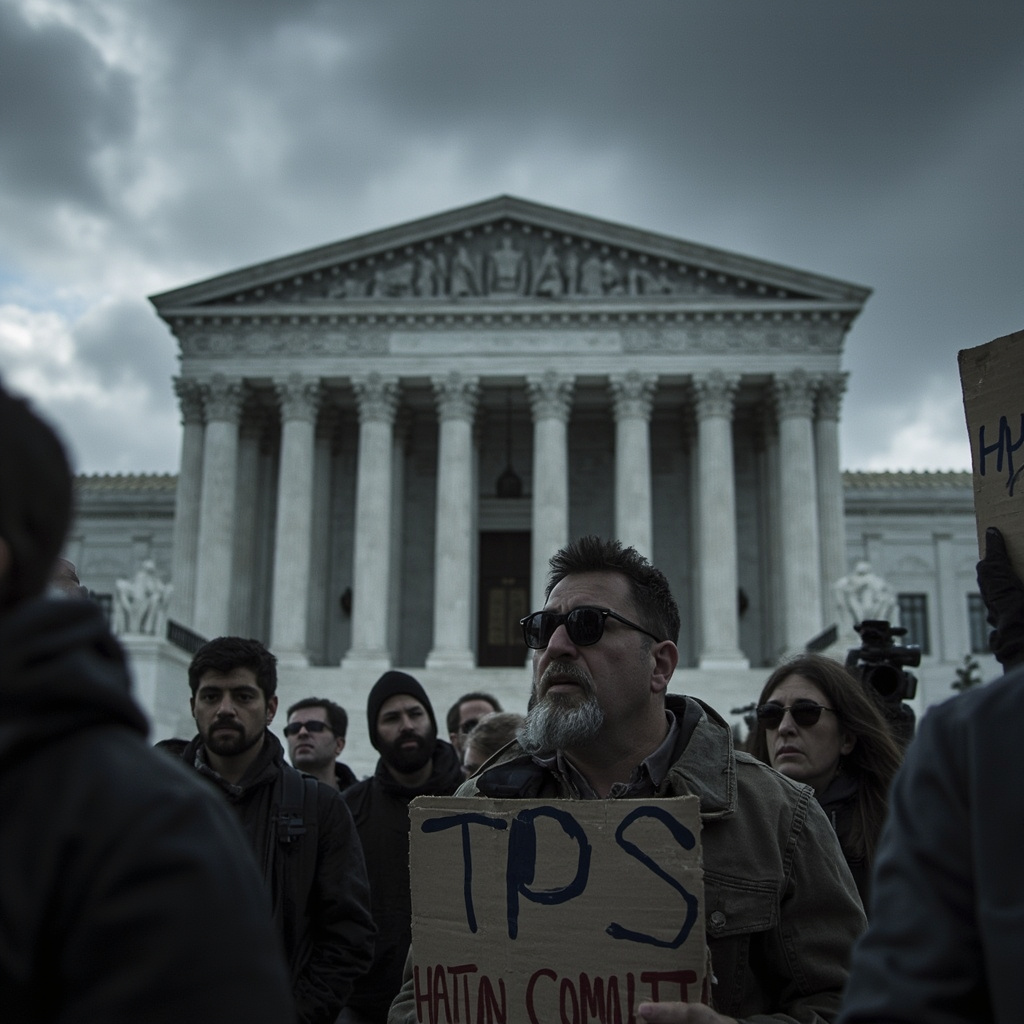
Supreme Court’s Conservative Wing Delivers Trio of Trump Wins on Immigration and Guns as Term Nears End
The Supreme Court’s conservative majority handed President Donald Trump a string of consequential victories Thursday, siding with his administration on immigration enforcement and gun rights in rulings that sent shockwaves through communities already on edge over their legal status. In a 6-3 decision along ideological lines, the justices allowed the Trump administration to immediately end Temporary Protected Status for roughly 350,000 Haitians and thousands of Syrians living legally in the United States — a ruling that could expose hundreds of thousands of immigrants to deportation. The same day, the court struck down a Hawaii law restricting firearms in public spaces and cleared the way for the administration to turn back asylum seekers at the southern border.
The TPS ruling, described by immigration advocates as a humanitarian crisis in the making, affects Haitians who have lived and worked in the United States for years, in some cases decades. The court’s decision overturned lower court injunctions that had temporarily blocked the administration’s termination of the program, which grants temporary legal status to nationals from countries devastated by war, natural disasters, or other extraordinary conditions. Haitians have been eligible for TPS since 2010, following a catastrophic earthquake that killed more than 200,000 people and displaced millions.
Haitian Communities in Ohio and Beyond Brace for Uncertainty
In Springfield, Ohio — home to one of the nation’s largest concentrated Haitian communities — reaction ranged from despair to defiance. The city, still recovering from the political firestorm triggered by Trump’s false claims about Haitian migrants eating pets during the 2024 campaign, braced for what community leaders warned could be an economic and social collapse.
“All of these people are going to have to run away or go somewhere, which I’m pretty sure is going to start tonight,” said Franky Pierre, a Haitian immigrant who arrived in the United States in 1992 after fleeing the aftermath of a military coup in Haiti. Pierre, who operates several Haitian-owned businesses in Springfield, said the ruling had shattered any sense of security his community had rebuilt. “For Springfield, it’s going to hurt. When I came here, this area was dead. In this plaza, there are now seven Haitian businesses. I would say most of the owners are on TPS.”
Viles Dorsainvil, executive director of the Haitian Support Center in Springfield, called the decision a betrayal of justice and human dignity. “We were expecting the Supreme Court to uphold justice and human dignity, but it’s the opposite,” Dorsainvil said. The worst aspect, she warned, is that many Haitian families who have spent years building lives in the United States no longer have support networks waiting for them back in Haiti. “It’s a very sad situation for the Haitian community here.”
Gun Rights Ruling Deepens Partisan Divide on the Court
Thursday’s gun ruling deepened the partisan fault lines that have come to define the Roberts Court’s most politically charged decisions. In a separate 6-3 ruling, the justices struck down Hawaii’s law requiring gun owners to obtain permission from property owners before carrying firearms onto private property open to the public — such as restaurants, parking lots, and shopping centers. The decision marked the latest in a series of expansive gun rights rulings under the current court’s conservative supermajority.
Senate Minority Leader Chuck Schumer, Democrat of New York, accused the court of prioritizing the gun lobby over public safety. “Today’s decision strikes down a commonsense Hawaii law, steamrolls private property rights, and invites more guns into more places where families should feel safe,” Schumer said. “Republicans may be in the pocket of the gun lobby, but the Supreme Court shouldn’t be.” Gun control advocacy groups were quick to denounce the ruling. “I will not mince words: This deeply dangerous majority opinion privileges guns over everything and all people in society,” said Kris Brown, president of Brady: United Against Gun Violence.
Despite the ideological cohesion in the major rulings, there was one notable exception. Justice Brett Kavanaugh’s majority opinion blocking lawsuits against the manufacturer of the weedkiller Roundup — siding with the company over cancer victims who alleged inadequate warnings — was joined by six colleagues, including two liberal justices. Meanwhile, Justice Ketanji Brown Jackson’s dissent was joined by Republican-appointed Justice Neil Gorsuch, a rare cross-ideological pairing that underscored how the court’s usual alignment can bend depending on the specific legal question at stake.
What Remains Unresolved as the Term Winds Down
Thursday’s rulings left several landmark cases still pending as the court approaches the final days of its term. The most politically explosive unresolved case is a challenge to Trump’s executive order attempting to end birthright citizenship for children born in the United States to parents who are in the country illegally or on temporary visas. Federal courts have blocked the order, but the Supreme Court has yet to issue a definitive ruling. Also pending are cases testing whether Trump can fire independent agency heads and whether states can ban transgender athletes from sports consistent with their gender identity.
The court’s willingness to side with the administration on its signature immigration priorities underscores the extent to which Trump’s second-term agenda has been shaped — and in some cases accelerated — by a judiciary stacked with his own appointees. For the hundreds of thousands of Haitians now staring at uncertain futures, the legal battle may be over, but the real consequences are only beginning.