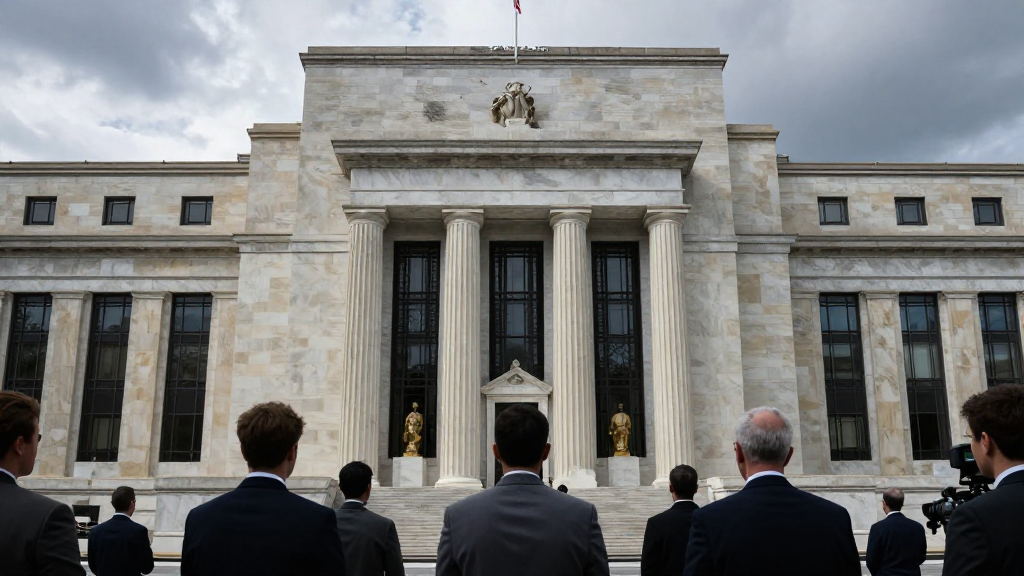
Warsh’s First Meeting: Shorter Statement, Sharper Tone
The Federal Reserve held interest rates steady on Wednesday, keeping its benchmark overnight borrowing rate anchored in a range of 3.5 percent to 3.75 percent, but the real story was written in the margins of the policy statement. In Kevin Warsh’s first meeting as Federal Reserve chairman, the FOMC’s post-meeting communique was slashed from 341 words to just 130, and the prior language indicating a bias toward future rate cuts was erased entirely. The statement offered only a bare-bones summary of economic conditions and a vow to control inflation. Warsh, speaking at a news conference afterward, framed the stripped-down approach as deliberate. “That statement just gives you the facts, as best we can judge it,” he said. “It is a bit shorter, a bit simpler and it dispenses with some older language.” The unanimous vote on rates was itself notable, coming after three regional Fed presidents dissented at the April meeting over what they viewed as overly restrictive forward guidance that ruled out the possibility of future rate hikes.
Warsh declined to participate in the closely watched dot plot, the anonymous grid that shows where each official believes the fed funds rate should be at year-end and beyond. “I did not submit a dot for me,” Warsh confirmed. “It is not helpful in the conduct of policy. I suspect by year-end, as I mentioned in my opening statements, there will be a review about communication broadly, press conferences, dots, meetings, and the like, transcripts, minutes. This will be part of that. I do not want to prejudge the outcomes there, but I am pretty open-minded about what they could be.” The omission of Warsh’s own projection from the grid marks a sharp break from the tradition of Fed chairmen lending their personal outlook to the consensus forecast. Markets interpreted it as a signal that Warsh intends to reshape or possibly eliminate the tool entirely before his tenure is over.
Inflation Forecasts Surge to Multi-Year Highs
The committee’s revised economic projections told a starker story than any statement language. Officials raised their inflation outlook for 2026 to 3.6 percent on a headline basis and 3.3 percent for core inflation, which strips out volatile food and energy prices. That is a significant jump from the March projection of 2.7 percent for both measures, reflecting the inflationary impact of the conflict in the Middle East and the associated energy supply shocks that have rippled through global commodity markets. The consumer price index for May already registered 4.2 percent annually, the highest inflation reading in three years, though the core measure came in lower at 2.9 percent. The divergence between headline and core inflation underscores how much of the current price pressure is being driven by energy markets rather than broad-based domestic demand. The Fed’s dual mandate puts controlling inflation on equal footing with maintaining employment, and the surge in energy prices triggered by the Iran-linked conflict has created a dilemma that no amount of rate policy can directly address.
The GDP growth projection was trimmed to 2.2 percent for 2026, down 0.2 percentage point from March, while the unemployment forecast was nudged lower to 4.3 percent, reflecting continued labor market resilience despite the economic uncertainty. The combination of slower growth and higher inflation has a familiar name that policymakers have been reluctant to use publicly: stagflation. Federal Reserve officials are trained to look through temporary supply shocks, but the geopolitical environment has made it difficult to determine how long energy prices will remain elevated. Productivity growth and capital investment were cited as bright spots in the statement, but these structural improvements have done little to cool consumer prices at the pump and in grocery aisles across the country.
The Dot Plot Rebellion: Nine Officials See a Rate Hike Ahead
Even without Warsh’s input, the dot plot sent a unmistakably hawkish signal. Based on 18 of 19 possible responses, the median estimate for the fed funds rate at the end of 2026 now stands at 3.8 percent, up from 3.4 percent in the March projections. That implies at least one rate hike is expected before the year closes, with the current target range of 3.5 to 3.75 percent sitting below that median. Nine of the 19 committee members indicated they anticipate at least one rate hike this year, while eight expected no change and just one penciled in a cut. The spread between hawks and doves on the committee has rarely been this wide. An additional dot was missing from the 2028 projections, adding to the uncertainty about the long-run trajectory of monetary policy under Warsh’s leadership.
The shift in the dot plot represents a complete reversal of the easing expectations that had been priced into markets entering the year. As recently as January, futures markets were pricing in multiple rate cuts for 2026. That expectation has been steadily eroded by a series of stronger-than-expected inflation readings and the geopolitical shock delivered by the Middle East conflict. Investment banks scrambled to update their Fed forecasts following the statement release. Goldman Sachs revised its year-end rate projection upward, citing the committee’s revised inflation trajectory as evidence that the Fed is prepared to act pre-emptively if price pressures persist. JPMorgan’s chief U.S. economist noted that the removal of forward guidance language, combined with the hawkish dot plot, suggests the Fed is entering a new phase of policy credibility testing. Markets now assign a roughly 60 percent probability on at least one rate hike by September, according to fed funds futures pricing.
A Fractured Global Policy Landscape
The Fed’s hawkish pivot sits against a backdrop of deepening fractures in global monetary policy coordination. The European Central Bank raised rates for the first time since 2023 at its most recent meeting, citing the same energy-driven inflation shock that has complicated the Fed’s task. The Bank of Japan, by contrast, has moved in the opposite direction, easing policy as Japan’s domestic demand remains subdued and the yen strengthens against a backdrop of relative stability in domestic prices. The result is a three-way divergence in major central bank policy that has not been seen since the aftermath of the global financial crisis. The dollar has strengthened against the yen as a result of the policy gap between Washington and Tokyo, creating second-order effects for emerging market economies that borrowed heavily in dollar-denominated debt during the era of near-zero U.S. rates.
Emerging market central banks are facing a particularly difficult environment. Countries like Brazil, India, and Indonesia that raised rates aggressively during the 2022-2023 inflation cycle now find themselves caught between the need to maintain tight policy to defend their currencies and the drag that high rates impose on domestic growth. The Institute of International Finance reported capital outflows from emerging market bond markets totaling $48 billion over the preceding three months, the largest such shift since the 2022 rate shock. Turkey’s central bank, operating under its own unique set of political constraints, has taken the opposite approach, cutting rates even as inflation has soared past 60 percent annually, a divergence that has drawn sharp criticism from International Monetary Fund officials. The overall picture is one of a global monetary system under significant stress, with the Fed’s hawkish turn adding to the pressure on economies that can ill afford capital flight. The next six weeks of data on inflation and employment will settle whether the next move from the Fed is up or whether Warsh decides the risks are balanced enough to hold steady for the remainder of the year.