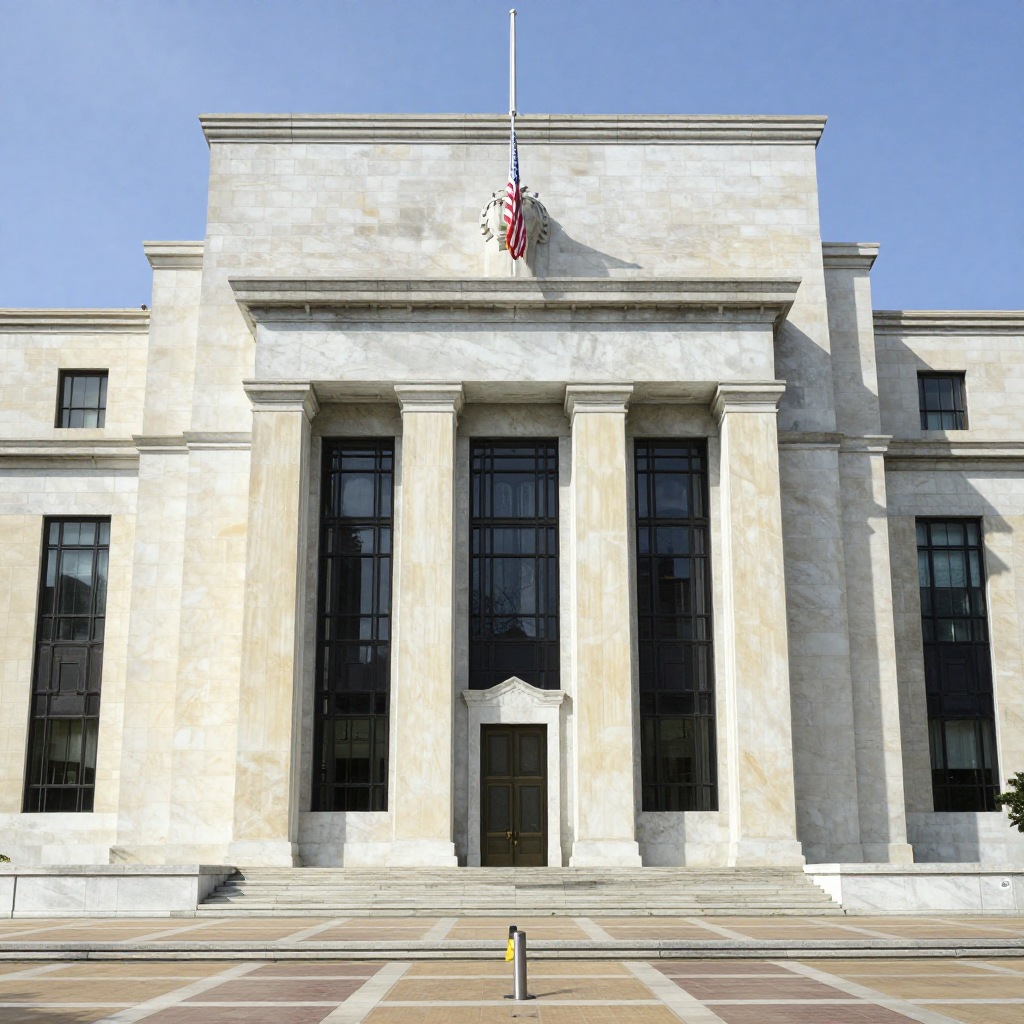
The Federal Reserve held interest rates steady on Wednesday in Kevin Warsh’s debut as chair, but the decision concealed a significant shift in the committee’s hawkish leanings. Nine of the 19 policymakers indicated they could support a rate increase before year-end, with six backing two quarter-point moves. The headline consensus masked a Federal Open Market Committee that is quietly pivoting toward tighter policy even as it holds fire for now. Markets took notice: the S&P 500 fell 1.2 percent on the day, the dollar strengthened, and the 10-year Treasury yield climbed to its highest level since early 2024.
Warsh Holds, But Nine Officials Favor Higher Rates
The Federal Reserve on Wednesday held its benchmark rate steady in the 3.50 to 3.75 percent target range, but the consensus masked a sharp shift in the committee’s hawkish orientation. For the first time since the rate-cut cycle began, a majority of Fed officials now indicate they could support a rate increase before year-end. Nine of the 19 policymakers said they favored moving rates higher, with six of those backing two quarter-point increases. The dot plot shift caught markets off guard and sent equities lower as investors reassessed the trajectory of U.S. monetary policy under the new chair. The S&P 500 fell 1.2 percent on the day as rate-sensitive sectors bore the brunt of the selloff, while the dollar strengthened against a basket of major currencies as traders priced in a more aggressive path for U.S. rates.
Kevin Warsh’s first rate decision as Fed chair was unanimous, 12-0, but the post-meeting projections told a far more complicated story. “This committee will deliver price stability,” Warsh said at his first press conference. “We are unambiguous and unanimous in our commitment to the 2 percent inflation objective.” Yet the projections told a different narrative: a committee that is increasingly worried about inflation and is not ruling out additional tightening if price pressures persist. The disconnect between the unanimous vote and the hawkish dot plot reflects a Fed that is divided over how much more needs to be done before rates can be considered appropriately restrictive. Some officials privately worry that waiting too long to act risks entrenching inflation expectations, while others argue that further tightening could choke off the modest growth that has kept unemployment from rising.
Inflation at 4.2 Percent Complicates the Picture
Consumer prices climbed to 4.2 percent annually in May, the highest reading in more than three years, according to the Bureau of Labor Statistics. The spike has been driven by a combination of supply shocks from the conflict in the Middle East and persistent services inflation that has proven resistant to the higher-rate environment. Energy prices have been a significant contributor, with the Iran-related disruption to global oil markets adding a geopolitical premium that the Fed cannot easily model or offset through rate adjustments alone. Warsh acknowledged at his press conference that the supply-driven nature of the current inflation surge presents a “genuinely difficult” tradeoff for policymakers, particularly when the supply shocks are external and largely outside the central bank’s control.
“We have recently seen the Fed rate come down while mortgage rates ticked up,” said Drew Powers, founder of Illinois-based Powers Financial Group. “One thing we should keep in mind is that zero percent interest rates are not the sign of a healthy economy. It should cost something to borrow money.” That view captures a growing consensus among practitioners that the post-pandemic era of near-zero rates was itself a distortion, and that the current level of rates, while burdensome for some borrowers, represents a more normalized cost of capital for the world’s largest economy. The challenge for Warsh is calibrating how much additional tightening is needed to bring services inflation down without triggering a broader economic slowdown that could push unemployment higher and turn what is currently a contained inflation problem into something more damaging.
The Five Task Forces and the Future of Fed Policy
Warsh used his debut press conference to announce the creation of five internal task forces charged with rethinking core aspects of how the Fed operates. The task forces will examine Fed communications, the balance sheet, data collection methods, productivity in the age of artificial intelligence, and inflation frameworks. The sweeping review signals that Warsh intends to leave a lasting institutional imprint on the institution, even as he navigates the immediate challenge of getting inflation back to 2 percent. “We will start with first principles, ask hard questions, examine current practice, consider alternatives, and propose next steps,” Warsh said, describing the mandate of each group. The task force on communications will review the controversial dot plot and the Summary of Economic Projections, both of which have been criticized for creating volatility and confusing markets about the Fed’s actual intentions.
Markets focused on the hawkish dot plot, but the announcement of the task forces may prove more consequential over the long run. The review of the Fed’s inflation frameworks could ultimately reshape how the central bank defines and pursues its price stability mandate. If the task forces recommend a higher inflation target or a switch to price-level targeting, the implications for long-term interest rates would be profound. For now, the immediate concern is the near-term rate path. With nine officials signaling openness to hikes, the market is now pricing in a meaningful probability of a rate increase at one of the remaining three FOMC meetings this year. The 10-year Treasury yield climbed above 4.5 percent in the session following the decision, its highest level since early 2024. Whether Warsh can hold the line at the next meeting, or is forced to act, will depend entirely on the incoming inflation and employment data over the coming weeks.