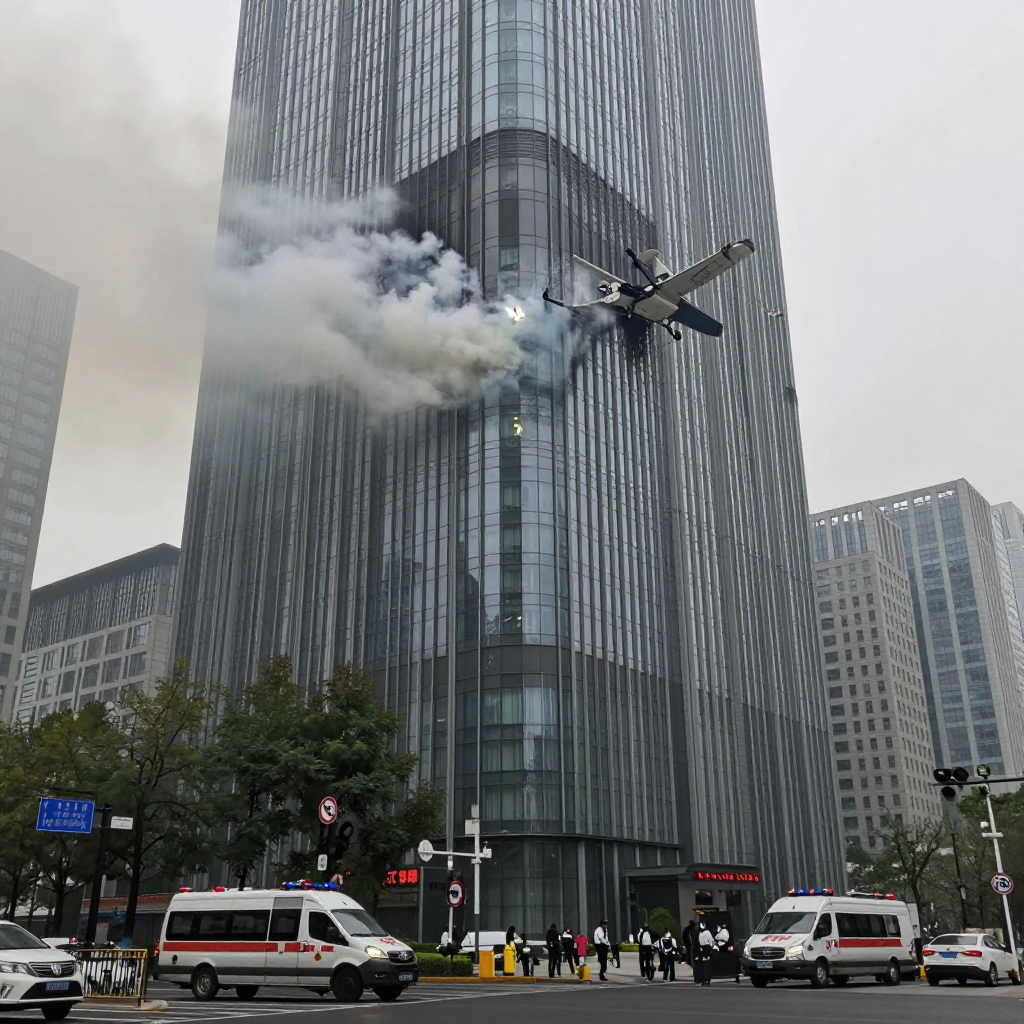
BEIJING — A small aircraft crashed into China’s tallest skyscraper on Friday evening, June 26, in an incident that triggered a major emergency response in the Chinese capital and sent debris cascading onto streets below, officials and news agencies reported.
The crash struck the Citic Tower, also known as Zun Tower, the tallest building in Beijing’s central business district at 528 metres. Videos circulating on social media showed emergency vehicles converging on the scene as firefighters and rescue workers rushed to the site. No casualties were immediately confirmed. Police and aviation authorities launched an investigation into the cause of the incident.
The aircraft involved was described by Chinese state media as a small private aircraft. The flight path and pilot identity remained under investigation Friday night. Authorities did not immediately confirm whether the crash was an accident or intentional. Aviation analysts said the incident raised immediate questions about airspace security around one of Beijing’s most symbolically important buildings.
Emergency Response and Scene Assessment
Firefighters and paramedics arrived within minutes of the crash, according to footage from the scene. The Citic Tower houses multiple multinational corporations and financial firms across its 110 floors. Building management issued a statement confirming the incident and urging tenants to remain indoors until authorities gave the all-clear.
Beijing’s municipal government said in an evening briefing that emergency crews had secured the perimeter and begun assessing structural damage. Officials declined to provide a casualty count pending next-of-kin notification. The Civil Aviation Administration of China issued a brief statement confirming it had opened an investigation but gave no further details.
Liu Yang, a spokesperson for Beijing’s municipal emergency management bureau, told reporters at the scene: “We are treating this as a major aviation incident and our priority right now is securing the site and ensuring there is no further danger to residents or workers in the building.”
Aviation Security Questions Raised
The crash immediately prompted scrutiny of how a private aircraft could approach one of China’s most symbolically important buildings undetected. The Citic Tower stands near the embassy district and is within restricted airspace that typically requires flight clearance. Analysts said any breach of that airspace would represent a significant security failure.
Zhang Hao, an aviation safety consultant based in Shanghai, said the incident demanded urgent answers. “Beijing’s central airspace is among the most tightly controlled in the world,” Zhang said. “A crash into a landmark of this significance is not simply an accident — it raises serious questions about how this aircraft entered restricted airspace and what monitoring systems failed.”
President Xi Jinping was briefed on the incident, according to state broadcaster CCTV. The President ordered a full investigation and called for strengthened aviation security measures across the country. The national parliament’s security committee said it would convene an emergency session over the weekend.
Global Implications for Urban Air Security
The Beijing crash follows a pattern of increasing concern about aircraft access to densely populated urban centres globally. In 2024, a helicopter crash into a New York highway sparked similar debates about perimeter security for critical infrastructure in major cities.
Security analysts said the incident would prompt reassessments of how cities worldwide protect their skylines from low-altitude aircraft threats. The Citic Tower, completed in 2018, had previously been cited in aviation navigation charts as requiring clearance for any flights within a five-kilometre radius.
International aviation bodies monitoring the incident said they were in contact with Chinese authorities. The crash occurred on the same day that aviation ministers from the Asia-Pacific Economic Cooperation forum were meeting in Singapore to discuss regional flight safety frameworks. Organisers said the Beijing incident would be added to the agenda of the closing session.
As emergency crews continued their work into Friday night, the broader fallout was only beginning to come into focus. The investigation into the crash and its causes is expected to take several days. What is already clear is that the crash has shattered any assumption that China’s capital was insulated from the kind of urban aviation risks that have prompted security reviews in other major global cities.
What to watch next: Chinese aviation and security officials are expected to brief the public Saturday morning. The Civil Aviation Administration has pledged a preliminary report within 72 hours. International aviation monitors will be watching for any statements from the flight’s operator or owner.