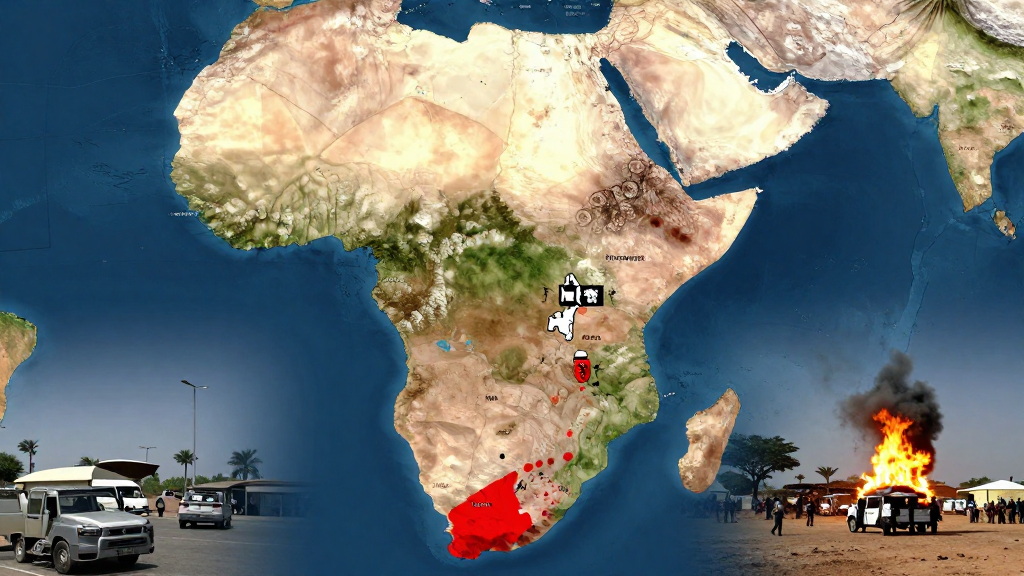
North Africa: Sudan War Deaths Pass 1,000 as Drone Strikes Intensify
Sudan is experiencing its deadliest phase of the three-year civil war, with the United Nations confirming that more than 1,000 civilians have been killed in drone attacks between January and May, accounting for roughly 80 percent of all conflict-related civilian deaths recorded this year. Both the Sudanese Armed Forces and the paramilitary Rapid Support Forces have dramatically escalated their use of drone strikes, hitting markets, hospitals and water infrastructure in regions far from traditional battlefields. The UN deputy Human Rights chief Awa Dabo told the Human Rights Council in Geneva that the conflict has entered a more dangerous phase. “The conflict has deepened and expanded,” she said. “The international community needs to act urgently to protect the Sudanese people and to avert an even wider crisis.” Attacks have spread beyond Darfur and Kordofan into Blue Nile, White Nile and Khartoum states. A cholera outbreak in West Kordofan has recorded 700 cases and 60 deaths as of June 16, overwhelming already stretched medical facilities.
West Africa: Benin New Leader Resets Relations with Niger and Burkina Faso
In West Africa, a significant diplomatic thaw is underway following the inauguration of Benin’s new President Romuald Wadagni, who visited both Niger and Burkina Faso this week in what his office described as “active neighbourhood diplomacy.” Niger’s military junta, which seized power in July 2023 and subsequently closed its border with Benin, issued a joint statement with Wadagni committing both countries to removing all obstacles to cooperation, including reopening the border. “We are committed to working to remove all obstacles to strengthening cooperation between the two countries, in particular the reopening of the border,” the joint statement read. The leaders also affirmed a shared commitment to fighting terrorism and banditry that has afflicted the subregion. Niger, Burkina Faso and Mali have formed the Alliance of Sahel States, a confederation that has shifted the region’s security alignment away from traditional Western partners.
Central Africa: Ebola Outbreak Reaches Fourth Province as Cases Near 1,400
In the Democratic Republic of Congo, the Ebola outbreak caused by the Bundibugyo strain has spread to a fourth province, health authorities confirmed, as the total number of confirmed and probable cases climbed to 1,307, including 377 deaths. The outbreak, now the second-largest Bundibugyo strain ever recorded, has put neighbouring Uganda on high alert as cross-border contact tracing continues. The World Health Organization has warned that the geographic expansion significantly complicates containment efforts, with health workers reporting that at least 300 positive cases remain unaccounted for in remote communities with limited road access. Regional health ministers held emergency talks this week to coordinate border screening and share medical supplies. The outbreak was first declared in late May in Équateur Province and has since spread eastwards, with the fourth province confirmation coming as a major setback to containment teams.
Southern Africa: South Africa Deadline Expires as Thousands Flee
Southern Africa is grappling with its own human displacement crisis as the June 30 deadline set by anti-immigrant activist groups in South Africa passed, triggering scenes of chaos at transit points and border crossings. An estimated 25,000 foreigners had fled South Africa in the days leading up to the deadline, with tens of thousands more in transit or sheltering in temporary accommodation, according to the International Organization for Migration. Nigerian authorities announced they had rescued 360 Nigerians held captive by Boko Haram militants in the northeast, with the freed captives arriving in Abuja under military escort. In South Africa, the activist deadline, widely publicised on social media, had set a date by which “illegal migrants” were told to leave or face consequences, prompting a humanitarian response from the African Union and neighbouring governments. The IOM warned that the mass movement of people across the region risks overstretching already fragile reception systems in destination countries.
East Africa: Kenya Crisis Compounds Regional Instability
Kenya is facing a convergence of crises that have stretched government response capacity to its limits, following an outbreak of unrest linked to disputed March 2026 elections that killed at least 42 people and led to the deployment of additional police units in multiple cities. Simultaneously, the country is managing increased cross-border movement as Congolese refugees arrive seeking safety from the Ebola outbreak. Rights groups have called on the Kenyan government to keep borders open for humanitarian reasons while ensuring security screening protocols are followed. “Regional governments must act in concert to prevent a situation where a public health emergency and a migration emergency compound one another,” a joint statement from three African human rights organisations said. The African Union has called for emergency consultations to address the simultaneous pressures across multiple regions, with observers warning that the continent is facing its most complex convergence of crises in decades.
The simultaneous deterioration of security, health and diplomatic conditions across five distinct African regions marks a critical moment for the continent’s governance structures. With Sudan’s war deepening, the Sahel reconfiguring its alliances, Ebola spreading, South Africa facing migration pressures and Kenya managing overlapping crises, the AU faces mounting pressure to demonstrate that pan-African institutions can respond to compounding emergencies at scale.