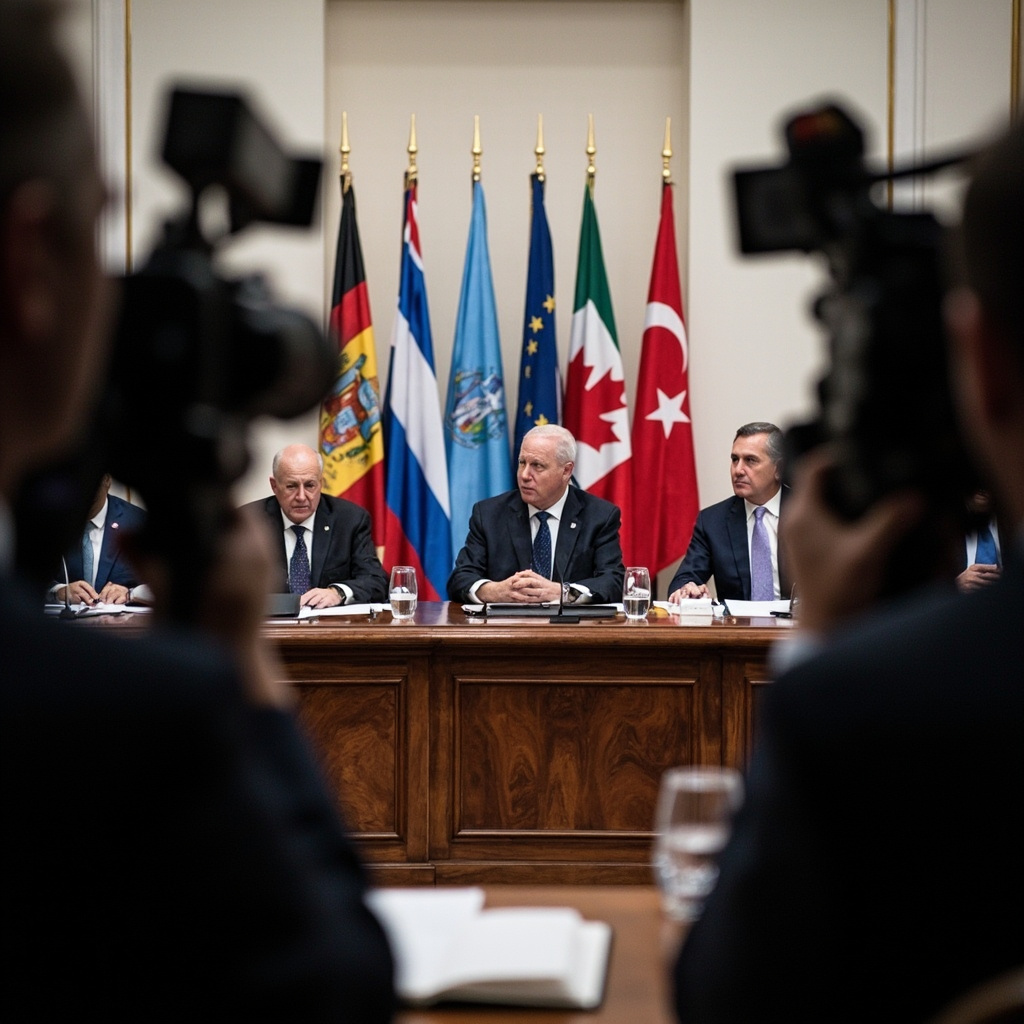
The G7 Summit in Évian, France, concluded on June 17 with an striking display of unity that belied the fractures visible in previous gatherings, as leaders from seven of the world’s largest economies adopted nine joint declarations addressing crises spanning Ukraine, the Middle East, artificial intelligence and critical minerals. Ukrainian President Volodymyr Zelensky attended the final session, which produced a renewed commitment to Ukraine’s sovereignty and a concrete escalation in military support, including air defense systems, additional interceptors and long-range capabilities. French President Emmanuel Macron, who hosted the two-day summit at the lakeside Convention Centre, described the outcome as a “summit of convergence” in remarks delivered at the closing press conference alongside European Council President António Costa.
Leaders Adopt Nine Declarations on Ukraine, Middle East and AI
The declaration on Ukraine marked a strategic shift, according to senior diplomats familiar with the negotiations. Leaders agreed to increase pressure on Russia’s war effort through sanctions targeting Russian oil and gas revenues, and to expand the range of weapons systems supplied to Kyiv. A French diplomatic source told reporters that the package represented “the most comprehensive defense commitment since the war began,” though the final communiqué stopped short of authorizing strikes on Russian territory. The statement reaffirmed support for Ukraine’s “freedom, sovereignty and territorial integrity” without setting a timeline for renewed peace talks. Germany and the United Kingdom both announced increases to their respective military aid budgets in the margins of the summit, according to a joint briefing released by the German chancellery.
Leaders also adopted a separate declaration on the Middle East, centered on a coordinated call for an immediate and unconditional reopening of the Strait of Hormuz. The statement directly implicated Iran, linking the Hormuz demand to what the communiqué described as Iran’s “nuclear and ballistic threats and its regional destabilization activities.” The language represented a harder line than the February ceasefire agreement between the United States and Iran, which had initially reduced tensions in the Gulf. Baghai responded that the G7 statement was “interventionist” and that Tehran would not accept external dictates regarding its regional relationships.
Ceasefire Demand and Lebanon Disarmament Accord
The summit also addressed Lebanon, with leaders calling for a strong and immediate ceasefire and backing Lebanese government efforts to consolidate state control over armed groups, specifically referencing Hezbollah by name. The agreement included language supporting “Hezbollah’s disarmament” and ensuring the state’s “monopoly on weapons,” a provision that drew immediate pushback from Iran-backed regional actors who issued a joint statement calling the language a “flagrant violation of Lebanese sovereignty.” The joint statement stopped short of imposing new sanctions but established a framework for future coordinated European Union action on Lebanese sovereignty, according to an EU official who briefed reporters on condition of anonymity ahead of the formal publication.
On Lebanon specifically, the G7 communiqué referenced the Taif Agreement of 1989 as the foundational framework for national reconciliation, a signal to Beirut that the international community expects disarmament to proceed through political negotiation rather than military force. France, which has historically maintained close ties to Lebanon’s Christian and Sunni leadership, dispatched its special envoy for Lebanese affairs to Beirut the day after the summit concluded. A statement from the French Foreign Ministry said the envoy would “gauge the willingness of all parties to engage constructively” with the G7 framework.
AI Regulation and Critical Minerals Deals Break New Ground
Beyond geopolitical crises, the Évian summit produced substantive agreements on economic governance. Leaders adopted a declaration on artificial intelligence that included a commitment to require AI chatbot developers to adapt language models when interacting with children, a provision framed as protecting young users from manipulative or harmful outputs. The G7 also agreed to coordinate on critical mineral supply chains, seeking to reduce dependence on Chinese processing of lithium, cobalt and rare earth elements essential to clean energy and semiconductor manufacturing. The Minerals Security Partnership, a US-led initiative that includes the European Union, Australia and Japan, was cited as the primary vehicle for redirecting investment toward processing facilities in ally countries.
A separate health declaration pledged more than one billion dollars in combined G7 funding to combat a resurgence of Ebola, with the World Health Organization coordinating distribution of vaccines and therapeutic treatments. The pledge followed emergency consultations convened by WHO Director-General Tedros Adhanom Ghebreyesus, who briefed G7 health ministers by video link from Geneva. On trade, G7 leaders acknowledged “macroeconomic imbalances” and agreed that the International Monetary Fund should play a central role in monitoring currency distortions and guiding corrective action. The communiqué warned against new trade wars and pledged to continue negotiations on digital services taxation, an issue that has strained relations between the United States and European partners since the Biden administration suspended retaliatory tariffs earlier this year.
Leaders agreed to reconvene in virtual format within 90 days to review compliance with the nine declarations, with a full summit scheduled for September in Berlin. The next G7 presidency rotates to Canada, which has signaled it will prioritize climate finance and Indo-Pacific infrastructure investment. French officials said the Évian package would be tabled at the United Nations General Assembly in September as a template for broader multilateral action on three principal tracks: sustained support for Ukraine’s defense, stabilization of the Gulf through Hormuz diplomacy, and establishment of binding rules for artificial intelligence. International observers noted that the unity on display in Évian would face immediate stress testing, depending on the outcome of ceasefire negotiations currently underway through Swiss-mediated back channels between the United States and Iran. Whether the pledges translate into binding commitments will be the central question heading into the autumn summit cycle, officials and analysts said.