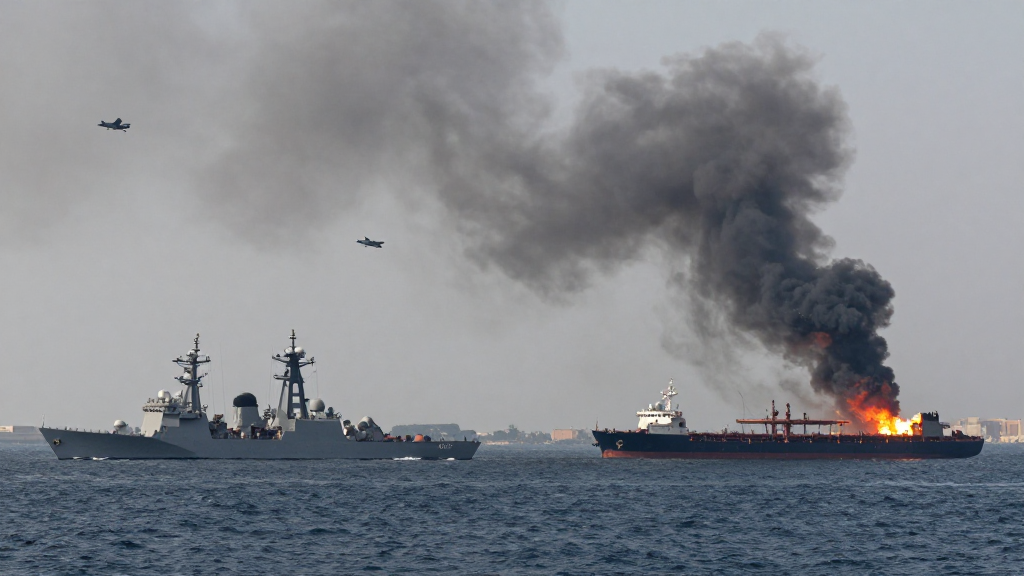
Ceasefire Collapses as Strikes Resume in the Strait of Hormuz
DUBAI — The United States and Iran are once again trading military strikes in the Strait of Hormuz, raising fears that a fragile ceasefire agreed just weeks ago may already be unravelling. The latest escalation began after Iran attacked a Singapore-flagged container ship near the Strait of Hormuz on Thursday, an incident that US President Donald Trump described as a “foolish violation” of the agreement that ended months of fighting.
On Friday, the United States responded with strikes on Iranian missile and drone storage sites as well as coastal radar installations around the Strait of Hormuz, saying the targets were linked to attacks on international shipping. On Saturday, the White House announced a third round of strikes after accusing Tehran of violating the ceasefire once again.
Diplomatic Efforts Under Severe Strain
The renewed fighting has placed the recently signed US-Iran agreement under severe strain. The deal was intended to restore commercial shipping through the Strait of Hormuz while creating space for wider negotiations over Iran’s nuclear programme and regional security. Instead, both governments are accusing each other of violating the agreement while continuing military operations.
Iran’s Foreign Minister Abbas Araghchi warned that continued American strikes could bring diplomatic efforts to a complete halt. “The American attacks themselves violate the ceasefire and threaten all diplomatic channels,” Araghchi said in a statement carried by Iranian state media. The minister added that Tehran retains sole custody of the Strait of Hormuz and will not negotiate under duress.
Trump, meanwhile, issued his strongest warning yet on Truth Social. “There may come a point where we are no longer able to be reasonable, and will be forced to militarily complete the job that we very successfully started,” he wrote. “If that happens, the Islamic Republic of Iran will no longer exist.”
Regional Partners Drawn Into Escalation
The widening conflict has drawn regional partners deeper into the confrontation. Iran launched missiles and drones toward American military facilities across the Middle East, including bases in Kuwait and Bahrain, according to the Islamic Revolutionary Guard Corps. A US official said a small number of drones were detected but failed to reach their intended targets. Washington said there were no American casualties or major damage.
Bahrain’s Ministry of Interior released footage showing a damaged residential building in Muharraq Governorate following the strikes. The ministry said initial assessments indicated the building was hit by debris from intercepted drones. Kuwait’s civil aviation authority said its airport had temporarily suspended some flights as a precautionary measure while engineers inspected runway infrastructure.
The Arab League issued a statement condemning Iran’s attacks on Bahrain and Kuwait, calling them a “dangerous escalation” that threatens regional stability. Secretary-General Ahmed Asmat Abdel-Meguid said the organisation stands in full solidarity with Bahrain and Kuwait and urged all parties to return to the negotiating table.
Oil Markets React to Hormuz Disruption
Brent crude rose 3.2 percent to $94.80 per barrel on Friday as traders assessed the risk of disruption to one of the world’s most critical oil shipping lanes. Approximately 21 million barrels per day of oil pass through the Strait of Hormuz, making any escalation a significant concern for global energy markets.
Shipping insurers said they were monitoring the situation closely. Lloyd’s Market Association issued a notice advising members to exercise caution when transititing the strait and to report any hostile activity immediately. Several major shipping firms rerouted vessels away from the Persian Gulf on Saturday, adding premiums to voyage costs and adding further pressure to global supply chains.
The renewed violence also raised concerns about the Lebanon front, which had eased following the broader US-Iran agreement. Israeli air strikes hit the southern town of Nabatieh Al Fawqa on Saturday, a day after Israel agreed to withdraw troops from parts of southern Lebanon. The Israeli military said it had killed Hezbollah militants operating in the Nabatieh area and destroyed a rocket launcher. Hezbollah had no immediate comment.
What Happens Next
Senior officials from Qatar, Oman and the United Arab Emirates have been in contact with both Washington and Tehran over the past 48 hours in an effort to prevent the situation from deteriorating further, according to a Western diplomat briefed on the talks. Qatar’s foreign ministry said Doha remains “cautiously engaged” with all parties and reiterated its readiness to host renewed negotiations if requested.
World leaders are watching closely. European Union foreign policy chief Kaja Kallas called for an emergency video conference of G7 foreign ministers to discuss the escalation. “The ceasefire is in intensive care,” Kallas told reporters in Brussels. “We are running out of time to save it.”
International freight companies are meanwhile preparing contingency plans. Several shipping lines said they would decide by Wednesday whether to resume normal operations through the Strait of Hormuz or maintain diversions around the Cape of Good Hope, a route that adds approximately 14 days to transit times and significantly increases costs.